
GHRP-6: the basics
What is it?
A lab-made chain of six amino acids that makes the pituitary gland release a burst of growth hormone. It works through the same receptor as ghrelin, a hunger hormone.
Research paper 1 ↗Research paper 2 ↗Research paper 3 ↗What do people claim it helps with?
Online sellers link it to muscle gain, fat loss, better recovery, injury healing and appetite. None of these has been shown in reliable treatment trials.
What has research actually shown?
In people it reliably causes a short rise in growth hormone and has been used in hormone tests. A large 2026 stroke trial of a combination product containing it did not meet its main goal.
Research paper 1 ↗Research paper 2 ↗Research paper 3 ↗Has this been demonstrated in people?
Small human hormone and pharmacology studies, one diagnostic study of 250 people and one stroke trial. Claims about tissue protection come mainly from animal research.
Research paper 1 ↗Research paper 2 ↗Research paper 3 ↗What side effects, risks and unknowns should I understand?
FDA says it may cause immune reactions and contain impurities, and that available data suggest effects on cortisol and higher blood sugar from lower insulin sensitivity.
FDA safety information 1 ↗FDA briefing 2 ↗Is it an approved medicine?
No FDA-approved medicine contains this peptide. Availability online or through a clinic does not mean it has been approved, and FDA lists it as a compounding substance that may present significant safety risks.
FDA safety information ↗Approval here means U.S. FDA approval and applies to a particular product, formulation and use. This is a starting overview, not a complete side-effect list. Sources checked 10 October 2026; independent scientific review pending.
How is it used or studied?
Studied as an injection under research conditions. There is no FDA-approved treatment formulation; a vial sold online is not the product used in a study.
Different routes and formulations can have different effects. A study of one product does not validate every product with the same peptide name.
A common misunderstanding
A spike in growth hormone after a dose is not the same as building muscle, burning fat or healing an injury.
What should I ask a clinician?
- What diagnosis or goal are we trying to address, and what established options are available?
- Was the expected benefit shown in people like me, using this exact product?
- How could my medicines, health conditions or pregnancy plans affect the risks?
- What monitoring is needed, and what would tell us the treatment is helping or should be stopped?
What do the research words mean?
- Peptide
- A short chain of amino acids, the building blocks of proteins.
- Preclinical
- Research in cells, tissues or animals before dependable treatment evidence in people.
- Controlled trial
- A study comparing a treatment with another treatment or a placebo to help separate its effects from other explanations.
- Biomarker
- A measurement, such as a hormone level. A change does not necessarily mean someone feels better or lives longer.
GHRP-6 Evidence & Clinical Profile
Human Study Limits
GHRP-6 has been investigated in clinical contexts. Patient outcomes must be evaluated against study size, design, and control cohorts.
Laboratory & In Vivo Assays
Cellular and animal disease models examine receptor binding affinities and signaling cascades, which require human confirmation.
What is GHRP-6?
Growth Hormone-Releasing Peptide-6 is GHRP-6 is a synthetic six-amino-acid peptide, first described in 1984, that triggers growth hormone release through the receptor later found to respond to ghrelin. In people it has been used mainly as a research and diagnostic test agent. It is not an FDA-approved medicine, and FDA has flagged compounded GHRP-6 as a possible significant safety risk. Aliases include: Growth hormone-releasing hexapeptide, SKF-110679, His-D-Trp-Ala-Trp-D-Phe-Lys-NH2, [His1,Lys6]GHRP.
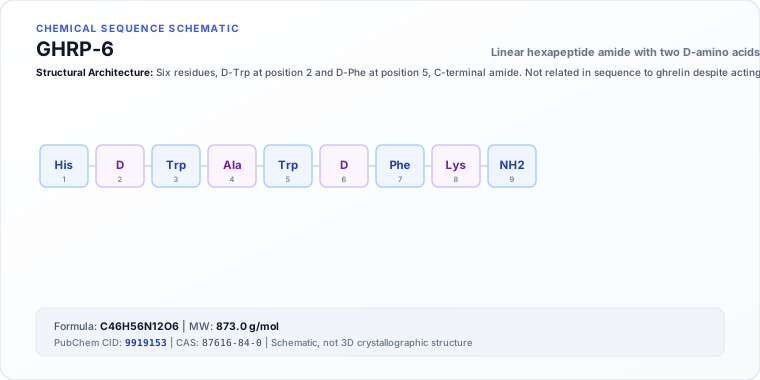
- Sequence (one-letter)
- H-(D-W)-A-W-(D-F)-K-NH2
- Molecular formula
- C46H56N12O6
- Molecular weight
- 873.0 g/mol
- CAS Number
- 87616-84-0
- UNII Code
- 4H7N4I6X6A
- PubChem CID
- 9919153
Identifiers checked against PubChem and FDA's Global Substance Registration System on 13 October 2026. FDA substance record ↗ · PubChem record ↗ See all names and codes in the peptide name index.
Clinical Trials & Human Cohorts
Human research can examine tolerability, symptoms or patient outcomes. The design and comparator determine what each result can establish.
GH-releasing hormone and GH-releasing peptide-6 for diagnostic testing in GH-deficient adults [2]
What was reported
A combined GHRH plus GHRP-6 test separated GH-deficient adults from healthy people, and no side effects were reported.
What limits the conclusion
This tests diagnosis, not treatment. GHRP-6 was given together with GHRH, so its separate contribution is not isolated.
Pharmacokinetic study of GHRP-6 in nine male healthy volunteers [3]
What was reported
After a single intravenous administration, GHRP-6 left the blood quickly, with an elimination half-life of about 2.5 hours.
What limits the conclusion
Nine men and single administrations only; the study did not assess clinical benefit or repeated-use safety.
Phase III open-label randomized trial of EGF and GHRP-6 in acute ischemic stroke [4]
What was reported
EGF plus GHRP-6 did not improve disability, daily function or survival versus standard care. A subgroup with severe stroke appeared to do better.
What limits the conclusion
Missed its primary endpoint. Open-label design, a combination product, and subgroup findings that need confirmation. Several authors work for the developer.
How the compound may work
Mechanisms describe how GHRP-6 may affect biological processes. Laboratory findings and patient outcomes answer different questions.
GHS-R1a agonism
GHRP-6 acts on the growth hormone secretagogue receptor (GHS-R1a) in the pituitary and hypothalamus, the receptor later shown to bind ghrelin. This pathway is separate from the GHRH receptor. [6]
Direct pituitary GH release
The 1984 discovery work found that GHRP-6 released GH in cell incubations and in several animal species, without releasing LH, FSH, TSH or prolactin in those experiments. [1]
Areas Being Studied
These research topics reflect active areas of scientific exploration, distinct from unverified commercial marketing claims.
GH deficiency testing
Combined GHRH plus GHRP-6 provocation testing in adults with pituitary disease. [2]
Acute ischemic stroke
EGF plus GHRP-6 missed its primary endpoint; benefit in severe stroke remains a hypothesis. [4]
Cardioprotection
Animal studies of protection against drug-induced heart damage; not tested as a treatment in people. [5]
Compare the study designs.
| Study | Design / sample | Outcome type | Key limitation |
|---|---|---|---|
| Adult GHD diagnostic test · 2000 [2] | Multicenter diagnostic accuracy study n = 250 |
Clinical endpoint evaluation | This tests diagnosis, not treatment. GHRP-6 was given together with GHRH, so its separate contribution is not isolated. |
| Pharmacokinetics · 2013 [3] | Phase 1 single-administration study n = 9 |
Clinical endpoint evaluation | Nine men and single administrations only; the study did not assess clinical benefit or repeated-use safety. |
| Acute stroke (COURAGE-2) · 2026 [4] | Phase 3 multicenter open-label RCT n = 188 |
Clinical endpoint evaluation | Missed its primary endpoint. Open-label design, a combination product, and subgroup findings that need confirmation. Several authors work for the developer. |
Regulatory Status & Clinical Safety
Regulatory Classification
Not FDA-approved. Listed in FDA's 503B category 2 (bulk substances that may present significant safety risks) since September 29, 2023, and in 503A category 3 (nominated without adequate support). WADA S2 prohibited substance.
Safety Realities & Impurities
Safety depends on the molecule, formulation, route and evidence. A laboratory purity measurement alone cannot establish safety for human use.
Clinical Trials Registry Records
Official registry records from ClinicalTrials.gov. Study registration does not imply government endorsement or guaranteed efficacy.
WADA & Anti-Doping Regulations
WADA Section S2: Prohibited Substance
The World Anti-Doping Agency (WADA) classifies GHRP-6 under Section S2 of the Prohibited List. Prohibited at all times (in- and out-of-competition). Last verified: October 2026.
Research Timeline
-
1984
Discovery
Bowers and colleagues describe the synthetic hexapeptide and its GH-releasing activity in cells and animals. [1]
-
1996
Receptor identified
The GH secretagogue receptor (GHS-R) through which GHRP-6 acts is cloned. [6]
-
2000
Diagnostic study
A 250-person multicenter study tests GHRH plus GHRP-6 for diagnosing adult GH deficiency. [2]
-
2023
FDA safety category
FDA adds GHRP-6 to 503B category 2, citing possible immunogenicity, impurities, cortisol effects and blood-sugar increases. [7]
-
2026
503A category 3
FDA's 503A list (updated May 2026) places GHRP-6 in category 3: nominated without adequate support. [8]
-
2026
Stroke trial result
The COURAGE-2 Phase 3 trial of EGF plus GHRP-6 misses its primary disability endpoint. [4]
-
2026
Banned in sport
WADA's 2026 Prohibited List names GHRP-6 among GH-releasing peptides in class S2. [9]
What Researchers Still Don't Know
Long-term safety profiles
Multi-year observational data in broader heterogeneous cohorts remains uncharacterized.
Optimal dose-response thresholds
Comparative trials optimizing minimal effective exposure versus adverse event rates.
Formulation bioavailability
Differences between oral, subcutaneous, and modified peptide delivery vehicles.
References
Primary sources verified against PubMed / NLM and regulatory databases.
- Discovery study (animal & in vitro)
- Multicenter diagnostic study
- Phase 1 pharmacokinetic study
- Phase 3 open-label RCT
- Animal study (rats)
- Receptor cloning study
- FDA safety list
- FDA compounding list
-
Anti-doping rule
World Anti-Doping Code International Standard: Prohibited List 2026 ↗ (external website)