
Peptides 101 Beginner

Peptides vs SARMs vs TRT: How They Differ

How growth hormone peptides, SARMs and testosterone replacement therapy differ in how they work, what trials show, their regulatory status and their WADA status.

11 min read Updated 15 sources InsidePeptides Editorial Team

A loose pile of plain round white tablets on a clean white surface
Photo: Christian Schnettelker from Essen, Deutschland, CC BY 2.0, via Wikimedia Commons.

Plain-English Summary

Peptides, SARMs and TRT are often discussed together in fitness circles, but they are very different. SARMs are non-steroidal oral chemicals that act on the androgen receptor; none is approved as a medicine, and FDA has warned about liver injury and heart risks. TRT is approved testosterone prescribed for men with diagnosed hypogonadism, and the large TRAVERSE trial found it did not increase major heart events in that group. The peptides promoted for muscle mostly signal the pituitary gland to release growth hormone; most are unapproved and have no muscle-building trials. All three are banned in sport, apart from TRT with a therapeutic use exemption.

Key Takeaways

  • SARMs, TRT and peptides act through different routes: SARMs and testosterone act on the androgen receptor inside cells, while the popular muscle peptides act on receptors on the pituitary gland.
  • No SARM had been approved as a medicine by FDA as of 17 October 2026, and FDA warns that SARMs are linked to liver injury and an increased risk of heart attack or stroke.
  • In a 2017 analysis of 44 products sold online as SARMs, only about half contained a SARM, and many contained other unapproved drugs.
  • TRT is approved testosterone for men with symptoms and consistently low testosterone confirmed by testing, not for building muscle in healthy men.
  • The TRAVERSE trial of 5,246 men found testosterone therapy was non-inferior to placebo for major cardiovascular events, but atrial fibrillation, acute kidney injury and pulmonary embolism were more frequent.
  • Growth hormone peptides such as ipamorelin and CJC-1295 are unapproved and have no published trials showing muscle gain.
  • WADA bans SARMs and testosterone under S1 and growth hormone peptides under S2, all prohibited at all times.
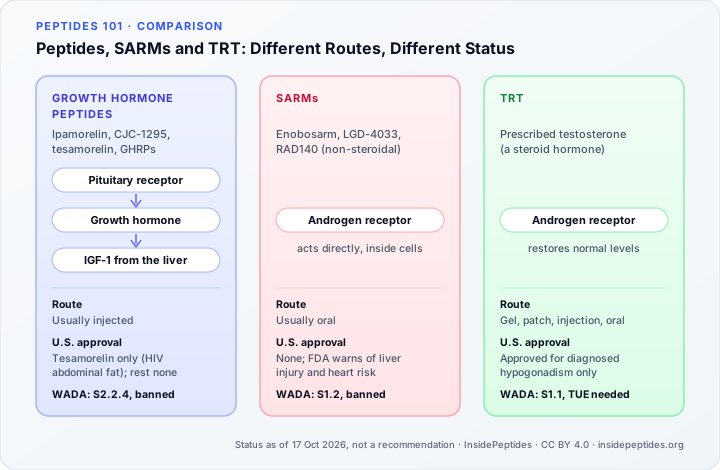
Diagram comparing where three substance groups act. Growth hormone peptides act on receptors on the pituitary gland, which releases growth hormone, which raises IGF-1 from the liver; most are unapproved and banned by WADA under S2. SARMs are oral non-steroidal chemicals that act directly on the androgen receptor inside muscle and other cells; none is approved and they are banned under S1.2. TRT supplies testosterone, which acts on the same androgen receptor; it is approved for diagnosed hypogonadism and banned under S1.1 unless an athlete has a therapeutic use exemption.
Where each acts: growth hormone peptides work upstream at the pituitary, while SARMs and testosterone act directly on the androgen receptor. Approval and WADA status as of 17 October 2026. Diagram by InsidePeptides, CC BY 4.0: free to reuse with a credit and link. Download SVG

Three different things grouped together

Peptides, SARMs and TRT are often mentioned in the same breath because people use all three in the hope of building muscle, but they differ in chemistry, in where they act in the body, in the evidence behind them and in their legal status.

  • SARMs (selective androgen receptor modulators) are small, non-steroidal chemicals, usually taken by mouth, that act on the same receptor as testosterone. None is an approved medicine.
  • TRT (testosterone replacement therapy) is prescribed testosterone, an approved medicine for men with diagnosed hypogonadism.
  • Peptides promoted for muscle, such as ipamorelin and CJC-1295, are short chains of amino acids that mostly signal the pituitary gland to release growth hormone. Most are unapproved.

A separate guide, Peptides vs Steroids, explains the chemical and mechanistic differences between peptide hormones and anabolic steroids. This guide adds SARMs and medical testosterone therapy to that comparison, and focuses on evidence and regulation. The muscle claims made about growth hormone peptides are examined in section 4.

This guide describes research and regulatory status only. It gives no doses or instructions and is not medical advice. Whether any treatment suits a particular person is a decision for a licensed clinician.

What SARMs are

Testosterone acts on the androgen receptor in many tissues: muscle and bone, but also the prostate, skin, hair follicles and the brain. SARMs were developed from the late 1990s onward as non-steroidal molecules that would activate the receptor mainly in muscle and bone, in the hope of treating muscle wasting and osteoporosis with fewer effects on the prostate. Well-known examples include enobosarm (ostarine), LGD-4033 (ligandrol) and RAD140. Unlike testosterone, they are not steroids, and most are active when swallowed.

What trials showed. In early clinical trials, SARMs did increase lean body mass. In a 12-week phase 2 trial of 120 older men and postmenopausal women, enobosarm increased lean body mass and improved a measure of physical function compared with placebo [3]. In a 21-day trial in 76 healthy young men, LGD-4033 increased lean body mass but also suppressed total testosterone and lowered HDL (“good”) cholesterol, effects that reversed after stopping [4]. These trials were short and small, and no SARM went on to approval.

Regulatory status. As of 17 October 2026, no SARM had been approved by FDA. FDA states that SARMs cannot be legally marketed in the U.S. as a dietary supplement, and that products sold as supplements or “for research use only” are considered unapproved drugs. It lists liver injury and acute liver failure, and an increased risk of heart attack or stroke, among the serious problems linked to them [2].

What is actually in the bottle. When researchers bought 44 products sold online as SARMs and analysed them in 2016, only 23 (52%) contained a SARM. Seventeen contained other unapproved drugs, four contained no active compound, and only 18 had the amount stated on the label [1].

Liver injury. Case reports describe drug-induced liver injury in people taking SARMs bought online, often with a cholestatic pattern (impaired bile flow) similar to that seen with oral anabolic steroids, which can take weeks to months to resolve [6]. A 2025 systematic review identified 15 published cases of SARM misuse, all in men, and reported liver injury, heart problems, tendon damage and testosterone suppression [5]. Case reports cannot show how common these harms are, but they show what can happen.

What TRT is

Testosterone replacement therapy is the use of approved testosterone medicines, as gels, patches, injections, oral or buccal forms, for men with hypogonadism: testes that produce too little testosterone. FDA states that testosterone is approved solely for men who have low testosterone together with an associated medical condition [9].

Diagnosis comes first. The Endocrine Society's clinical guideline recommends diagnosing hypogonadism only in men with symptoms and signs of testosterone deficiency and testosterone levels that are unequivocally and consistently low, confirmed by repeating a fasting morning blood test. It recommends looking for the cause, aiming for testosterone in the mid-normal range during treatment, and monitoring symptoms, red blood cell levels and prostate cancer risk. It recommends against starting testosterone in men planning to father a child soon, and in men with conditions such as breast or prostate cancer, untreated severe sleep apnoea, or a recent heart attack or stroke [7].

The TRAVERSE trial. For years there was uncertainty about whether testosterone therapy raised the risk of heart attack and stroke. TRAVERSE, a randomised, double-blind, placebo-controlled trial, enrolled 5,246 men aged 45 to 80 with symptomatic hypogonadism and existing or high risk of cardiovascular disease. Over a mean follow-up of 33 months, the combined rate of cardiovascular death, non-fatal heart attack or non-fatal stroke was 7.0% with testosterone and 7.3% with placebo, meeting the test for non-inferiority. Atrial fibrillation, acute kidney injury and pulmonary embolism were more frequent with testosterone [8].

After reviewing TRAVERSE and blood-pressure monitoring studies, FDA announced class-wide labelling changes in February 2025. It removed the boxed-warning language about increased cardiovascular risk, added TRAVERSE results to labels, kept the limitation of use for age-related low testosterone, and required warnings about increased blood pressure [9].

TRT is not a muscle-building treatment for healthy men. Muscle gains seen in trials of high-dose testosterone in healthy men [10] involve hormone levels well above the normal range, which is anabolic steroid use rather than replacement, and carries the harms summarised in section 7.

How peptides differ

Mechanism. Testosterone and SARMs both act directly on the androgen receptor, which sits inside cells and changes which genes are switched on. The peptides promoted for muscle work one step further upstream. GHRH analogues such as CJC-1295, sermorelin and tesamorelin, and ghrelin mimetics such as ipamorelin, GHRP-2, GHRP-6 and hexarelin, bind receptors on the surface of pituitary cells and prompt the release of growth hormone, which in turn raises IGF-1. The background is in Growth Hormone Secretagogues and Peptide Receptors.

Because peptides are broken down in the gut, most must be injected, whereas many SARMs are taken by mouth (see Oral vs Injected Peptides). A few peptides act on the testosterone axis itself: gonadorelin and kisspeptin signal the pituitary to release the hormones that tell the testes to make testosterone. They are research or specialist medicines, not muscle treatments.

Evidence. Growth hormone, the end product of the muscle peptides, increased lean body mass in randomised trials in healthy young adults, but did not improve strength or exercise capacity [12]. No published randomised trial has measured muscle or strength for ipamorelin, CJC-1295 or the related research peptides.

Regulation. Among growth hormone peptides, only tesamorelin had a current U.S. approval as of 17 October 2026, and that approval is for excess abdominal fat in adults with HIV-associated lipodystrophy [13]. FDA has placed GHRP-2, GHRP-6 and ipamorelin in a category of bulk substances that may present significant safety risks in compounding, and has noted serious adverse events reported with CJC-1295 [14]. For the wider picture, see Are Peptides Legal? and Approved vs Unapproved Peptides.

Side by side: peptides, SARMs and TRT

The table summarises the three groups as of 17 October 2026. It compares evidence and status, not suitability for any person.

Growth hormone peptidesSARMsTRT
What it isShort amino-acid chains (e.g. ipamorelin, CJC-1295, tesamorelin)Non-steroidal small molecules (e.g. enobosarm, LGD-4033, RAD140)Testosterone, a steroid hormone
Where it actsReceptors on pituitary cells; raises growth hormone and IGF-1Androgen receptor inside cellsAndrogen receptor inside cells
Usual routeInjectionOralGel, patch, injection, oral or buccal
U.S. approvalTesamorelin only, for HIV-associated abdominal fat [13]; others unapprovedNone approved [2]Approved for diagnosed hypogonadism [9]
Strongest human evidenceHormone-response studies; no muscle trials for research peptidesSmall, short phase 1 and 2 trials showing lean-mass gains [3][4]Large randomised trials, including TRAVERSE [8]
Main safety concernsBlood sugar, fluid retention, IGF-1 effects, product quality [13][14]Liver injury, heart risk, testosterone and HDL suppression, mislabelled products [1][2][4]Raised red blood cells, blood pressure, fertility suppression; atrial fibrillation and pulmonary embolism more frequent in TRAVERSE [7][8][9]
WADA 2026S2.2.4, prohibited at all timesS1.2, prohibited at all timesS1.1, prohibited at all times; therapeutic use exemption possible

WADA statuses are from the 2026 Prohibited List [15].

Status in sport

All three groups are prohibited at all times, in and out of competition, under the World Anti-Doping Agency's 2026 Prohibited List [15]:

  • TRT: testosterone is listed under S1.1, anabolic androgenic steroids. An athlete with genuine, documented hypogonadism must apply for a therapeutic use exemption.
  • SARMs: listed by name under S1.2, other anabolic agents, including andarine, enobosarm (ostarine), LGD-4033 (ligandrol), RAD140, S-23 and YK-11.
  • Growth hormone peptides: listed under S2.2.4, growth hormone releasing factors, which names CJC-1295, sermorelin, tesamorelin, ipamorelin, GHRP-2, GHRP-6 and examorelin (hexarelin).
  • Testosterone-stimulating peptides: gonadorelin and kisspeptin, with their analogues, are listed under S2.2.1 for male athletes.

The list also covers substances with a similar chemical structure or biological effect, so a compound being unnamed does not make it permitted. Contaminated or mislabelled products, common among SARMs [1], are not a defence under anti-doping rules. See WADA Peptide Rules and Peptides and Athletes.

Risks and what remains unknown

The quality of safety evidence differs as much as the substances do.

  • TRT has the most data: large randomised trials, labelled warnings and monitoring guidance, but only for men with diagnosed hypogonadism treated to normal levels [7][8]. Those data do not describe high-dose use for muscle.
  • Testosterone and other steroids used above normal levels have well-documented harms. An Endocrine Society scientific statement links performance-enhancing drug use to an increased risk of death and to cardiovascular, psychiatric, hormonal, liver and kidney disorders [11].
  • SARMs have short trial data, FDA warnings and a growing set of case reports of liver injury, with the added problem that products often do not contain what the label says [1][2][5]. The claim that they are a “safer steroid” has not been tested in long-term trials.
  • Growth hormone peptides have almost no long-term safety data in healthy people. Known concerns from approved and related drugs include raised blood sugar and the unknown effects of prolonged IGF-1 elevation [13], plus impurity and immune risks in unregulated products [14].

No trial has compared these groups head to head, so statements that one is “safer” than another go beyond the evidence. A substance with fewer reported harms may simply have been studied less. For a broader framework, see Are Peptides Safe? and Understanding Evidence Levels.

Frequently asked questions

What is the difference between peptides and SARMs?

SARMs are non-steroidal small molecules, usually taken by mouth, that act directly on the androgen receptor, the same receptor as testosterone. The peptides promoted for muscle are short amino-acid chains, usually injected, that signal the pituitary to release growth hormone. Neither group has approved muscle-building uses [2].

Are SARMs legal?

In the U.S., no SARM is an approved medicine, and FDA states they cannot be legally marketed as dietary supplements; products sold “for research use only” are treated as unapproved drugs [2]. Laws on possession differ by country. All SARMs are banned in sport [15].

Is TRT the same as taking steroids?

Testosterone is an anabolic steroid, but TRT aims to restore normal levels in men with diagnosed hypogonadism under medical monitoring [7]. Steroid misuse pushes levels well above normal and carries greater, well-documented risks [11].

Does TRT cause heart attacks?

In TRAVERSE, men with hypogonadism and high cardiovascular risk had a similar rate of major heart events on testosterone and placebo, although atrial fibrillation, acute kidney injury and pulmonary embolism were more frequent with testosterone [8]. Individual risk is a question for the prescribing clinician.

Are peptides safer than SARMs or TRT?

That cannot be stated on current evidence. TRT has large trials in a defined population; SARMs and growth hormone peptides have short or no trials and unreliable products. Less evidence of harm is not evidence of safety.

Can peptides replace TRT?

No peptide is approved as a replacement for testosterone therapy. Peptides such as gonadorelin and kisspeptin act on the hormone signals that control testosterone production and are studied in specialist settings, but treatment decisions for low testosterone belong with a clinician.

Core Scientific Definitions

Precise biomedical definitions for terms used throughout this guide.

Androgen receptor
A receptor inside cells that testosterone and related hormones bind to; once activated, it switches genes on or off, including genes involved in muscle growth, hair growth and the prostate.
SARM
Selective androgen receptor modulator: a non-steroidal chemical designed to activate the androgen receptor in muscle and bone while having less effect on other tissues such as the prostate.
Hypogonadism
A medical condition in which the testes (or ovaries) produce too little sex hormone; in men it is diagnosed from symptoms together with consistently low testosterone on repeated morning blood tests.
TRT
Testosterone replacement therapy: prescribed testosterone that aims to bring low testosterone back into the normal range in men with diagnosed hypogonadism.
Non-inferiority trial
A trial designed to show that a treatment is not meaningfully worse than a comparison on a given outcome, such as heart attacks and strokes, rather than to show that it is better.

Peer-Reviewed References & Primary Sources

This educational guide is built strictly upon peer-reviewed literature, official regulatory guidance, and authoritative biochemical repositories.

  1. Chemical Composition and Labeling of Substances Marketed as Selective Androgen Receptor Modulators and Sold via the Internet Van Wagoner RM et al. JAMA 2017;318:2004-10. PMID 29183075. JAMA · 2017
  2. FDA Warns of Use of Selective Androgen Receptor Modulators (SARMs) Among Teens, Young Adults U.S. Food and Drug Administration. Consumer update (content current as of 26 April 2023; accessed 17 October 2026). U.S. Food and Drug Administration · 2023
  3. The selective androgen receptor modulator GTx-024 (enobosarm) improves lean body mass and physical function in healthy elderly men and postmenopausal women: results of a double-blind, placebo-controlled phase II trial Dalton JT et al. J Cachexia Sarcopenia Muscle 2011;2:153-61. PMID 22031847. J Cachexia Sarcopenia Muscle · 2011
  4. The safety, pharmacokinetics, and effects of LGD-4033, a novel nonsteroidal oral, selective androgen receptor modulator, in healthy young men Basaria S et al. J Gerontol A Biol Sci Med Sci 2013;68:87-95. PMID 22459616. J Gerontol A Biol Sci Med Sci · 2013
  5. Athlete Selective Androgen Receptor Modulators Abuse: A Systematic Review Vasireddi N et al. Am J Sports Med 2025;53:999-1009. PMID 39755947. Am J Sports Med · 2025
  6. Cholestatic Drug-Induced Liver Injury From Rad-140 Successfully Treated With Corticosteroids Niazi B et al. ACG Case Rep J 2025;12:e01803. PMID 40761329. ACG Case Rep J · 2025
  7. Testosterone Therapy in Men With Hypogonadism: An Endocrine Society Clinical Practice Guideline Bhasin S et al. J Clin Endocrinol Metab 2018;103:1715-44. PMID 29562364. J Clin Endocrinol Metab · 2018
  8. Cardiovascular Safety of Testosterone-Replacement Therapy Lincoff AM et al. N Engl J Med 2023;389:107-17. PMID 37326322. N Engl J Med · 2023
  9. FDA issues class-wide labeling changes for testosterone products U.S. Food and Drug Administration. Drug alert, 28 February 2025 (accessed 17 October 2026). U.S. Food and Drug Administration · 2025
  10. The effects of supraphysiologic doses of testosterone on muscle size and strength in normal men Bhasin S et al. N Engl J Med 1996;335:1-7. PMID 8637535. N Engl J Med · 1996
  11. Adverse health consequences of performance-enhancing drugs: an Endocrine Society scientific statement Pope HG Jr et al. Endocr Rev 2014;35:341-75. PMID 24423981. Endocr Rev · 2014
  12. Systematic review: the effects of growth hormone on athletic performance Liu H et al. Ann Intern Med 2008;148:747-58. PMID 18347346. Ann Intern Med · 2008
  13. EGRIFTA WR (tesamorelin) prescribing information Theratechnologies Inc. Egrifta WR (tesamorelin for injection) prescribing information, DailyMed, accessed 17 October 2026. DailyMed, U.S. National Library of Medicine · 2026
  14. Certain Bulk Drug Substances for Use in Compounding that May Present Significant Safety Risks U.S. Food and Drug Administration. Certain bulk drug substances for use in compounding that may present significant safety risks (content current as of 22 April 2026; accessed 17 October 2026). U.S. Food and Drug Administration · 2026
  15. World Anti-Doping Code International Standard: Prohibited List 2026 World Anti-Doping Agency. World Anti-Doping Code International Standard: Prohibited List 2026, in force from 1 January 2026. World Anti-Doping Agency · 2026
Written By InsidePeptides Editorial Team
Review Status Scientific review pending
Last Updated
Last Evidence Review Pending verification

Educational Disclaimer: This guide is for education only and is not medical advice, diagnosis or treatment. Many peptides discussed here are not approved for human use. Talk to a licensed clinician before making any health decision.