
Evidence-Based Summary
CJC-1295 and ipamorelin both increase endogenous growth hormone (GH) secretion from the anterior pituitary gland, but they do so through two completely different receptor systems with differing pharmacokinetics. CJC-1295 is a synthetic 29-amino-acid peptide analogue of Growth Hormone-Releasing Hormone (GHRH) that binds to somatotroph GHRH receptors, activating adenylate cyclase and cAMP signaling. When formulated with the Drug Affinity Complex (DAC), it forms covalent bonds with circulating serum albumin, extending its elimination half-life from minutes to 6–8 days. In contrast, ipamorelin is a synthetic pentapeptide that selectively targets the Growth Hormone Secretagogue Receptor 1a (GHSR-1a), the native receptor for ghrelin. Ipamorelin triggers intracellular inositol triphosphate (IP3)/calcium mobilization, releasing episodic pulses of GH with a short elimination half-life of ~2 hours. Neither compound is approved by the FDA or EMA. CJC-1295 clinical development was terminated following a fatal coronary event in Phase 2 trials, and both peptides are classified on the WADA Prohibited List under Section S2.
Quick Comparison: CJC-1295 vs Ipamorelin
A high-level comparison of molecule class, molecular receptor targets, FDA regulatory approvals, and verified clinical programs.
| Feature | CJC-1295 | Ipamorelin |
|---|---|---|
| Primary drug class | Growth Hormone-Releasing Hormone (GHRH) analogue | Selective Growth Hormone Secretagogue Receptor (GHSR-1a) agonist |
| Target receptor | GHRH Receptor (GHRHR) on pituitary somatotrophs | GHSR-1a (Ghrelin receptor) |
| Molecular architecture | 29-amino-acid modified peptide (with or without DAC lysine) | Pentapeptide (Aib-His-D-2-Nal-D-Phe-Lys-NH2) |
| Molecular weight | 3358.9 g/mol (Modified GRF 1-29) / 3647.3 g/mol (CJC-1295 DAC) | 711.9 g/mol |
| Elimination half-life | ~30 mins (no DAC) vs ~6 to 8 days (with DAC) | ~2 hours (rapid clearance) |
| Primary signaling cascade | Gαs protein → adenylate cyclase → intracellular cAMP / PKA | Gαq/11 protein → PLC → IP3/DAG → intracellular Ca2+ release |
| Selectivity for GH release | High selectivity for GH; does not stimulate ACTH, cortisol, or prolactin | Exceptional selectivity; does not elevate cortisol, ACTH, or prolactin at clinical doses |
| FDA Regulatory Status | Unapproved investigational drug (development halted; formerly FDA Category 2, now “nominated but withdrawn”) | Unapproved investigational drug (in FDA Category 2 compounding safety-risk list) |
| WADA Prohibited Status | Prohibited at all times (Category S2) | Prohibited at all times (Category S2) |
How CJC-1295 and Ipamorelin Modulate the Somatotroph Axis
The secretion of growth hormone is tightly regulated by the interplay between hypothalamic GHRH (which stimulates GH synthesis and release) and ghrelin/GHSR ligands (which augment pulsatile exocytosis), balanced by somatostatin inhibition.
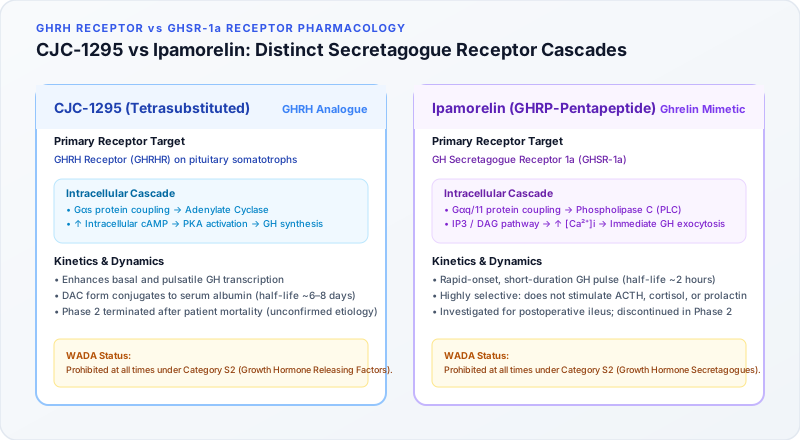
CJC-1295: GHRH Receptor Stimulation & GH Gene Transcription
Primary Target: GHRH Receptor (GHRHR; Class B GPCR)
Affinity Profile: Sub-nanomolar affinity for human GHRHR; resistant to DPP-4 cleavage
CJC-1295 binds to the GHRH receptor on the cell membrane of pituitary somatotrophs, activating Gαs and stimulating adenylate cyclase. The ensuing rise in cyclic AMP activates protein kinase A (PKA), which phosphorylates transcription factor CREB. This enhances transcription of the growth hormone gene and primes somatotroph granules for release. When conjugated with DAC (maleimidopropionic acid), it covalently binds to circulating albumin, producing persistent tonic GHRH stimulation rather than physiological pulsatility.
Ipamorelin: GHSR-1a Selective Activation & Calcium Mobilization
Primary Targets: Growth Hormone Secretagogue Receptor 1a (GHSR-1a; Class A GPCR)
Affinity Profile: Selective nanomolar agonist at GHSR-1a; minimal off-target affinity
Ipamorelin mimics endogenous ghrelin at the GHSR-1a receptor, coupling to Gαq/11. This stimulates phospholipase C (PLC), producing inositol 1,4,5-trisphosphate (IP3) and diacylglycerol (DAG). IP3 triggers rapid release of calcium from endoplasmic reticulum stores, causing instantaneous exocytosis of pre-formed growth hormone granules. Unlike older secretagogues (such as GHRP-6 or GHRP-2), ipamorelin does not stimulate the hypothalamic-pituitary-adrenal axis or induce significant elevations in cortisol or prolactin.
Regulatory & Clinical Trial Status
Neither peptide has received FDA or EMA approval for human clinical therapy.
CJC-1295 Status & Formulations
CJC-1295 was originally developed by ConjuChem Biotechnologies. Clinical development progressed to Phase 2 trials for lipodystrophy and growth hormone deficiency. However, the trial was terminated in 2006 after a patient died from a fatal coronary event during the study. In 2023, FDA placed CJC-1295 in Category 2 of its interim compounding policy; FDA now lists it as “nominated but withdrawn”, which is not a safety clearance.
Ipamorelin Status & Formulations
Ipamorelin was originally investigated by Novo Nordisk and Helsinn Therapeutics as a potential treatment for postoperative ileus (Phase 2 trials). The trials failed to demonstrate sufficient efficacy to warrant commercial approval. FDA placed ipamorelin acetate in Category 2 in September 2023, and it remains there, citing possible immunogenicity, impurities and serious adverse events, including a death, reported when it was given intravenously.
Critical Regulatory Distinction
Both CJC-1295 and ipamorelin are classified under Category S2 of the World Anti-Doping Code. Athletes who test positive for either peptide or their urinary metabolites receive mandatory anti-doping bans.
Human Clinical Trial Data and Outcomes
Both peptides progressed through early-stage human clinical trials before their formal pharmaceutical development was abandoned.
CJC-1295: CJC-1295 Clinical Program
Phase 1 and early Phase 2 trials in healthy adults demonstrated that CJC-1295 with DAC elevated mean plasma GH concentrations by 2- to 10-fold and increased circulating IGF-1 levels by 1.5- to 3-fold for up to 28 days post-injection. However, constant non-pulsatile elevation of GH and IGF-1 raises long-term safety concerns regarding insulin resistance, acromegalic tissue changes, and cardiovascular strain. The Phase 2 program was permanently suspended after a participant death.
Ipamorelin: Ipamorelin Clinical Program
Phase 1 studies in healthy volunteers confirmed that intravenous and subcutaneous ipamorelin induced dose-dependent GH release without significant changes in ACTH, cortisol, prolactin, or glucose. A Phase 2 multicenter trial evaluated ipamorelin for accelerating bowel function recovery in bowel resection patients, but the primary clinical endpoint was not met, leading Helsinn to discontinue development.
Safety Profile, Endocrine Disruption & Unknowns
Exogenous elevation of growth hormone and IGF-1 carries well-documented physiological consequences.
FDA Compounding Safety Concerns
FDA flagged both peptides as bulk substances that may present significant safety risks in compounding. For CJC-1295 it noted serious adverse events including increased heart rate and a systemic vasodilatory reaction; for ipamorelin, serious adverse events including a death with intravenous use. Ipamorelin remains in Category 2; CJC-1295 is now listed as “nominated but withdrawn”, which is not a clearance.
| Safety Consideration | CJC-1295 | Ipamorelin |
|---|---|---|
| FDA Approved Formulations | None (Investigation halted) | None (Investigation halted) |
| Clinical development phase reached | Terminated during Phase 2 | Discontinued after Phase 2 |
| Impact on Insulin Sensitivity | Risk of hyperglycemia & insulin resistance from sustained GH elevation | Transient GH spikes; lower risk of chronic insulin desensitization |
| Hormonal off-target effects | None observed on cortisol or prolactin | Minimal; does not elevate cortisol or prolactin at therapeutic doses |
| Half-life & Washout period | Days to weeks (DAC formulation maintains long receptor occupancy) | Rapid clearance (~2 hours); physiological recovery is rapid |
| WADA Anti-Doping Status | Prohibited at all times (Category S2) | Prohibited at all times (Category S2) |
What CJC-1295 and Ipamorelin Have in Common
Where the two compounds overlap in biology, evidence or regulatory context.
Pituitary Somatotroph Stimulation
Both peptides act directly on anterior pituitary somatotrophs to induce the release of endogenous growth hormone and elevate downstream hepatic IGF-1.
Preservation of Negative Feedback
Unlike recombinant human growth hormone (rhGH), which entirely bypasses pituitary regulation, secretagogues remain partially subject to endogenous somatostatin tone.
Unapproved Investigational Status
Neither compound is approved by the FDA or EMA for therapeutic use, anti-aging, body composition, or sports recovery.
Prohibited in Competitive Sport
Both substances are classified under WADA Section S2 as prohibited growth factor secretagogues.
Key Scientific & Clinical Differences
Meaningful distinctions in mechanism, strength of evidence, safety and regulatory status.
Receptor Target & Second Messenger
CJC-1295 acts on GHRHR via Gαs-cAMP signaling; ipamorelin acts on GHSR-1a via Gαq-IP3/calcium signaling.
Pharmacokinetic Duration
CJC-1295 DAC maintains receptor stimulation for 6–8 days via albumin binding; ipamorelin clears within 2 hours, generating a physiological spike.
Pattern of Secretion
CJC-1295 DAC elevates baseline trough levels of GH (tonic secretion); ipamorelin primarily amplifies peak pulse amplitude without altering baseline troughs.
Clinical Discontinuation Rationale
CJC-1295 was halted due to a fatal cardiac event in Phase 2; ipamorelin was discontinued due to lack of clinical efficacy in postoperative ileus.
Scientific Comparison vs Clinical Recommendations
Inside Peptides compares scientific evidence, receptor pharmacology, and official regulatory documents to advance public and professional understanding. We do not determine which compound is appropriate for an individual patient, rank medications with arbitrary scores, or recommend initiating or switching treatments.
Decisions about any medicine require a licensed healthcare professional who can weigh personal medical history, contraindications, interactions and monitoring needs. Unapproved peptides have no established safe use, and products sold as “research chemicals” are not the preparations studied in clinical research.
Approved Uses vs Online Claims
A critical scientific distinction between verified, FDA-approved clinical uses and unverified claims circulating on social media and vendor platforms.
“CJC/Ipamorelin stack” is a natural fountain of youth with zero risks
insufficientUnapproved drugs that FDA flags as compounding safety risks.
Chronic elevation of growth hormone and IGF-1 can induce insulin resistance, carpal tunnel syndrome, peripheral edema, and theoretically accelerate proliferation of occult neoplastic cells.
Secretagogues do not suppress natural pituitary function unlike rhGH
insufficientNo long-term safety studies validate chronic secretagogue safety beyond several weeks.
While secretagogues do not immediately shut down pituitary somatotrophs, sustained supraphysiological exposure, especially with long-acting DAC formulations, can downregulate pituitary receptors and disrupt normal diurnal pulsatility.
Ipamorelin increases appetite drastically like GHRP-6
insufficientPharmacological evaluation shows high GHSR-1a selectivity.
Unlike GHRP-6, ipamorelin does not induce intense hunger or orexigenic surges at standard experimental doses due to its structural selectivity.
Evidence Strength Across Clinical Domains
Inside Peptides evaluates scientific certainty at the claim level. Because clinical evidence varies significantly depending on the therapeutic endpoint evaluated, each domain is assessed independently.
Short-Term GH and IGF-1 Elevation
Well-established in Phase 1 human trials for both compounds.
Long-Term Anti-Aging / Longevity Efficacy
Zero clinical trial evidence demonstrating lifespan extension or anti-aging benefits in humans.
Body Composition (Fat Loss / Muscle Gain)
Mild body composition effects seen with GHRH analogues in specific clinical subsets; no rigorous trials for elective cosmetic use.
Long-Term Cardiovascular and Oncological Safety
Unresolved safety concerns; development suspended before Phase 3 completion.
What Research Still Doesn’t Tell Us
Identifying open scientific questions, pending active-comparator trials, and areas where long-term clinical data remain incomplete.
Long-Term Neoplastic Risk
Epidemiological studies link elevated circulating IGF-1 concentrations with higher lifetime risks of certain malignancies. The long-term oncological safety of secretagogues has never been established.
True Cardiovascular Toxicity Profile
The exact etiology of the fatal cardiac event that terminated the CJC-1295 Phase 2 trial was never conclusively elucidated in peer-reviewed clinical literature.
Efficacy of Co-Administration (“Stacking”)
While online clinics frequently co-administer CJC-1295 and ipamorelin based on theoretical pathway synergy, no formal Phase 3 trial has ever evaluated the combination in humans.
Related Compound Profiles
Individual profiles provide full molecular datasheets, CAS numbers, preclinical histories, and compound monographs.
Related Educational Resources
Scientific & Regulatory References
Every pharmacological mechanism, clinical trial result, and regulatory approval cited on this page is traceable to official FDA prescribing documentation, ClinicalTrials.gov registries, or peer-reviewed medical publications.
-
Peer-Reviewed Clinical Trial
Prolonged stimulation of growth hormone (GH) and insulin-like growth factor I (IGF-I) by CJC-1295, a long-acting analog of GH-releasing hormone, in healthy adults
-
Peer-Reviewed Pharmacological Study
Ipamorelin, the first selective growth hormone secretagogue
-
Regulatory Ruling
Certain Bulk Drug Substances for Use in Compounding that May Present Significant Safety RisksFDA list of bulk drug substances under Category 2 and those nominated but withdrawn (content current as of 22 April 2026)
-
Anti-Doping Policy
World Anti-Doping Code International Standard Prohibited ListSection S2: Peptide Hormones, Growth Factors, Related Substances, and Mimetics