
Losing Muscle on GLP-1 Drugs: How Much, and Can You Prevent It?
How much of the weight lost on semaglutide, tirzepatide and retatrutide is lean mass, how it compares with diet, and what protects muscle.

Key takeaways
- In trial body scans, lean mass made up about 26% to 39% of the tissue lost with tirzepatide and semaglutide, similar to diet and weight-loss surgery.
- Lean mass is not the same as muscle, and whether these losses affect strength, falls or daily function is still being studied.
- Resistance training with enough protein has the best support for protecting muscle; muscle-sparing drugs such as bimagrumab remain investigational.
In this article
Yes, some of the weight you lose on a GLP-1 drug is lean mass, but "melting muscle" overstates it. In the body-scan substudies of the main trials, lean mass made up about 39% of the tissue lost with semaglutide (Ozempic, Wegovy) and about 26% with tirzepatide (Mounjaro, Zepbound). That is the same broad range seen with strict diets and weight-loss surgery. Most of what went was fat.1378
Two caveats matter more than the headline numbers. Lean mass is not the same as muscle, and nobody yet knows whether these losses affect strength, falls or daily life in the long run. What the evidence does support is strength training with enough protein; no supplement or peptide has been shown to protect muscle on these drugs.5910
This article gives no dosing information, recommends no products and is not medical advice.
How much of the weight lost was lean mass?
The table brings together the published dual-energy X-ray absorptiometry (DXA) substudies we could verify on 22 October 2026, with a diet-only trial and a surgery meta-analysis for comparison. "Lean share" is lean mass lost divided by fat plus lean mass lost; where the authors reported their own figure, we say so.
| Study (length) | Treatment | People scanned | Total weight lost | Fat mass lost | Lean mass lost | Lean share of tissue lost | Source |
|---|---|---|---|---|---|---|---|
| STEP 1 DXA substudy (68 weeks) | Semaglutide | 95 | 14.73 kg | 8.36 kg | 5.26 kg | 39% (our calculation) | 12 |
| SURMOUNT-1 DXA substudy (72 weeks) | Tirzepatide, all doses pooled | 124 | 21.3% | 15.9 kg (33.9%) | 5.6 kg (10.9%) | 26% (authors) | 3 |
| SURMOUNT-1 DXA substudy (72 weeks) | Placebo plus lifestyle counselling | 36 | 5.3% | 3.6 kg (8.2%) | 1.2 kg (2.6%) | 25% (authors) | 3 |
| BELIEVE (48 weeks) | Semaglutide alone, higher-dose group | 57 randomised | 14.2 kg | 9.6 kg | 3.9 kg | 29% (fat loss index 71.1%) | 6 |
| Retatrutide phase 2 substudy, type 2 diabetes (36 weeks) | Retatrutide, two highest-dose groups | 103 completed both scans, all groups | Not in abstract | About 10.5–10.9 kg (23.2–26.1%) | About 6.4–6.5 kg | About 37–38% (as summarised in a 2026 review) | 45 |
| TEMPO Diet trial (12 months) | Severe calorie restriction, no drug | 45 | 15.3 kg | 10.2 kg | 3.2 kg | 24% (our calculation) | 7 |
| TEMPO Diet trial (12 months) | Moderate calorie restriction, no drug | 37 | 8.4 kg | 5.5 kg | 2.1 kg | 28% (our calculation) | 7 |
| Bariatric surgery meta-analysis (mostly 6 months) | Weight-loss surgery | 301 | BMI down 10.8 kg/m² | 22.3 kg | 7.4 kg | 25% (our calculation) | 8 |
The rows involve different people and lengths of follow-up, so they cannot be ranked against each other. TEMPO enrolled only postmenopausal women; the retatrutide substudy enrolled people with type 2 diabetes. We could not access the full retatrutide paper, so its lean figures come from a 2026 review.45 The STEP 1 placebo group lost only 3.26 kg (1.37 kg fat, 1.83 kg lean), too little to give a meaningful share.1 All the drug substudies were funded by the drugs' makers: Novo Nordisk for STEP 1, Eli Lilly for the others.2346
The clearest comparison is inside SURMOUNT-1, where the authors found almost the same split of fat to lean loss with tirzepatide (74:26) as with placebo plus lifestyle advice (75:25).3 A 2025 joint advisory from the American College of Lifestyle Medicine, the American Society for Nutrition, the Obesity Medicine Association and The Obesity Society reached the same conclusion more broadly: the losses are "similar to those documented with other obesity therapies that achieve large weight reductions, such as bariatric surgery and very low-calorie restricted diets."10 The drug is not uniquely stripping muscle. What changes is scale: the more weight you lose, the more lean mass you lose in kilograms, even when the proportion stays similar.3
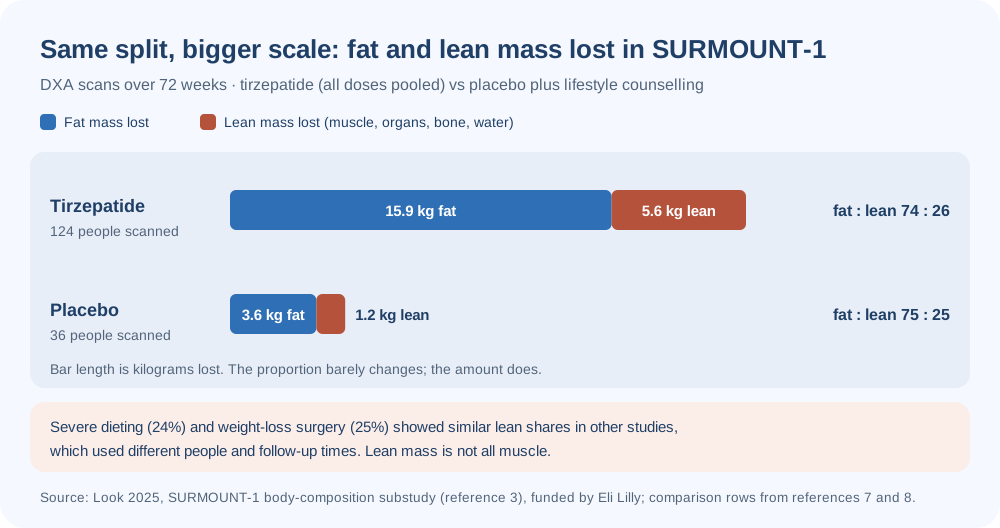
That also bears on the "skinny-fat" worry. In SURMOUNT-1, roughly three-quarters of the tissue lost was fat.3 On those numbers, body composition shifted towards leaner, not fatter; the risk is less the proportion than the absolute amount of muscle lost by people who had little to spare. The advisory names the factors that push lean loss up: cutting calories hard, losing weight fast, doing no strength training and, because appetite falls so sharply on these GLP-1 drugs, eating too little protein.10
Lean mass is not all muscle
DXA does not measure muscle directly. A 2024 review notes that lean mass "includes not only muscle but also organs, bone, fluids, and water in fat tissue."9 The joint advisory estimates that muscle is about half of lean body mass, so the STEP 1 figures would correspond to roughly a fifth of total weight lost being muscle.10 Early DXA changes may partly reflect water, glycogen and organ mass.5
MRI studies give a more detailed picture. The 2024 review concluded that muscle volume falls about as much as would be expected from ageing, illness and the weight lost, and that less fat inside muscle may mean better muscle quality.9 One of that review's authors works for AMRA Medical, a company that sells MRI body-composition analysis, and the conclusion has not been tested in long outcome trials.
Does it affect strength?
This is the real gap. A 2026 review found that "direct clinical evidence linking incretin therapy-induced lean mass loss to adverse outcomes remains limited", because the main trials were not designed to detect sarcopenia (age-related muscle loss), frailty or disability. It also stressed that current evidence neither shows these drugs cause sarcopenia nor rules out important muscle loss in vulnerable people.5
Other kinds of weight loss offer some reassurance. In a meta-analysis of weight-loss surgery, people lost 7.4 kg of lean mass but handgrip strength did not change significantly.8 In TEMPO, severe and moderate dieting led to similar handgrip strength.7 Whether that holds for older or frailer people on newer, more powerful drugs is not known.
What protects muscle: strength training and protein
Keeping muscle while you lose weight is realistic. Building a lot of it during major weight loss has not been shown in these trials. The best evidence is for exercise, and it comes from liraglutide, an older GLP-1 drug, rather than semaglutide or tirzepatide.
In a randomised trial of 195 adults who had first lost weight on a low-calorie diet, the group given liraglutide plus exercise cut body-fat percentage by 3.9 points over a year, about twice as much as exercise alone or liraglutide alone.11 A later analysis of the same trial found that exercise, with or without the drug, improved stair-climb times and fitness; liraglutide alone did not. Absolute strength held up in the drug and exercise groups, while strength relative to body weight fell by 7.8% with placebo.12
The joint advisory recommends that GLP-1 drugs be prescribed alongside a structured exercise programme: strength training at least three times a week plus at least 150 minutes of moderate aerobic activity, tailored to the person. It puts protein high on the list too, but warns that "increased protein intake alone is likely inadequate" without strength training, and suggests help from a registered dietitian.10 We do not give protein amounts here; a dietitian or prescriber can set a target that fits you.
This guidance rests on expert review, not long trials of resistance training with semaglutide or tirzepatide.
Muscle-sparing drugs and "muscle peptides"
The most advanced attempt at a drug fix is bimagrumab, an investigational antibody that blocks activin type II receptors. The BELIEVE phase 2 trial tested it with and without semaglutide in 507 adults with obesity. At 48 weeks, the highest-dose combination lost 17.8 kg against 14.2 kg with semaglutide alone, and lost 1.3 kg of lean mass against 3.9 kg. Common side effects of bimagrumab included muscle spasms, diarrhoea and acne.6 The trial was funded by Eli Lilly. A 2026 review noted that such drugs have not shown consistent improvements in strength or function and "should not yet be considered standard care."5 Bimagrumab is not approved for any use as of 22 October 2026.
Peptides sold online for muscle are further behind. Our guide to peptides for muscle growth found no randomised trial showing that ipamorelin, CJC-1295 or similar growth hormone secretagogues build muscle or strength in people, and we found none testing them during GLP-1 treatment. Products sold as "research use only" are not made to medicine standards.
Does retatrutide burn fat or just make you eat less?
For the approved drugs, eating less is the main measured effect. In a 20-week randomised trial, people on semaglutide ate 35% less at a self-chosen lunch than people on placebo.13 In another semaglutide study described by the European Medicines Agency, ad libitum energy intake across a test day was 24% lower than with placebo, and resting energy use fell by about 600 kJ a day, the opposite of "burning more"; the agency said only "a minor part" of that fall could be explained by lean mass lost.14 A tirzepatide study found that differences in lunch intake were "not sufficient to explain the different weight outcomes" compared with semaglutide, and said energy expenditure needs more study.15
Retatrutide adds activity at the glucagon receptor, which is why people expect it to burn fat as well. What has actually been measured is narrower:
- In mice: retatrutide's glucagon component added higher energy expenditure to the lower food intake.16
- Briefly, in people: in a crossover study of 10 volunteers, a glucagon infusion raised resting energy expenditure over a few hours.17 That was natural glucagon, not retatrutide.
- In a retatrutide trial: liver fat fell by more than 80% at 24 weeks in the two highest-dose groups of a substudy of 98 people with fatty liver disease. The authors said this "may be related to the greater weight reduction achieved with retatrutide, direct hepatic effects of glucagon receptor agonism or both."18
- Not yet shown: we found no published human study measuring whether retatrutide raises energy expenditure, in a PubMed search on 22 October 2026. The abstract of the phase 3 TRIUMPH-1 report gives weight, knee pain and sleep apnoea results, not body composition, so there are no lean-mass figures yet for people without diabetes.21
Retatrutide is not FDA-approved as of 22 October 2026; FDA says retatrutide is not a component of any FDA-approved drug and has "not been found safe and effective for any condition."19 More on where it stands is in our retatrutide questions explainer and our guide to multi-receptor agonists.
What about belly fat?
No medicine in these trials targeted one part of the body, but visceral fat, the deep fat around the organs, fell substantially with all three drugs. On semaglutide in STEP 1 it fell by 0.36 kg against 0.10 kg with placebo.1 On tirzepatide in SURMOUNT-1, a DXA estimate of visceral fat fell by 40.1% against 7.3% with placebo.3 On retatrutide, MRI showed falls of 16.1% to 48.3% across doses at 48 weeks, while visceral fat rose 2.5% with placebo.18 Diet alone also does this: in TEMPO, visceral fat fell in both diet groups, more with severe restriction.7
When to talk to your doctor
The advisory lists the groups most at risk of muscle and bone loss: people who are older, sedentary, chronically ill, malnourished or living with type 2 diabetes. It suggests clinicians assess muscle strength and function before starting a GLP-1 drug and screen for sarcopenia risk.10 If that describes you, or you have had falls or have low bone density, raise it with your prescriber before or early in treatment.
Contact your prescriber if you notice new or worsening weakness (trouble with stairs, getting up from a chair or carrying shopping), a fall or unsteadiness, difficulty managing everyday tasks you could do before, or that you are eating too little to keep up regular meals. Seek urgent care after a fall with injury, a head injury, or sudden weakness on one side of the body. Report a suspected side effect to the FDA's MedWatch programme or your national regulator.20
Other effects of fast weight loss are covered in our explainers on hair loss and "Ozempic face" and retatrutide's side effects. If the scale is not moving, see what the trials say is normal; for what happens when treatment ends, see stopping semaglutide or tirzepatide.
How we reviewed this article
Sources
InsidePeptides relies on primary sources: peer-reviewed studies, trial registries and regulators’ own documents. Read our editorial policy.
- U.S. Food and Drug Administration. 2021. Clinical review, NDA 215256: Wegovy (semaglutide) injection. Table 15, DEXA substudy summary results, trial 4373 (STEP 1). Accessed 22 October 2026.
- Wilding JPH et al. 2021. Once-Weekly Semaglutide in Adults with Overweight or Obesity. New England Journal of Medicine 384(11):989–1002. PMID: 33567185. DOI: 10.1056/NEJMoa2032183. STEP 1.
- Look M et al. 2025. Body composition changes during weight reduction with tirzepatide in the SURMOUNT-1 study of adults with obesity or overweight. Diabetes, Obesity and Metabolism 27(5):2720–2729. PMID: 39996356. DOI: 10.1111/dom.16275. Funded by Eli Lilly; correction to Figure 4 axis label published 2025.
- Coskun T et al. 2025. Effects of retatrutide on body composition in people with type 2 diabetes: a substudy of a phase 2, double-blind, parallel-group, placebo-controlled, randomised trial00092-0). Lancet Diabetes & Endocrinology 13(8):674–684. PMID: 40609566. DOI: 10.1016/S2213-8587(25)00092-0. All authors employed by Eli Lilly.
- Kim JY et al. 2026. Beyond Fat Loss: Addressing the Sarcopenia Challenge of Incretin-Based Therapies. Diabetes & Metabolism Journal 50(5):844–862. PMID: 42722378. DOI: 10.4093/dmj.2026.0702.
- Heymsfield SB et al. 2026. Bimagrumab plus semaglutide alone or in combination for the treatment of obesity: a randomized phase 2 trial. Nature Medicine 32(3):869–882. PMID: 41772149. DOI: 10.1038/s41591-026-04204-0. BELIEVE; NCT05616013. Funded by Eli Lilly.
- Seimon RV et al. 2019. Effect of Weight Loss via Severe vs Moderate Energy Restriction on Lean Mass and Body Composition Among Postmenopausal Women With Obesity: The TEMPO Diet Randomized Clinical Trial. JAMA Network Open 2(10):e1913733. PMID: 31664441. DOI: 10.1001/jamanetworkopen.2019.13733.
- Jung HN et al. 2023. Preserved Muscle Strength Despite Muscle Mass Loss After Bariatric Metabolic Surgery: a Systematic Review and Meta-analysis. Obesity Surgery 33(11):3422–3430. PMID: 37728838. DOI: 10.1007/s11695-023-06796-9.
- Neeland IJ, Linge J, Birkenfeld AL. 2024. Changes in lean body mass with glucagon-like peptide-1-based therapies and mitigation strategies. Diabetes, Obesity and Metabolism 26(Suppl 4):16–27. PMID: 38937282. DOI: 10.1111/dom.15728.
- Mozaffarian D et al. 2025. Nutritional priorities to support GLP-1 therapy for obesity: a joint Advisory from the American College of Lifestyle Medicine, the American Society for Nutrition, the Obesity Medicine Association, and The Obesity Society. American Journal of Clinical Nutrition 122(1):344–367. PMID: 40450457. DOI: 10.1016/j.ajcnut.2025.04.023. Several authors report advisory roles with GLP-1 manufacturers.
- Lundgren JR et al. 2021. Healthy Weight Loss Maintenance with Exercise, Liraglutide, or Both Combined. New England Journal of Medicine 384(18):1719–1730. PMID: 33951361. DOI: 10.1056/NEJMoa2028198. NCT04122716.
- Jensen SBK et al. 2026. Physical Fitness with Exercise and GLP-1 Receptor Agonist Treatment Alone or Combined After Diet-Induced Weight Loss: A Secondary Analysis of a Randomized Controlled Trial in Adults with Obesity. Sports Medicine 56(7):1785–1800. PMID: 41579235. DOI: 10.1007/s40279-025-02386-0.
- Friedrichsen M et al. 2021. The effect of semaglutide 2.4 mg once weekly on energy intake, appetite, control of eating, and gastric emptying in adults with obesity. Diabetes, Obesity and Metabolism 23(3):754–762. PMID: 33269530. DOI: 10.1111/dom.14280.
- European Medicines Agency. 2022. Wegovy: EPAR public assessment report. EMA/112307/2022, pages 54–55 (trial 3685). Accessed 22 October 2026.
- Heise T et al. 2023. Tirzepatide Reduces Appetite, Energy Intake, and Fat Mass in People With Type 2 Diabetes. Diabetes Care 46(5):998–1004. PMID: 36857477. DOI: 10.2337/dc22-1710.
- Coskun T et al. 2022. LY3437943, a novel triple glucagon, GIP, and GLP-1 receptor agonist for glycemic control and weight loss: From discovery to clinical proof of concept. Cell Metabolism 34(9):1234–1247.e9. PMID: 35985340. DOI: 10.1016/j.cmet.2022.07.013.
- Tan TM et al. 2013. Coadministration of glucagon-like peptide-1 during glucagon infusion in humans results in increased energy expenditure and amelioration of hyperglycemia. Diabetes 62(4):1131–1138. PMID: 23248172. DOI: 10.2337/db12-0797.
- Sanyal AJ et al. 2024. Triple hormone receptor agonist retatrutide for metabolic dysfunction-associated steatotic liver disease: a randomized phase 2a trial. Nature Medicine 30(7):2037–2048. PMID: 38858523. DOI: 10.1038/s41591-024-03018-2. NCT04881760.
- U.S. Food and Drug Administration. 2026. FDA's concerns with unapproved GLP-1 drugs used for weight loss. Content current as of 1 October 2026; accessed 22 October 2026.
- U.S. Food and Drug Administration. MedWatch: The FDA Safety Information and Adverse Event Reporting Program. Accessed 22 October 2026.
- Jastreboff AM et al. 2026. Retatrutide, a Triple Hormone Receptor Agonist, for Treatment of Obesity. New England Journal of Medicine, published online 29 September 2026. PMID: 42814954. DOI: 10.1056/NEJMoa2604169. TRIUMPH-1; NCT05929066.
History
Each entry records a dated change to this article’s content. Link and formatting changes are not listed.
Current version
Written by InsidePeptides Editorial Team
Scientific review pending
Last updated
Published


