
Foundayo's Heart-Safety Trial: What ACHIEVE-4 Shows and What It Doesn't
Lilly's pill Foundayo passed its heart-safety test against insulin in ACHIEVE-4. What the trial proved, why the death figures are exploratory and what's next.

Key takeaways
- In ACHIEVE-4, published in The Lancet, Lilly's oral GLP-1 drug orforglipron (Foundayo) met its one formal goal: in 2,749 adults with type 2 diabetes and heart or kidney disease, it did not raise the risk of major heart events compared with insulin glargine (hazard ratio 0.84, 95% CI 0.59 to 1.20).
- Fewer people died on orforglipron (19 against 43), but those death analyses were not protected against chance findings from multiple testing, the trial was open-label, and it compared the pill with insulin rather than placebo, so it does not show that Foundayo protects the heart.
- Foundayo is approved in the US only for weight management; Lilly has submitted it for type 2 diabetes, and a separate placebo-controlled outcomes trial, ATTAIN-Outcomes, is not expected to finish before 2031.
In this article
Foundayo, Eli Lilly's once-daily GLP-1 pill, has passed the heart-safety test that regulators expect of every new diabetes drug. In ACHIEVE-4, 2,749 adults with type 2 diabetes and existing heart or kidney disease took either orforglipron (the drug in Foundayo) or insulin glargine for a median of about two years. Major heart events were no more common on the pill: 4.2% against 5.0%, a hazard ratio of 0.84. The results were presented at the European Association for the Study of Diabetes (EASD) meeting and published in The Lancet on 30 September 2026.12
Lilly's announcement also highlighted something more striking: fewer than half as many deaths in the orforglipron group. That figure is real, but it is not the kind of result that proves a drug saves lives, and the trial was not built to show it. This article sets out what ACHIEVE-4 settled, what it only hints at, and where Foundayo stands. For background on how the pill differs from injections, see our guide to oral GLP-1 pills. This article gives no dosing information and is not medical advice.
What the trial was designed to answer
Makers of new diabetes drugs are expected to show that their medicine does not increase heart attacks, strokes and heart deaths. Most do this with a "cardiovascular outcomes trial" whose main goal is non-inferiority: showing that the new drug is not meaningfully worse than the comparison. ACHIEVE-4 was one of these. The authors note that some injectable peptide GLP-1 drugs have proven heart benefits, but that the heart safety of a non-peptide GLP-1 drug like orforglipron had not been studied.1
The design, as reported in the paper and the trial registry:13
- Who: adults with type 2 diabetes, a BMI of 25 or more, and an A1C between 7.0% and 10.5% despite up to three glucose-lowering medicines (metformin, a sulfonylurea and/or an SGLT2 inhibitor). All had established cardiovascular disease or chronic kidney disease: 85.9% had heart or blood-vessel disease and 37.6% had kidney disease. Their average age was 63.
- What: orforglipron by mouth once daily, increased to the highest dose each person tolerated, or insulin glargine injected once daily and adjusted to blood sugar.
- Where and when: 317 sites in 16 countries and territories, including the US; enrolment ran from May 2023 to September 2024.
- Main measure: time to the first "MACE-4" event: death from heart or blood-vessel causes, non-fatal heart attack, non-fatal stroke, or hospital admission for unstable angina.
- The bar to clear: orforglipron would count as non-inferior if the upper end of the 95% confidence interval for the hazard ratio was below 1.8.
- Open-label: everyone knew which treatment they were on.
Lilly sponsored and funded the trial, and seven of the eleven authors are Lilly employees.1
The headline result: safe, not protective
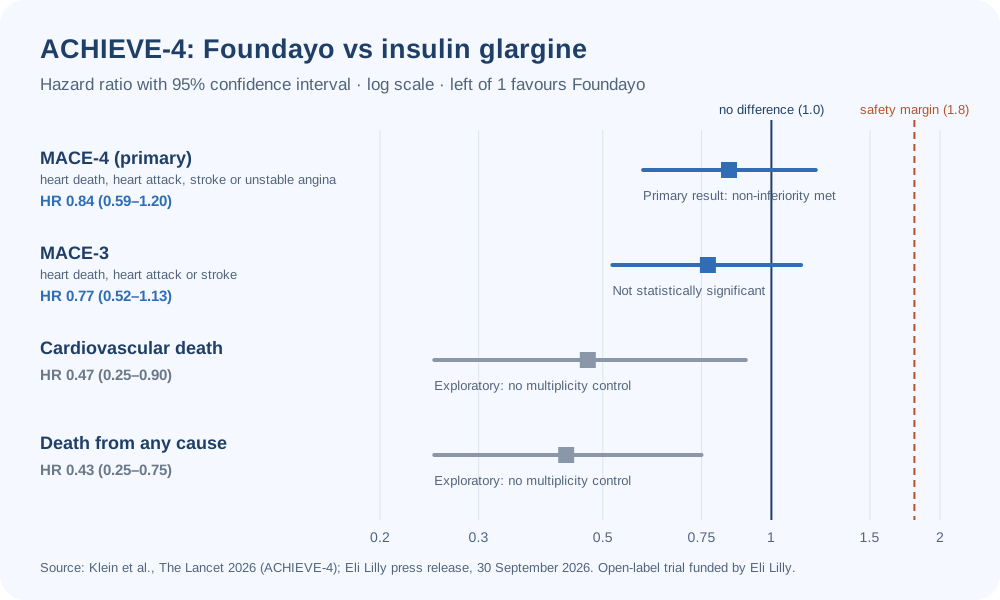
The primary outcome occurred in 57 of 1,358 people on orforglipron (4.2%) and 67 of 1,343 on insulin glargine (5.0%). The hazard ratio was 0.84, with a 95% confidence interval of 0.59 to 1.20.1
Two things follow from that interval. Its upper end, 1.20, is far below the 1.8 margin, so the trial clearly met its goal: orforglipron did not raise heart risk compared with insulin. But the interval also crosses 1, which means the trial cannot exclude the possibility that the two treatments carry the same risk, or even that orforglipron's is slightly higher. Lilly's own release says superiority was not shown (p = 0.336).2 The narrower three-part measure, MACE-3, which leaves out unstable angina, gave a hazard ratio of 0.77 (0.52 to 1.13), also not statistically significant.2
So the accurate summary is that orforglipron is not worse than insulin for the heart. That is what the paper's authors concluded: "the cardiovascular safety of orforglipron was confirmed".1 It is not evidence that the pill lowers heart risk.
The death figures, and why they need caution
Over the study, 19 people (1.4%) died in the orforglipron group and 43 (3.2%) in the insulin group. The investigators judged all but one of those deaths, in the insulin group, to be unrelated to treatment.1 Lilly reported hazard ratios of 0.47 (0.25 to 0.90) for death from cardiovascular causes and 0.43 (0.25 to 0.75) for death from any cause.2
Those numbers are why the release talks about "the potential for more comprehensive health benefits".2 But Lilly's endnotes also say these were pre-planned analyses that were not controlled for type 1 error. In plain terms, the trial tested several outcomes, and when you test several things, the odds that one of them shows a striking difference by chance go up. Trials guard against this with a pre-set statistical hierarchy. The death results sat outside that safeguard, so they are hypothesis-generating, not confirmed.
There are other reasons to hold back:
- The numbers are small. Sixty-two deaths in total is enough to produce a wide confidence interval and a large swing from a handful of cases.
- It does not line up neatly with the rest. MACE-3 includes cardiovascular death, yet it did not show a clear difference. A real halving of heart deaths would usually pull the composite down more convincingly.
- The comparison was insulin, not placebo. Insulin glargine is an active treatment that, in this trial, was linked to weight gain and to far more episodes of low blood sugar (see below). A difference between the groups could reflect harms on the insulin side as well as any benefit of orforglipron. The trial cannot separate the two.
None of this means the signal is wrong. It means it needs testing in a trial designed for it.
What else the trial reported
Most of the extra results come from Lilly's release and use the "efficacy estimand", which assumes everyone stayed on their assigned treatment. Several were not controlled for multiple testing either.2
- Blood sugar and weight at 52 weeks: A1C fell from an average of 8.22% by 1.6 percentage points with orforglipron and 1.0 with insulin. Body weight fell 8.8% with orforglipron and rose 1.7% with insulin.2
- Kidney measures: eGFR, a measure of kidney filtering, declined less with orforglipron than with insulin (by 2.8 on the standard scale), and the albumin level in urine, a marker of kidney damage, fell 27.1% more. These were not controlled for multiple testing.2
- Low blood sugar: clinically significant or severe hypoglycaemia occurred in 6.8% of people on orforglipron and 19.2% on insulin glargine.1
- Stomach and gut side effects: reported by 62.1% on orforglipron against 14.2% on insulin, and the most common reason people stopped the pill. Lilly says 10.6% of the orforglipron group stopped because of side effects during the first 52 weeks; it did not give the comparable figure for insulin in its release.12
Liver safety has been checked separately. A pooled analysis of seven orforglipron phase 3 trials, more than 11,000 people in all, found no cases that met the criteria for drug-induced liver injury, and liver-enzyme rises were about as common as with placebo or comparator drugs. Lilly funded and co-wrote that analysis.8
How this compares with semaglutide's heart trials
It helps to see how other GLP-1 drugs earned their heart claims.
In SUSTAIN-6, injected semaglutide was tested against placebo in 3,297 people with type 2 diabetes at high cardiovascular risk. The main outcome fell from 8.9% to 6.6%, a hazard ratio of 0.74 (0.58 to 0.95), an interval that stays below 1.9 In SELECT, the weight-loss dose of semaglutide was tested against placebo in 17,604 people with heart disease and overweight but no diabetes, as a trial designed from the start to show superiority; the hazard ratio was 0.80 (0.72 to 0.90).10 Ozempic's US label now includes reducing the risk of major cardiovascular events in adults with type 2 diabetes and established heart disease.11
ACHIEVE-4 is a different kind of evidence: an active-comparator safety trial whose main interval crosses 1. Lilly is testing orforglipron for heart benefit in ATTAIN-Outcomes, a placebo-controlled trial of about 7,100 adults with atherosclerotic heart disease and/or chronic kidney disease, with or without diabetes. It is recruiting, with primary completion estimated for August 2031.212 Until then, any claim that Foundayo protects the heart goes beyond the evidence.
Our article on GLP-1 drugs beyond weight loss tracks which heart, kidney and other benefits have been proven for which drugs.
Where Foundayo stands
- Approved for weight management only. FDA approved Foundayo on 1 April 2026 to reduce excess body weight and maintain weight reduction in adults with obesity, or with overweight and at least one weight-related condition.67 Its US label does not include type 2 diabetes.6
- Diabetes is under review. In its second-quarter 2026 results, Lilly listed "the submission for orforglipron for type 2 diabetes in the U.S." without giving a decision date.5 ACHIEVE-4 is part of the evidence for that application.
- Sales are growing. Lilly reported Foundayo revenue of $184 million in the third quarter of 2026 and $281 million for the year to date.4
- The label's warnings still apply. Like other GLP-1 drugs, Foundayo carries a boxed warning about thyroid C-cell tumours seen in rodents and should not be used by people with a personal or family history of medullary thyroid cancer or MEN 2.6
What this means if you have type 2 diabetes and heart disease
If you are considering Foundayo, ACHIEVE-4 is reassuring on one specific point: in people like you, it did not increase heart attacks, strokes or heart deaths compared with insulin over about two years. It also caused less low blood sugar and led to weight loss rather than weight gain, though stomach side effects were common.
What it does not tell you is that Foundayo will lower your heart risk the way some injected GLP-1 drugs have been shown to. If heart protection is the main goal, ask your prescriber which treatments have outcome evidence for that, and whether the trade-offs between a daily pill and a weekly injection matter for you. Until FDA rules on the diabetes application, prescribing Foundayo for diabetes alone would be off-label in the US.
For the wider picture of oral and injectable drugs in development, see where the next weight-loss drugs stand and our comparison of insulin and GLP-1. If you are struggling with results on a GLP-1, our guide to what the trials say is normal may help.
What to watch for next
- FDA's decision on type 2 diabetes, and whether the label mentions ACHIEVE-4's heart-safety result.5
- Results posted to ClinicalTrials.gov for NCT05803421. The registry lists the trial as completed in March 2026; no results were posted when we checked on 3 November 2026.3
- ATTAIN-Outcomes, the trial that can actually answer whether orforglipron prevents heart attacks, strokes or deaths.12
How we reviewed this article
Sources
InsidePeptides relies on primary sources: peer-reviewed studies, trial registries and regulators’ own documents. Read our editorial policy.
- Klein KR et al. 2026. Cardiovascular safety of orforglipron versus insulin glargine in adults with type 2 diabetes at increased cardiovascular risk (ACHIEVE-4): a phase 3, event-driven, randomised, open-label, non-inferiority, active comparator trial. Lancet 408(10564):1557-1570. PMID: 42815506. DOI: 10.1016/S0140-6736(26)01865-901865-9). Funded by Eli Lilly; epub 30 September 2026. A correction notice appeared in the same issue.
- Eli Lilly and Company. 2026. Lilly's oral GLP-1, Foundayo (orforglipron), demonstrated cardiovascular safety alongside sustained A1C reduction and weight loss in its largest and longest type 2 diabetes study. Press release (PR Newswire), 30 September 2026, as republished by Placera. Accessed 3 November 2026.
- ClinicalTrials.gov. NCT05803421: A Study of Daily Oral Orforglipron (LY3502970) Compared With Insulin Glargine in Participants With Type 2 Diabetes and Obesity or Overweight at Increased Cardiovascular Risk (ACHIEVE-4). Phase 3, open-label; sponsor Eli Lilly. Completed 16 March 2026; no results posted; checked 3 November 2026.
- Eli Lilly and Company. 2026. Lilly reports third-quarter 2026 financial results, raises full-year guidance and highlights regulatory progress across the portfolio. Press release filed with the SEC (Form 8-K, Exhibit 99.1), 29 October 2026. Accessed 3 November 2026.
- Eli Lilly and Company. 2026. Lilly reports second-quarter 2026 financial results, raises full-year guidance, and highlights continued growth and pipeline progress. Press release filed with the SEC (Form 8-K), 5 August 2026. Accessed 3 November 2026.
- Eli Lilly and Company. 2026. FOUNDAYO (orforglipron) tablets: prescribing information. DailyMed, label version published 13 August 2026; indications and boxed warning checked 3 November 2026.
- Eli Lilly and Company. 2026. FDA approves Lilly's Foundayo (orforglipron), the only GLP-1 pill for weight loss that can be taken any time of day without food or water restrictions. Press release (PR Newswire), 1 April 2026, as republished by BioSpace. Accessed 3 November 2026.
- Wharton S et al. 2026. Hepatic Safety of Orforglipron in Adults With Obesity or Overweight and/or Type 2 Diabetes: A Pooled Analysis of the Orforglipron Phase 3 Clinical Trials. Diabetes Obes Metab 28(9):8347-8358. PMID: 42338042. DOI: 10.1111/dom.71032.
- Marso SP et al. 2016. Semaglutide and Cardiovascular Outcomes in Patients with Type 2 Diabetes. N Engl J Med 375(19):1834-1844. PMID: 27633186. DOI: 10.1056/NEJMoa1607141.
- Lincoff AM et al. 2023. Semaglutide and Cardiovascular Outcomes in Obesity without Diabetes. N Engl J Med 389(24):2221-2232. PMID: 37952131. DOI: 10.1056/NEJMoa2307563.
- Novo Nordisk. 2026. OZEMPIC (semaglutide) injection: prescribing information. DailyMed, revised May 2026; indications checked 3 November 2026.
- ClinicalTrials.gov. NCT07241390: A Study of Orforglipron (LY3502970) on Cardiovascular Outcomes in Adults With Atherosclerotic Cardiovascular Disease and/or Chronic Kidney Disease (ATTAIN-Outcomes). Recruiting; estimated primary completion August 2031; checked 3 November 2026.
History
Each entry records a dated change to this article’s content. Link and formatting changes are not listed.
Current version
Written by InsidePeptides Editorial Team
Scientific review pending
Last updated
Published


