
Does BPC-157 Cause Cancer? What the Evidence Actually Shows
BPC-157 boosts blood-vessel growth signals in lab studies, but its cancer risk has never been tested. What FDA found, what is known and what is not.

Key takeaways
- In lab and rat studies BPC-157 switches on blood-vessel and cell-migration signals that tumours also use, which is why the cancer question exists.
- FDA found no carcinogenicity studies; a 2020 study found no DNA damage in three standard tests.
- Tumour data are one mouse study and one conference abstract, and there are no long-term human data.
In this article
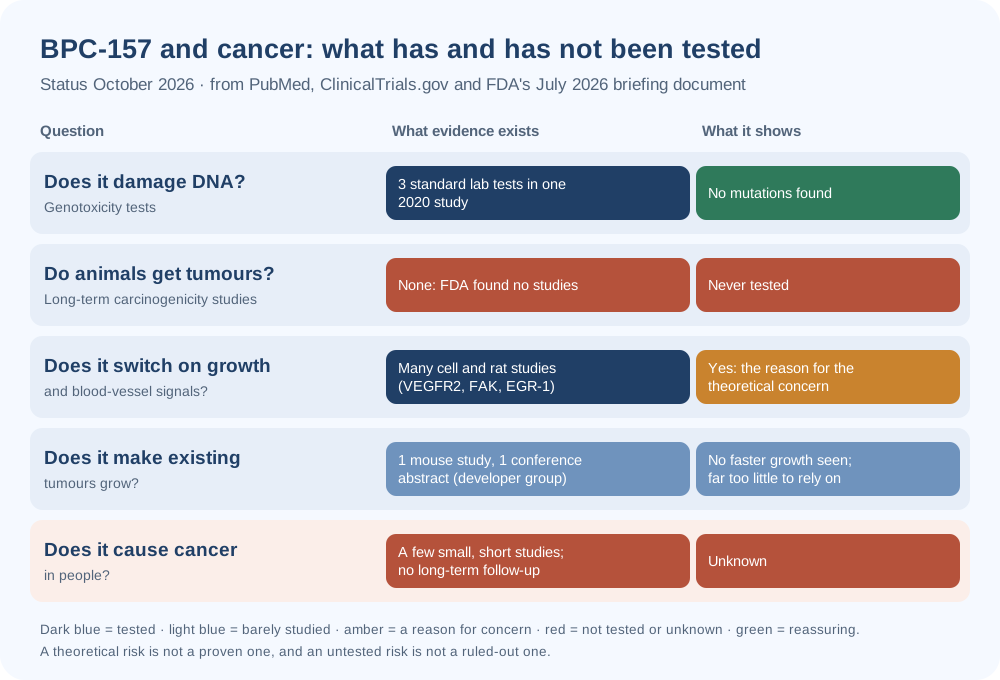
Nobody knows whether BPC-157 raises the risk of cancer, because it has never been properly tested for that. FDA found no long-term animal studies of cancer risk, and the few human studies are small, short and without long-term follow-up. The worry is real but theoretical: in lab and rat studies, BPC-157 switches on blood-vessel growth and cell-migration signals that tumours also use.1234
BPC-157 is one of the most popular unapproved peptides of 2026, and "does BPC-157 cause cancer?" is one of the most common questions about it. Most answers online come from people who sell it or from forums. This guide sets out why the concern exists, what has actually been tested, what has not, and why that gap matters. It gives no dosing information, recommends no seller and is not medical advice.
The short version
- The concern is about growth signals. In cell and rat studies, BPC-157 increases blood-vessel growth through the VEGFR2 receptor and switches on pathways for cell movement and repair. Tumours rely on the same kinds of signals.34567
- Cancer risk has never been tested properly. FDA's July 2026 review found no carcinogenicity studies, the standard long-term animal studies used to judge whether a medicine can cause tumours.1
- One reassuring result: in a 2020 study, BPC-157 did not damage DNA in three standard lab tests. That lowers one kind of risk but says nothing about whether it helps an existing tumour grow.12
- Tumour studies are almost absent. One mouse cancer experiment and one conference abstract, both from groups linked to BPC-157's developers, did not show faster tumour growth. That is far too little to rely on.89
- There are no long-term human data. No trial has studied BPC-157 in people with cancer or followed users for years. KFF Health News reported a liver specialist's view that problems which take time to develop, like cancer, "might not be spotted for years."11011
Why people worry about cancer
BPC-157 is promoted for healing. In animal studies, the effects researchers report are mostly about growth and repair: more new blood vessels, faster cell movement and stronger growth signalling. Those are useful for healing a tendon. They are also processes that tumours exploit.
The main lab findings are:
- New blood vessels (angiogenesis). A 2017 study found that BPC-157 increased blood-vessel density in chick embryo and cell tests, and sped up blood-flow recovery in rats with blocked leg arteries. It did this by raising and activating VEGFR2, a key receptor for blood-vessel growth signals.3
- Cell movement. In rat tendon cells, BPC-157 increased cell survival under stress and "markedly increased the in vitro migration" of the cells, through a signalling route called FAK-paxillin.4
- Growth-hormone signalling. In the same group's tendon cells, BPC-157 increased the number of growth-hormone receptors, which made the cells multiply faster when growth hormone was added.5
- The EGR-1 gene. A 2007 study found that BPC-157 (tested under the code PL 14736) switched on EGR-1, a gene that helps start the release of growth factors and the build-up of new tissue.6
FDA's July 2026 briefing document summarises the same research: scientists have suggested BPC-157 may work by raising "the expression of growth factors and their receptors", inducing angiogenesis and stimulating nitric oxide production. FDA also noted that "the molecular targets for BPC-157 have not been identified and its mechanisms of action remain poorly understood."1
Why that matters for cancer. A 2025 independent review of BPC-157 by researchers in Poland spelled out the concern. It noted that "the formation of blood vessels during carcinogenesis enables oxygen supply to the tumor," that VEGF-family receptors are found in many human cancers, and that "elevated EGR-1 levels can also affect tumor progression." It concluded that "there is no convincing certainty that BPC 157 is harmless."7
None of this shows that BPC-157 causes cancer. Many normal healing processes use these signals, and plenty of medicines affect them without causing tumours. The concern is that a substance designed to boost growth signals has never been tested for the most obvious long-term risk of doing so.
What has actually been tested
DNA damage: tested, nothing found
The best-documented safety work is a 2020 study of BPC-157 in rats, dogs and lab tests, done by researchers in China developing it as a wound-healing drug. FDA's review described three standard tests for DNA damage: a bacterial mutation test, a chromosome test in hamster cells and a bone-marrow test in mice. None found damage, and FDA wrote that the results "demonstrate that BPC-157 is not a mutagen."12
This matters, but only for one route to cancer. A substance can cause or worsen cancer without damaging DNA, for example by helping tumours that already exist to grow blood vessels. Genotoxicity tests do not measure that.
Long-term cancer studies: never done
Medicines meant for long-term use normally go through carcinogenicity studies: animals are given the drug for most of their lives and checked for tumours. FDA explains that these studies are needed when a medicine is expected to be used "continuous[ly] for a minimum of 6 months of life" or for six months in total.1
For BPC-157, FDA's July 2026 review was blunt: "the nominator did not submit, and FDA did not identify carcinogenicity studies of BPC-157." It added that studies "were also unavailable to determine the carcinogenic potential" of the peptide.1 FDA also found no repeat-dose safety studies longer than 28 days, and no animal safety studies at all for the routes people actually use, such as injection under the skin.1
Tumour growth: barely studied
The idea that BPC-157 might instead fight cancer comes from a very small amount of work by groups linked to its developers at the University of Zagreb:
- A 2018 review on cancer cachexia, the severe weight and muscle loss that affects many people with advanced cancer. It was co-written by a Zagreb researcher and proposed BPC-157 as a possible treatment "before clinical trial."8 The 2025 independent review noted that in the mouse experiment it describes, "Although the tumor volume was lower, there was no statistical significance."7
- A 2004 conference abstract reporting that BPC-157 inhibited the growth of human melanoma cells in a dish. It was cited in 2025 by the Zagreb group, who also described an "unpublished" finding of fewer lung tumours in mice.9 Neither has been published as a full peer-reviewed study that others can check.
In 2025 the Zagreb group published a comment arguing that BPC-157 "presents prominent anti-tumor potential, in vivo and in vitro" and does not promote harmful blood-vessel growth.9 That is a hypothesis from the people who developed it, supported by a handful of small experiments. It is not evidence that BPC-157 is safe for people with cancer, and it is not evidence that it treats cancer.
Human data: short and small
FDA's review identified five published human studies.1 Two gave BPC-157 as an enema, for at most two weeks; FDA noted the authors "provided limited information on safety and associated safety monitoring."1 The other three are small pilots without a control group from one clinic group in Florida: knee injections, injections into the bladder wall in 12 women, and an intravenous safety test in two people.121314 A 2025 systematic review found "No clinical safety data were found," and a 2025 narrative review from University of Utah researchers said BPC-157 "should be considered investigational, and its use approached with caution."1015
We searched ClinicalTrials.gov on 17 October 2026. It lists no trial of BPC-157 in people with cancer and none designed to look at cancer risk. An early safety trial registered in 2015 has never posted results.16
The thymosin beta-4 question
BPC-157 is often injected together with TB-500, a fragment of the natural protein thymosin beta-4 (Tβ4). Tβ4 raises a similar question. A 2013 review described the β-thymosin family as "involved not only in normal cell migration, but also in tumor metastasis," based on lab, animal and human tissue studies.17
KFF Health News reported in October 2026 that a researcher planning a heart trial of full-length Tβ4 would screen volunteers "for early signs of cancer," because the protein "triggers vessel growth and cell migration, which might exacerbate malignant growths."11 That is a precaution taken by a trial team, not evidence of harm. But it shows how seriously researchers treat the question for growth-promoting peptides. For more on mixing these products, see our guide to GLOW and KLOW peptide stacks.
A separate risk: what is really in the vial
The cancer question is about BPC-157 itself. There is a second, more immediate problem: most BPC-157 sold online is not made to medicine standards.
FDA warned that because "there is lack of information regarding potential impurities" in BPC-157 and on whether it clumps together, "we cannot rule out the potential for immunogenicity," meaning an unwanted immune reaction.1 The Associated Press reported that, according to FDA, "Possible risks include contamination, allergic reactions and tumor growth."18 A 2026 review of unregulated "biohacking" injections listed "product contamination, manufacturing impurities," "pathological angiogenesis" and "carcinogenesis" among the potential risks of products like BPC-157.19
A product that contains something other than what the label says cannot be judged by research on pure BPC-157. Our guides to what a certificate of analysis can show and peptide immunogenicity explain the limits of seller testing.
Who should be especially careful
Because the open question is whether BPC-157 could help existing tumours grow, the people with the most at stake are those who have, or have had, cancer, or who are being checked for it. There is no research on BPC-157 in these groups at all.
If you are in one of these groups and considering BPC-157, or already using it, talk to your doctor, ideally including your cancer specialist. Tell them exactly what product you have used. This article cannot tell you whether it is safe for you, because nobody has the data to answer that.
Legal and regulatory status (October 2026)
BPC-157 is not an approved medicine in the US, UK or EU. In July 2026 an FDA advisory committee voted 8–6 to recommend allowing pharmacies to compound it, against the advice of FDA's own scientists; FDA has not acted on that vote.120 On 15 October 2026, the Associated Press reported that HHS had sent a temporary "interim access policy" for peptides including BPC-157 to the White House for review.18 Neither step involves any new safety testing. For every date in one place, see is BPC-157 legal? A dated timeline. See also our explainers on the FDA panel vote and the HHS stopgap plan.
Frequently asked questions
Does BPC-157 cause cancer?
There is no evidence that it does, but it has never been properly tested. FDA found no long-term animal cancer studies, and there are no long-term human data.1
Can BPC-157 make an existing tumour grow?
Unknown. BPC-157 boosts blood-vessel growth signals in lab and rat studies, which is why researchers raise the question. The only tumour experiments are one mouse study and one conference abstract, which did not show faster growth but are far too limited to settle it.379
Is BPC-157 a cancer treatment?
No. Claims that it fights cancer rest on a conference abstract, an unpublished mouse finding and a review proposing it for cancer-related weight loss. No human trial has tested it for cancer.8916
Does BPC-157 damage DNA?
A 2020 study found no DNA damage in three standard lab tests, and FDA's review agreed it is not a mutagen. That does not rule out other ways a substance could affect cancer risk.12
Is TB-500 linked to cancer?
TB-500 is a fragment of thymosin beta-4, a protein that lab studies link to cell migration and tumour spread. Researchers testing full-length thymosin beta-4 in a heart trial plan to screen volunteers for early signs of cancer as a precaution. There are no human data on TB-500 itself.1117
How we reviewed this article
Sources
InsidePeptides relies on primary sources: peer-reviewed studies, trial registries and regulators’ own documents. Read our editorial policy.
- FDA. Briefing document: BPC-157-related bulk drug substances. Pharmacy Compounding Advisory Committee, 23–24 July 2026. Sections on genotoxicity, carcinogenicity and human safety.
- Xu C et al. 2020. Preclinical safety evaluation of body protective compound-157, a potential drug for treating various wounds. Regulatory Toxicology and Pharmacology 114:104665. PMID: 32334036. DOI: 10.1016/j.yrtph.2020.104665.
- Hsieh MJ et al. 2017. Therapeutic potential of pro-angiogenic BPC157 is associated with VEGFR2 activation and up-regulation. Journal of Molecular Medicine 95(3):323–333. PMID: 27847966. DOI: 10.1007/s00109-016-1488-y.
- Chang CH et al. 2011. The promoting effect of pentadecapeptide BPC 157 on tendon healing involves tendon outgrowth, cell survival, and cell migration. Journal of Applied Physiology 110(3):774–780. PMID: 21030672. DOI: 10.1152/japplphysiol.00945.2010.
- Chang CH et al. 2014. Pentadecapeptide BPC 157 enhances the growth hormone receptor expression in tendon fibroblasts. Molecules 19(11):19066–19077. PMID: 25415472. DOI: 10.3390/molecules191119066.
- Tkalcević VI et al. 2007. Enhancement by PL 14736 of granulation and collagen organization in healing wounds and the potential role of egr-1 expression. European Journal of Pharmacology 570(1–3):212–221. PMID: 17628536. DOI: 10.1016/j.ejphar.2007.05.072.
- Józwiak M et al. 2025. Multifunctionality and possible medical application of the BPC 157 peptide: literature and patent review. Pharmaceuticals 18(2):185. PMID: 40005999. DOI: 10.3390/ph18020185.
- Kang EA et al. 2018. BPC157 as potential agent rescuing from cancer cachexia. Current Pharmaceutical Design 24(18):1947–1956. PMID: 29898649. DOI: 10.2174/1381612824666180614082950.
- Sikiric P et al. 2025. BPC 157 therapy: targeting angiogenesis and nitric oxide's cytotoxic and damaging actions, but maintaining, promoting, or recovering their essential protective functions. Pharmaceuticals 18(10):1450. PMID: 41155565. DOI: 10.3390/ph18101450. Comment by the University of Zagreb group; cites Radeljak S et al., Melanoma Research 2004, a conference abstract.
- Vasireddi N et al. 2025. Emerging use of BPC-157 in orthopaedic sports medicine: a systematic review. HSS Journal 21(4):485–495. PMID: 40756949. DOI: 10.1177/15563316251355551.
- Maxmen A. People Say These Peptides Hurt Them. Their Stories Are Muffled in MAHA's Push for Medical Freedom. KFF Health News, 13 October 2026.
- Lee E, Padgett B. 2021. Intra-articular injection of BPC 157 for multiple types of knee pain. Alternative Therapies in Health and Medicine 27(4):8–13. PMID: 34324435.
- Lee E, Walker C, Ayadi B. 2024. Effect of BPC-157 on symptoms in patients with interstitial cystitis: a pilot study. Alternative Therapies in Health and Medicine 30(10):12–17. PMID: 39325560.
- Lee E, Burgess K. 2025. Safety of intravenous infusion of BPC157 in humans: a pilot study. Alternative Therapies in Health and Medicine 31(5):20–24. PMID: 40131143.
- McGuire FP et al. 2025. Regeneration or risk? A narrative review of BPC-157 for musculoskeletal healing. Current Reviews in Musculoskeletal Medicine 18(12):611–619. PMID: 40789979. DOI: 10.1007/s12178-025-09990-7.
- ClinicalTrials.gov. Search for BPC-157, BPC 157 and PL 14736 returned four studies, none in cancer or measuring cancer risk; NCT02637284, a phase 1 safety trial registered in 2015, has no posted results. Checked 17 October 2026.
- Sribenja S et al. 2013. Roles and mechanisms of β-thymosins in cell migration and cancer metastasis: an update. Cancer Investigation 31(2):103–110. PMID: 23320791. DOI: 10.3109/07357907.2012.756111.
- Associated Press. Trump administration advances plan for peptide drugs favored by RFK Jr. Published by STAT, 15 October 2026.
- Moiz A, O'Keefe EL, O'Keefe JH. 2026. Dangers of injectable peptides and other unregulated "biohacking" drugs. Missouri Medicine 123(4):337–343. PMID: 42757290.
History
Each entry records a dated change to this article’s content. Link and formatting changes are not listed.
Current version
Written by InsidePeptides Editorial Team
Scientific review pending
Last updated
Published


