
1. The Standard Anatomy of a Scientific Paper (IMRAD)
Scientific journal articles follow a standardized structure developed to ensure reproducible reporting, known by the acronym IMRAD [1]:
- Abstract: A brief 250-word summary of the study's background, methods, results, and conclusions.
- Introduction: Outlines the clinical problem, historical literature, and specific experimental hypothesis being tested.
- Methods: The crucial technical blueprint detailing subject eligibility, randomization, blinding, dosing protocols, analytical assays, and statistical tests.
- Results: The factual presentation of collected data in text, tables, and graphs without subjective speculation.
- Discussion: The authors' interpretation of findings, contextual comparison with existing studies, and acknowledgment of limitations [1].
2. The Abstract Trap: Why Headlines Mislead
Relying exclusively on the Abstract is the most common error in health information consumption [2].
Research has shown that 'spin', reporting strategies that highlight a benefit of the experimental treatment despite a statistically non-significant primary outcome, is common. In one analysis of 72 randomized trials with non-significant primary outcomes, spin appeared in the abstract conclusions of 58% of reports and in the main-text conclusions of half of them; the authors concluded that reporting and interpretation were frequently inconsistent with the results [2].
3. The Critical Methods Audit
When critically appraising a peptide research paper, navigate directly to the Methods section and conduct a structured audit [3]:
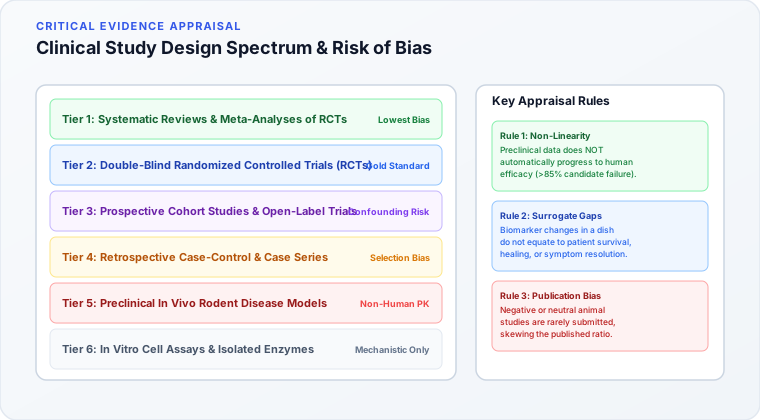
- What is the model system? Is the study conducted in plastic petri dishes (in vitro), laboratory mice (in vivo animal), or living humans? Animal findings cannot be extrapolated to clinical human outcomes.
- Is there a control group? Did the control cohort receive an identical placebo, an active comparator, or no intervention at all?
- Was there blinding? Who was blinded, patients, evaluators, or both?
- What was the sample size (n)? Was a formal statistical power calculation conducted beforehand?
- What was the source of the peptide? Was the peptide pharmaceutical-grade with verified HPLC purity, or an uncharacterized research batch? [3]
4. Interpreting Results: Absolute vs Relative Measures
Pharmaceutical claims frequently use relative risk metrics to exaggerate modest real-world improvements [4].
For example, if an adverse event occurs in 2 out of 100 control patients (2%) and 1 out of 100 peptide-treated patients (1%):
- Relative Risk Reduction (RRR): (2% - 1%) / 2% = 50% reduction (headline claim).
- Absolute Risk Reduction (ARR): 2% - 1% = 1% reduction (real-world clinical difference).
- Number Needed to Treat (NNT): 1 / 0.01 = 100 patients must be treated for one person to benefit.
Always seek the absolute risk difference and baseline numbers before accepting therapeutic claims [4].
5. Conflicts of Interest & Predatory Publishing Red Flags
Scientific integrity requires verifying the credibility of the research authors and publishing journal. A Cochrane review found that industry-sponsored drug and device studies more often reported favorable efficacy results and favorable conclusions than studies with other sources of sponsorship [5]:
- Funding & Financial Disclosures: Check the funding statement at the end of the paper. Did commercial peptide vendors or patent holders fund the trial or participate in data analysis?
- Publication status: A DOI or database listing is not a peer-review certificate. Check the publisher, article type, review policy and linked notices. Use our peer-review verification workflow.
Core Scientific Definitions
Precise biomedical definitions for terms used throughout this guide.
- IMRAD
- The standard organizational structure of scientific research articles: Introduction, Methods, Results, And Discussion.
- Predatory Journal
- An exploitative publishing outlet that charges authors fees without providing legitimate peer review or editorial quality checks.
- Relative Risk Reduction (RRR)
- The proportional reduction in risk between treatment and control groups, which often magnifies tiny absolute clinical benefits.
Peer-Reviewed References & Primary Sources
This educational guide is built strictly upon peer-reviewed literature, official regulatory guidance, and authoritative biochemical repositories.
-
Reporting and interpretation of randomized controlled trials with statistically nonsignificant results for primary outcomes JAMA · 2010
-
Helping doctors and patients make sense of health statistics Psychol Sci Public Interest · 2007
Educational Disclaimer: This guide is produced strictly for biomedical educational purposes and does not constitute medical advice, diagnosis, or treatment recommendations. Experimental peptides discussed herein may lack regulatory authorization for human clinical use. Consult a licensed medical practitioner before considering any therapeutic intervention.