
1. The Biochemical Continuum
In life sciences, molecules made of amino acids are described with different terms: oligopeptides, polypeptides, and proteins. Lay discussions often treat peptides and proteins as completely separate classes of matter, but from a strictly chemical perspective, they exist along a continuous spectrum [1].
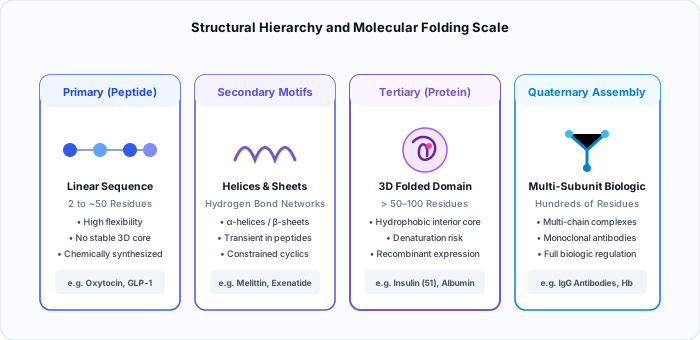
Both classes are linear polymers built from amino acid residues joined by identical covalent amide bonds. The fundamental difference lies in length, thermodynamic folding behavior, and conformational flexibility. Where a short peptide functions like an agile chemical key sampling dynamic structural shapes, a protein functions like an intricate, folded molecular machine whose biological function depends strictly on maintaining a precise three-dimensional architecture [2].
2. Size Thresholds: The 50 Amino Acid Convention
Biochemists have historically relied on a rule of thumb based on chain length:
- Peptides: Polymers containing between 2 and approximately 50 amino acid residues, corresponding to a molecular weight generally below 5,000 Daltons (5 kDa) [1].
- Proteins: Polymers containing more than 50 amino acids, extending to thousands of residues (e.g., titin, the largest human protein, contains over 34,000 amino acids) [3].
However, this 50-residue cutoff is an arbitrary convention. Some 40-residue peptides can form stable alpha-helical bundles, while some 70-residue polypeptides remain intrinsically disordered without a defined 3D fold. Consequently, modern structural biology evaluates folding state and thermodynamic cooperativity rather than chain length alone [2].
3. Regulatory Boundaries: FDA 40 vs 100 Rule
While biochemists debate structural nuance, pharmaceutical regulatory agencies must establish strict legal boundaries. In the United States, the Food and Drug Administration (FDA) implemented formal statutory definitions under the Biologics Price Competition and Innovation Act (BPCI Act) [4]:
- Peptide (Small Molecule Drug Pathway): Any polymer composed of 40 or fewer amino acids. These compounds are regulated as small-molecule drugs under section 505 of the Federal Food, Drug, and Cosmetic Act (FD&C Act).
- Intermediate Polypeptide (41 to 100 amino acids): Polymers composed of 41 to 100 amino acids are evaluated on a case-by-case basis; if produced synthetically, they are generally reviewed as drugs unless they meet specific biological criteria.
- Protein / Biological Product (>100 amino acids): Any alpha-amino acid polymer with a specific, defined sequence that is greater than 100 amino acids in length is legally classified as a "protein" and regulated as a biological product under section 351 of the Public Health Service Act (PHS Act) [4].
This statutory distinction governs whether a compound follows a New Drug Application (NDA) pathway or a Biologics License Application (BLA), dictating generic vs biosimilar competition frameworks.
4. 3D Folding & Structural Complexity
The core structural distinction between peptides and proteins centers on tertiary structure [3]:
Peptides: Conformational Flexibility
Because short peptide chains possess relatively few internal contacts, they generally do not have enough intramolecular hydrophobic burial to overcome the entropic penalty of folding. Instead, in aqueous solution, an unmodified peptide exists as an ensemble of interconverting conformations. When the peptide encounters its specific receptor, it undergoes induced fit, adopting an active conformation dictated by the binding pocket [2].
Proteins: Rigid Thermodynamic Cores
Long protein chains fold cooperatively into unique, stable three-dimensional architectures. Hydrophobic amino acid side chains collapse into an internal core shielded from water, while hydrophilic residues interact with the solvent. This folded state is held together by hydrogen bonds, ionic salt bridges, and covalent disulfide bonds. If exposed to elevated temperatures, extreme pH, or organic solvents, the protein undergoes denaturation, unfolding into a disorganized state that permanently destroys its biological function [3].
5. Chemical Synthesis vs Recombinant Expression
The size difference between peptides and proteins fundamentally dictates how they are manufactured at commercial pharmaceutical scale [5]:
Peptide Synthesis: Chemical SPPS
Peptides containing up to 40–50 amino acids are typically manufactured using purely chemical methods, specifically automated Solid-Phase Peptide Synthesis (SPPS). Starting from the C-terminus attached to a polymer resin bead, amino acid derivatives with temporary protecting groups (Fmoc or Boc) are coupled sequentially. This allows precise chemical customization, including the insertion of unnatural amino acids, D-stereoisomers, backbone N-methylation, and fatty acid conjugation [5].
Protein Manufacturing: Recombinant Expression
Proteins containing hundreds of residues cannot be manufactured cleanly through chemical step-by-step synthesis because cumulative step yields decline exponentially. Instead, therapeutic proteins are manufactured using recombinant DNA technology in living cell factories, such as Escherichia coli bacteria, yeast (Pichia pastoris), or Chinese Hamster Ovary (CHO) mammalian cell cultures. The host cells translate synthetic gene constructs, fold the protein, and perform complex post-translational modifications such as glycosylation [2].
6. Immunogenicity & Pharmacokinetics
The human immune system recognizes foreign macromolecules through specialized antigen-presenting cells (APCs). This creates profound differences in therapeutic safety and clearance between peptides and proteins [2]:
- Immunogenicity Risk: Small peptides (under 30–40 residues) are generally too small to cross-link B-cell receptors or efficiently present complex conformational epitopes. As a result, synthetic peptides exhibit a significantly lower rate of anti-drug antibody (ADA) formation. Large recombinant proteins (especially monoclonal antibodies and fusion proteins) present extensive surface epitopes and are inherently more immunogenic [5].
- Metabolic Elimination: Peptides are cleared primarily through rapid hydrolysis by ubiquitous cell-surface peptidases and renal glomerular filtration. Large proteins (above the ~50 kDa renal filtration cutoff) are eliminated via pinocytosis, endosomal trafficking, and target-mediated drug disposition (TMDD) [2].
7. Head-to-Head Comparison Table
| Feature | Peptides | Proteins |
|---|---|---|
| Chain Length | Typically 2 to ~50 amino acids | Generally >50 to thousands of amino acids |
| Molecular Weight | < 5,000 Daltons (<5 kDa) | > 5,000 to >150,000 Daltons (>5 to >150 kDa) |
| 3D Structural Folding | High conformational flexibility; rarely a permanent hydrophobic core | Cooperative, defined tertiary & quaternary 3D architectures |
| Denaturation Risk | Low (few tertiary contacts to disrupt) | High (sensitive to heat, agitation, and extreme pH) |
| Manufacturing Method | Chemical Solid-Phase Synthesis (SPPS) | Recombinant DNA in living cell cultures (CHO, E. coli) |
| Regulatory Pathway (FDA) | FD&C Act / Small Molecule Drug (≤40 aa) | PHS Act Section 351 / Biologics License (>100 aa) |
| Intrinsic Immunogenicity | Generally low | Moderate to high (anti-drug antibody risk) |
| Representative Examples | Oxytocin (9 aa), GLP-1 (30 aa), Tirzepatide (39 aa) | Human Albumin (585 aa), IgG Antibodies (~1,300 aa) |
8. Boundary Case Studies: Oxytocin to Antibodies
To ground these scientific distinctions in real-world pharmacology, consider how different therapeutic agents occupy this continuum:
Oxytocin (9 amino acids, 1,007 Da): A classic oligopeptide hormone synthesized chemically. It possesses a single intramembrane disulfide bridge forming a 6-amino acid ring and a 3-amino acid tail. It has no tertiary structure, is cleared within 3–5 minutes by peptidases, and is non-immunogenic [1].
Semaglutide (31 amino acids, 4,113 Da): A synthetic polypeptide analogue of GLP-1. While linear, it features a chemically conjugated C18 diacid fatty chain that binds circulating human serum albumin. This reversible protein hitchhiking shields the peptide from DPP-4 cleavage, extending half-life to approximately 165 hours [5].
Human Insulin (51 amino acids, 5,808 Da): The quintessential boundary molecule. Composed of two peptide chains linked by disulfide bonds, insulin forms a stable, compact globular fold. While small enough to be studied as a polypeptide, it is regulated as a biological product [4].
Pembrolizumab (IgG4 Monoclonal Antibody, ~1,300 amino acids, ~149,000 Da): A classic large biologic protein composed of four separate polypeptide chains linked by 16 disulfide bonds with complex asparagine-linked glycosylation. It requires mammalian bioreactor production and cold-chain storage [2].
Core Scientific Definitions
Precise biomedical definitions for terms used throughout this guide.
- Primary Structure
- The specific linear sequence of amino acid residues joined by covalent peptide bonds from the N-terminus to the C-terminus.
- Tertiary Structure
- The overall three-dimensional geometric configuration of a single polypeptide chain, stabilized by hydrophobic interactions, hydrogen bonds, salt bridges, and disulfide linkages.
- Denaturation
- The unfolding or disruption of a protein’s native three-dimensional tertiary structure due to heat, pH changes, or solvents, leading to loss of biological function.
- Biological Product (Biologic)
- A complex pharmaceutical product manufactured in or derived from a living biological system (such as recombinant cell cultures), regulated under section 351 of the PHS Act.
- Immunogenicity
- The propensity of a therapeutic molecule to stimulate an unwanted immune response in the host, such as the generation of neutralizing anti-drug antibodies (ADAs).
Peer-Reviewed References & Primary Sources
This educational guide is built strictly upon peer-reviewed literature, official regulatory guidance, and authoritative biochemical repositories.
-
IUPAC Compendium of Chemical Terminology (Gold Book) - Peptides & Proteins International Union of Pure and Applied Chemistry · 2019
-
The Future of Peptide-based Drugs Chemical Biology & Drug Design · 2013 · 81(1): 136–147
-
Lehninger Principles of Biochemistry (8th Edition) Macmillan Learning · 2021 · Chapter 4: The Three-Dimensional Structure of Proteins
-
Definition of the Term "Biological Product" (Final Rule / Guidance for Industry) U.S. Food and Drug Administration (FDA) CDER · 2020 · 21 CFR Part 600 / Federal Register 85 FR 10057
-
Peptide therapeutics: current status and future directions Drug Discovery Today · 2015 · 20(1): 122–128
Educational Disclaimer: This guide is produced strictly for biomedical educational purposes and does not constitute medical advice, diagnosis, or treatment recommendations. Experimental peptides discussed herein may lack regulatory authorization for human clinical use. Consult a licensed medical practitioner before considering any therapeutic intervention.