
Evidence-Based Summary
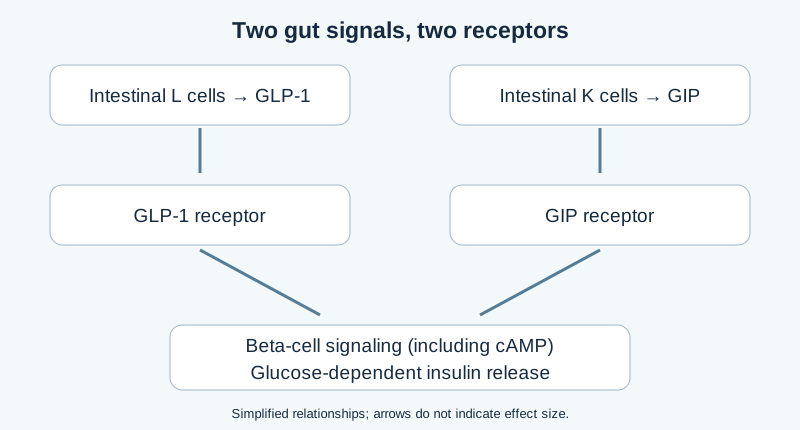
Both GLP-1 and GIP are incretins: gut signals that help increase insulin release after food when glucose is elevated. GLP-1 generally suppresses glucagon at elevated glucose and slows stomach emptying; GIP can stimulate glucagon when glucose is normal or low. Each activates its own receptor. Neither pathway alone predicts the outcome of a medicine that activates one or both receptors.
Quick Comparison: GLP-1 vs GIP
A high-level comparison of molecule class, molecular receptor targets, FDA regulatory approvals, and verified clinical programs.
| Feature | GLP-1 | GIP |
|---|---|---|
| Name | Glucagon-like peptide-1 | Glucose-dependent insulinotropic polypeptide |
| Main gut cell source | L cells distributed through the intestine, enriched distally | K cells, particularly in the upper small intestine |
| Receiver on cells | GLP-1 receptor (GLP-1R) | GIP receptor (GIPR) |
| Insulin | Supports glucose-dependent insulin release | Supports glucose-dependent insulin release |
| Glucagon | Usually suppresses secretion at elevated glucose | Can stimulate secretion at normal or low glucose; context matters |
| Stomach emptying | Slows gastric emptying; the effect depends on exposure and context | Does not have the same established gastric-emptying effect |
| Native hormone versus medicine | Short-lived hormone; engineered agonists have different exposure | Short-lived hormone; dual agonists are not simply native GIP |
Pancreatic Synergy vs Extrapancreatic Divergence
A GPCR (G protein-coupled receptor) is a cell-surface receiver that passes a message into the cell. GLP-1R and GIPR are distinct GPCRs. In pancreatic beta cells, signaling increases cAMP, an internal messenger that helps amplify insulin release when glucose is available.
GLP-1 pathway
Primary Target: GLP-1R
Affinity Profile: A receptor distinct from GIPR
Food-associated GLP-1 signaling helps beta cells release insulin. Effects on glucagon and gastric emptying also influence the glucose response. The pathway involves multiple tissues and is not reduced to a single direct alpha-cell action.
GIP pathway
Primary Targets: GIPR
Affinity Profile: GIPR means the GIP receptor, rather than a second name for GLP-1R
GIP signaling helps beta cells release insulin and can affect glucagon depending on blood glucose. Adipose and brain effects remain active research areas; a simple “fat-storage hormone” label does not describe all drug outcomes.
Endogenous Biomolecules and Therapeutic Translation
These are native hormones. U.S. approval applies to specific engineered medicines and formulations, not a blanket approval of all GLP-1 or GIP products. Checked 10 October 2026.
GLP-1 Status & Formulations
Semaglutide is an engineered GLP-1 receptor agonist with product-specific FDA indications; it is not the short-lived native hormone.
GIP Status & Formulations
Tirzepatide is an engineered dual GIP/GLP-1 receptor agonist with product-specific FDA indications; a dual-medicine outcome does not measure the independent contribution of native GIP.
Critical Regulatory Distinction
Read the semaglutide and tirzepatide profiles for current U.S. labels. Physiology findings, medicine trials and regulatory authorization answer separate questions.
Decades of Incretin Clamp Studies
The incretin effect compares an oral glucose challenge with intravenous glucose adjusted to match the blood-glucose response, rather than identical amounts given by two routes.
GLP-1: The Incretin Effect
Gasbjerg et al. (2019) studied 18 healthy men in a randomized, double-blind crossover experiment. On separate days they received receptor blockers for GIP, GLP-1, both, or saline during oral glucose tests. Blocking both impaired glucose tolerance more than blocking either alone.
GIP: Differential Response in Diabetes
This short physiology experiment supports contributions from both endogenous signals. It does not establish chronic weight outcomes or a treatment recommendation. Healthy men in a tightly controlled test are not representative of all people with type 2 diabetes.
Endogenous Clearance & Regulation
DPP-4 is an enzyme that rapidly inactivates native incretin hormones. Engineered medicines resist breakdown or extend exposure, so their pharmacokinetics (how the body absorbs and clears them) differ.
| Safety Consideration | GLP-1 | GIP |
|---|---|---|
| Native exposure | Short-lived signaling after food | Short-lived signaling after food |
| Medicine safety | Requires product-specific trial and label evidence | Requires product-specific trial and label evidence; dual-target trial effects cannot be assigned to GIP alone |
What GLP-1 and GIP Have in Common
Where the two compounds overlap in biology, evidence or regulatory context.
Both support glucose-dependent insulin release
Their signals help coordinate the response to nutrients.
Each has a distinct receptor
Related signaling systems are not identical receptors or interchangeable compounds.
Key Scientific & Clinical Differences
Meaningful distinctions in mechanism, strength of evidence, safety and regulatory status.
Glucagon context
GIP and GLP-1 differ in their effects at different glucose levels.
Gastric emptying
GLP-1 has a well-established slowing effect; GIP does not have the same physiological profile.
Scientific Comparison vs Clinical Recommendations
Inside Peptides compares scientific evidence, receptor pharmacology, and official regulatory documents to advance public and professional understanding. We do not determine which compound is appropriate for an individual patient, rank medications with arbitrary scores, or recommend initiating or switching treatments.
Decisions about any medicine require a licensed healthcare professional who can weigh personal medical history, contraindications, interactions and monitoring needs. Unapproved peptides have no established safe use, and products sold as “research chemicals” are not the preparations studied in clinical research.
Approved Uses vs Online Claims
A critical scientific distinction between verified, FDA-approved clinical uses and unverified claims circulating on social media and vendor platforms.
GIP only stores fat, so a GIP-targeting medicine cannot reduce weight
OversimplifiedNative hormones and pharmaceutical agonists require separate evaluation.
Tissue-specific physiology does not determine the net outcome of an engineered dual agonist. Tirzepatide weight trials test the whole medicine, not isolated GIP effects.
Evidence Strength Across Clinical Domains
Inside Peptides evaluates scientific certainty at the claim level. Because clinical evidence varies significantly depending on the therapeutic endpoint evaluated, each domain is assessed independently.
Contribution to insulin release in healthy humans
Controlled physiology experiments support both pathways, with context-dependent contributions.
Relative contribution to dual-agonist weight loss
Whole-medicine trials do not isolate each target’s contribution.
What Research Still Doesn’t Tell Us
Identifying open scientific questions, pending active-comparator trials, and areas where long-term clinical data remain incomplete.
Native signaling versus prolonged drug exposure
Duration, tissue distribution and receptor pharmacology differ; do not equate a meal-time hormone response with chronic medicine effects.
Different populations
Diabetes, glucose level and experimental conditions can change incretin responses.
Related Compound Profiles
Individual profiles provide full molecular datasheets, CAS numbers, preclinical histories, and compound monographs.
Related Educational Resources
Scientific & Regulatory References
Every pharmacological mechanism, clinical trial result, and regulatory approval cited on this page is traceable to official FDA prescribing documentation, ClinicalTrials.gov registries, or peer-reviewed medical publications.
-
Original randomized crossover physiology study
Separate and Combined Glucometabolic Effects of Endogenous GIP and GLP-1 in Healthy Individuals18 healthy men; short-term receptor-antagonist experiment, not a weight-management trial.
-
Foundational physiology review
The incretin system in healthy humans: The role of GIP and GLP-1
-
Original active-comparator medicine trial
Tirzepatide as Compared with Semaglutide for the Treatment of ObesityDifferent question from native-hormone physiology.