
Zepbound vs Wegovy HD: What Lilly’s New Comparison Does and Doesn’t Show
Is Zepbound better than the new higher-dose Wegovy HD? What Lilly’s indirect comparison, SURMOUNT-5 and STEP UP show, and what is still unknown.

Key takeaways
- Zepbound (tirzepatide) beat standard-dose Wegovy in the head-to-head SURMOUNT-5 trial, but no randomised trial has compared it with Wegovy HD, the higher semaglutide dose FDA approved in March 2026.
- Lilly’s indirect, Lilly-funded comparison estimated 3.2 to 4.5 percentage points more weight loss with Zepbound when everyone who started was counted, but the gap shrank to a range that included zero when estimated as if everyone stayed on treatment.
- A 2026 meta-analysis found more serious adverse events with tirzepatide, based on three trials, the largest in people with type 2 diabetes, and none including Wegovy HD, so whether one product is safer than the other is unknown.
In this article
Zepbound has beaten standard Wegovy in a head-to-head trial. Whether it beats the new higher-dose Wegovy HD has not been tested that way. The only comparison so far is an indirect, Lilly-funded analysis, and the size of the advantage it reports depends heavily on how people who stopped treatment are counted. As of 31 October 2026, no randomised trial has put Zepbound against Wegovy HD, and Lilly's analysis has not been published as a peer-reviewed paper.123
FDA approved Wegovy HD, a higher-dose version of Novo Nordisk's semaglutide injection, on 19 March 2026.1 On 29 September 2026, at the European Association for the Study of Diabetes meeting in Milan, Eli Lilly announced that Zepbound (tirzepatide) "was associated with more weight loss than Wegovy HD" in an indirect treatment comparison.23 This article is about that product question: what Wegovy HD adds, what Lilly's numbers do and do not show, and what is still unknown. For the broader comparison of the two medicines, including diabetes, heart and kidney trials, see our semaglutide vs tirzepatide page. Nothing here is medical advice, and we give no dosing information.
What Wegovy HD is
Wegovy HD is not a new drug. It is the same molecule as Wegovy and Ozempic, semaglutide, at a higher weekly dose, sold in its own single-dose pen.4 FDA approved it 54 days after filing, the fourth approval under the agency's Commissioner's National Priority Voucher pilot, which shortens reviews for products the agency considers national priorities.1
The label does not treat it as a starting point. It describes the higher dose as an optional step for adults who already tolerate the standard top Wegovy dose and need more weight loss.4 Novo Nordisk's self-pay page lists the Wegovy HD pen at $399 a month (checked 31 October 2026); what an insured patient pays depends on the plan.5
The approval rests mainly on STEP UP, a Novo Nordisk-funded, double-blind trial of 1,407 adults with obesity and no diabetes, followed for 72 weeks.6 Counting everyone randomised, including people who stopped treatment, average weight loss was:
- 18.7% with Wegovy HD
- 15.6% with standard-dose Wegovy
- 3.9% with placebo
The extra loss from the higher dose was 3.1 percentage points (95% CI 1.6 to 4.7).6 Novo's headline figure of 20.7% comes from a different analysis that estimates the effect if everyone had stayed on treatment.7 Both numbers are legitimate; they answer different questions, which matters again below.
The higher dose had costs. Gastrointestinal side effects were reported by 70.8% of people on Wegovy HD, 61.2% on standard Wegovy and 42.8% on placebo. Dysesthesia, an altered or painful skin sensation, affected 22.9%, 6.0% and 0.5%.6 The label adds that among people who had this skin reaction on the higher dose, 18% did not report recovering during the trial.4 FDA said it is "currently conducting further investigations regarding this drug reaction."1
What Lilly's comparison reported
Lilly took the results of SURMOUNT-1, its placebo-controlled tirzepatide trial in adults without diabetes, and STEP UP, Novo's Wegovy HD trial.28 Both lasted 72 weeks. The analysis adjusted for four characteristics measured in both trials: sex, age, starting weight and HbA1c, a measure of blood sugar.39 It compared Wegovy HD with the top Zepbound dose and with the middle dose tested in SURMOUNT-1. Results came with 95% credible intervals, the range in which the true difference probably lies. The lead investigator was John Wilding of the University of Liverpool, and the analysis was funded by Lilly.3
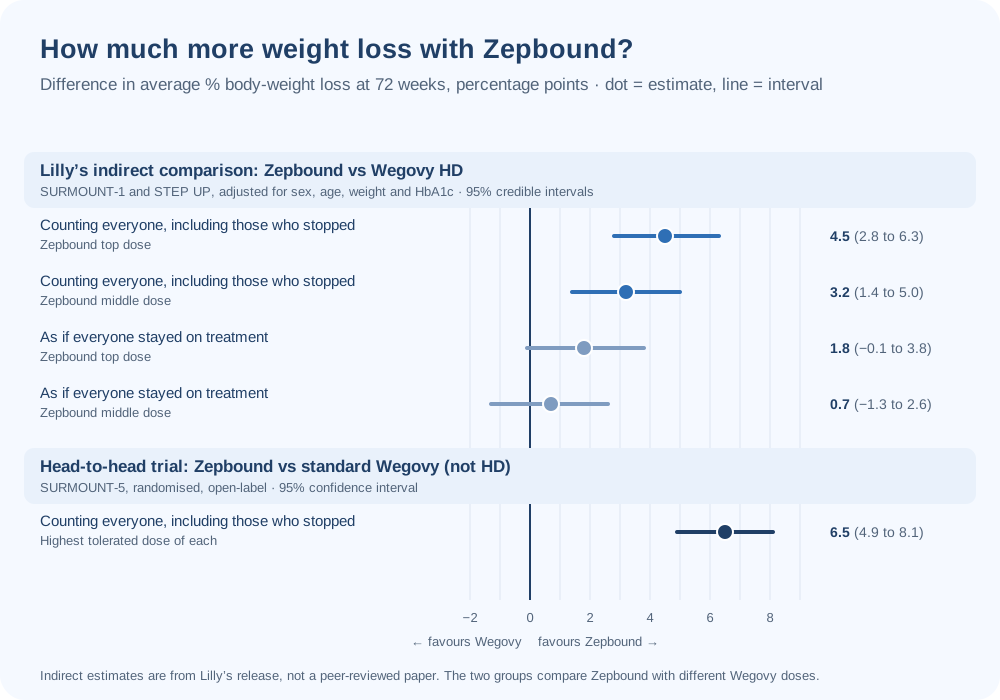
The headline results, counting everyone who started treatment:
- Top Zepbound dose: 4.5 percentage points more weight loss than Wegovy HD (credible interval 2.8 to 6.3).
- Middle dose: 3.2 points more (1.4 to 5.0).
Estimated as if everyone had stayed on treatment, the gaps shrank:
- Top dose: 1.8 points more (−0.1 to 3.8).
- Middle dose: 0.7 points more (−1.3 to 2.6).
Both of those intervals include zero, so on that analysis the comparison cannot rule out no difference at all.39 The top dose also had higher odds of reaching 20% weight loss under both approaches, with very wide intervals (for example, an odds ratio of 3.54, credible interval 1.05 to 11.05); the middle dose did not reach statistical significance.39 Lilly said discontinuation because of side effects was comparable but, according to trade-press reports of the release, gave no figures.3
Both men framed it as a suggestion rather than proof. Thomas Seck, a Lilly medical executive, said the comparison "suggests the same doses of Zepbound may outperform Wegovy HD, as well." Wilding said that without a head-to-head trial, it "offers useful evidence for physicians as they make treatment decisions."9
Why the way dropouts are counted changes the answer
Every weight-loss trial loses people: some stop because of side effects, cost or other reasons. Researchers then have to decide what question they are answering.
- "Counting everyone" (the treatment-regimen or treatment-policy approach) asks what happens to people who are offered the drug, including those who stop. It is closer to real life.
- "As if everyone stayed on treatment" (the efficacy or trial-product approach) asks what the drug does when taken as intended. It flatters every drug, because it models away the people who quit.
In Lilly's analysis, most of Zepbound's advantage over Wegovy HD sits in the first approach and fades in the second. Our reading, which Lilly's release did not address according to Pharmacy Times, is that much of the headline gap may reflect differences in who stopped treatment, or how each trial handled missing data, rather than a large difference in what the two medicines do in people who keep taking them.3 That could still matter to a patient: a drug people stay on is worth more than one they abandon. But it is not the same as "Zepbound works much better."
Why an indirect comparison is weaker evidence
In a randomised controlled trial, chance decides who gets which drug, so the two groups are alike in everything, including traits nobody measured. Any difference at the end can be put down to the drugs.
An indirect comparison has no such protection. The people in SURMOUNT-1 and STEP UP were never randomised against each other. They were recruited at different times, at different sites, under different rules. SURMOUNT-1 accepted a body mass index (BMI) of 27 or more with a weight-related condition; STEP UP required a BMI of at least 30.68 Statistical adjustment can balance the four characteristics Lilly chose, but not differences in diet and exercise support, how dropouts happened, or the many traits that were not adjusted for. Even the placebo groups behaved differently: placebo patients lost 3.1% in SURMOUNT-1 and 3.9% in STEP UP.68
Then there is who did the analysis. Lilly makes Zepbound, chose the method and the outcomes, and announced the results by press release before any peer-reviewed paper. That does not make the numbers wrong. Indirect comparisons are a standard tool, and regulators and health-technology assessors use them when no direct trial exists. A Novo Nordisk-funded analysis would deserve exactly the same caution. But when the sponsor sells one of the products, the analysis is best read as a hypothesis, which is how Pharmacy Times described it.3 Our explainer on statistical vs clinical significance covers why a few percentage points may or may not matter to an individual.
What the head-to-head trial does show
SURMOUNT-5 is the direct evidence. It randomised 751 adults with obesity and no diabetes to Zepbound or Wegovy, each at the highest dose the person could tolerate, for 72 weeks. Average weight loss was 20.2% with Zepbound and 13.7% with Wegovy, a difference of 6.5 percentage points (95% CI 4.9 to 8.1).1011 By the end, 71.7% of people on Zepbound and 45.0% on Wegovy had lost at least 15% of their body weight.11
SURMOUNT-5 has limits of its own. It was open-label, so participants knew what they were taking, and it was funded by Lilly.10 Most importantly for this question, Wegovy HD was not part of it: the Wegovy group could only reach the standard top dose.310
A rough cross-check, and it is only that: STEP UP found the higher dose adds about 3 points over standard Wegovy, and SURMOUNT-5 found Zepbound ahead of standard Wegovy by about 6.5 points.610 If both held up in the same people, a remaining gap of roughly 3 points would not be surprising, in line with Lilly's "counting everyone" estimates. But this stitches two different trials together too, so it is no stronger than Lilly's analysis.
The safety question
A meta-analysis in the October 2026 issue of Clinical Obesity was reported by Medscape under the headline "Tirzepatide Beats Semaglutide for Weight Loss, but Loses on Safety." It pooled 10 studies of 41,381 adults: 3 randomised trials and 7 retrospective cohort studies.12 Tirzepatide produced 4.28 percentage points more weight loss on average. Serious adverse events were more common with tirzepatide: 5.7% against 2.9%, a risk ratio of 1.83 (95% CI 1.18 to 2.85). Overall side effects, gastrointestinal side effects and stopping because of side effects did not differ significantly.12
Three points put that result in context:
- It rests on three trials. The authors acknowledge this, and they did not grade the certainty of the evidence.12
- The largest trial behind it was in people with type 2 diabetes. The paper does not name the studies behind the safety result, but its totals match the three randomised trials, the largest of which was SURPASS-2, in adults with diabetes, comparing tirzepatide with a lower semaglutide dose than Wegovy uses. There, serious adverse events affected 5.3% to 7.0% across the tirzepatide groups and 2.8% with semaglutide.1213 In SURMOUNT-5, in people without diabetes, the figures were 4.8% and 3.5%.11 That attribution is our arithmetic, not the authors' statement.
- None of the studies included Wegovy HD.12 Wegovy HD's own trial showed more side effects than standard Wegovy, notably the skin-sensation reaction, but serious adverse events were not higher than with the standard dose (6.8% against 10.9%; 5.5% with placebo).6
So the meta-analysis raises a question worth following in larger trials, but it does not show that Zepbound is less safe than Wegovy HD. That comparison has no data at all.
What real-world data add
Studies of health records point the same way as the trials. The largest US study, of 18,386 matched adults with overweight or obesity, found that people starting tirzepatide lost more weight than those starting semaglutide: 2.4 percentage points more at three months, 4.3 at six months and 6.9 at a year.14 But about half had type 2 diabetes, the semaglutide group included diabetes-labelled products such as Ozempic, and, as in all observational studies, people who are prescribed one drug may differ from those prescribed the other.14 The seven cohort studies in the meta-analysis share those limits.12
None of this covers Wegovy HD. We found no published real-world study of it as of 31 October 2026.
If you are choosing, or already on Wegovy
This is a decision for you and a prescriber, but these are the facts that bear on it:
- The weight-loss evidence still leans towards Zepbound, but against Wegovy HD the likely gap is smaller than the SURMOUNT-5 result, and how much smaller is uncertain.310
- Averages are not predictions. In every trial here, results varied widely from person to person.
- The labels differ in ways that can matter more than a few points. Wegovy is approved to reduce the risk of heart attack, stroke and cardiovascular death in adults with established heart disease and obesity or overweight, based on the SELECT trial, which tested the standard dose.415 Zepbound is approved for moderate to severe obstructive sleep apnoea in adults with obesity.16 Lilly's tirzepatide heart-outcomes trial in obesity, SURMOUNT-MMO, is expected to finish in October 2027.17
- Side effects differ. The skin-sensation reaction is far more common with Wegovy HD than with standard Wegovy.46
- Self-pay prices, checked 31 October 2026: Novo lists $399 a month for Wegovy HD; Lilly lists $449 a month for the higher Zepbound vial doses if refilled within 45 days, and $699 otherwise.518 Insurance coverage varies by plan.
- No trial has tested switching between Wegovy HD and Zepbound. Combining semaglutide with another drug of the same class is not recommended on the Wegovy label.4
If you are thinking about stopping either medicine, our guide to weight regain after stopping semaglutide or tirzepatide covers what the trials found.
What would settle it
- A randomised head-to-head trial of Zepbound against Wegovy HD. We found none registered on ClinicalTrials.gov when we searched on 31 October 2026.
- A peer-reviewed paper of Lilly's indirect comparison, with the full methods, the discontinuation figures and an explanation of why the two approaches disagree.
- Longer follow-up of Wegovy HD, especially of the skin-sensation reaction FDA is investigating.1
- Heart-outcome results for tirzepatide in obesity from SURMOUNT-MMO.17
We will update this article if any of these appear.
How we reviewed this article
Sources
InsidePeptides relies on primary sources: peer-reviewed studies, trial registries and regulators’ own documents. Read our editorial policy.
- FDA. FDA Approves Fourth Product Under National Priority Voucher Program, Higher Dose Semaglutide. Press announcement, 19 March 2026.
- Eli Lilly and Company. Lilly's Zepbound (tirzepatide 10 mg and 15 mg) was associated with more weight loss than Wegovy HD (semaglutide injection 7.2 mg) in a new indirect treatment comparison. News release, 29 September 2026. Company claim; not peer-reviewed. Also distributed via PR Newswire.
- Pharmacy Times. Tirzepatide Linked to More Weight Loss Than Semaglutide 7.2 mg. 1 October 2026. Reports the Lilly release, its funding and its limitations.
- Novo Nordisk. WEGOVY (semaglutide) injection and tablets: full prescribing information. Revised June 2026. Via Drugs@FDA.
- Novo Nordisk. Price your Wegovy. NovoCare self-pay prices. Checked 31 October 2026.
- Wharton S et al. 2025. Once-weekly semaglutide 7·2 mg in adults with obesity (STEP UP): a randomised, controlled, phase 3b trial00226-8). Lancet Diabetes Endocrinol 13(11):949–963. PMID: 40961952. DOI: 10.1016/S2213-8587(25)00226-8. NCT05646706.
- Novo Nordisk. Wegovy HD (semaglutide 7.2 mg) approved in the US, providing 20.7% mean weight loss. Company announcement No 19/2026, 19 March 2026. Company claim; the 20.7% figure assumes everyone stayed on treatment.
- Jastreboff AM et al. 2022. Tirzepatide Once Weekly for the Treatment of Obesity. N Engl J Med 387(3):205–216. PMID: 35658024. DOI: 10.1056/NEJMoa2206038. NCT04184622.
- Gallagher A. Indirect Comparison Links Tirzepatide to Greater Weight Loss Than Semaglutide. Drug Topics, 3 October 2026. Reports the Lilly release, including quotations and odds ratios.
- Aronne LJ et al. 2025. Tirzepatide as Compared with Semaglutide for the Treatment of Obesity. N Engl J Med 393(1):26–36. PMID: 40353578. DOI: 10.1056/NEJMoa2416394. NCT05822830.
- ClinicalTrials.gov. NCT05822830: A Study of Tirzepatide (LY3298176) in Participants With Obesity or Overweight With Weight Related Comorbidities (SURMOUNT-5). Results record: least-squares mean difference, weight-loss thresholds and serious adverse events. Checked 31 October 2026.
- Paccola GP et al. 2026. Comparative Efficacy of Tirzepatide Versus Semaglutide for Weight Loss in Adults With Overweight or Obesity: A Systematic Review and Meta-Analysis of Head-to-Head Studies. Clin Obes 16(5):e70111. PMID: 42670242. DOI: 10.1111/cob.70111.
- Frías JP et al. 2021. Tirzepatide versus Semaglutide Once Weekly in Patients with Type 2 Diabetes. N Engl J Med 385(6):503–515. PMID: 34170647. DOI: 10.1056/NEJMoa2107519. NCT03987919. Serious adverse event counts from the ClinicalTrials.gov results record.
- Rodriguez PJ et al. 2024. Semaglutide vs Tirzepatide for Weight Loss in Adults With Overweight or Obesity. JAMA Intern Med 184(9):1056–1064. PMID: 38976257. DOI: 10.1001/jamainternmed.2024.2525.
- Lincoff AM et al. 2023. Semaglutide and Cardiovascular Outcomes in Obesity without Diabetes. N Engl J Med 389(24):2221–2232. PMID: 37952131. DOI: 10.1056/NEJMoa2307563. NCT03574597.
- FDA. FDA Approves First Medication for Obstructive Sleep Apnea. Press announcement, 20 December 2024.
- ClinicalTrials.gov. NCT05556512: A Study of Tirzepatide (LY3298176) on the Reduction on Morbidity and Mortality in Adults With Obesity (SURMOUNT-MMO). Active, not recruiting; estimated primary completion October 2027. Checked 31 October 2026.
- Eli Lilly and Company. Zepbound coverage, affordability and savings. Self-pay vial prices, offer effective 23 February 2026. Checked 31 October 2026.
History
Each entry records a dated change to this article’s content. Link and formatting changes are not listed.
Current version
Written by InsidePeptides Editorial Team
Scientific review pending
Last updated
Published


