
Do Peptide Serums Actually Work? What the Skin Studies Show
Do peptide serums work? Matrixyl, Argireline, GHK-Cu and SNAP-8 trials compared: who ran them, what they measured, skin penetration and what works better.

Key takeaways
- Cosmetic peptides such as Matrixyl, Argireline and GHK-Cu have small, short human trials, many run or funded by the companies selling them, with mixed results.
- Most cosmetic peptides are larger than molecules that cross skin easily, and claims that they boost collagen come mainly from cell studies.
- Daily sunscreen and prescription retinoids have far stronger evidence for sun-damaged skin, and we found no study showing that pricier peptide products work better.
In this article
Probably a little, at best. A few cosmetic peptides have small human trials showing modest improvements in fine lines, but most of those trials lasted 12 weeks or less, many were run or paid for by the companies selling the ingredient, and some independent tests found no difference from the same cream without the peptide. A 2026 meta-analysis of randomised trials found only two topical peptide trials, and for wrinkles their effect was "smaller, non-significant".2
That doesn't mean your serum is useless, but it does mean the evidence is far thinner than the marketing, and much thinner than the evidence behind sunscreen and prescription retinoids.67 Below, you can look up the peptide on your label, see why the effects tend to be small, and decide what to do next. We recommend no products and give no dosing information; this is not medical advice.
Look up the peptide on your label
Ingredient lists use chemical names, so the first column gives the label name and the trade name it is sold under. This is the best human evidence we could find for each, from PubMed and journal records checked on 22 October 2026. Company involvement is what each paper discloses.
| On the label | Best human evidence | What it found | Who ran or paid for it |
|---|---|---|---|
| Palmitoyl pentapeptide-4 (Matrixyl) | Randomised, double-blind split-face trial against the same moisturiser without the peptide; 93 women; 12 weeks. A smaller randomised trial in 21 women over 8 weeks38 | Fewer visible fine lines and wrinkles than the control side. In the small trial it "appeared" to do better than Argireline and placebo | Large trial: all authors worked for Procter & Gamble. Small trial: university team, no conflicts declared. The best-studied peptide here, but the large trial has not been repeated at that size by anyone else |
| Acetyl hexapeptide-8 (Argireline) | Placebo-controlled trial in 60 people over 4 weeks; an independent double-blind split-face trial in 19 women over 4 weeks; a four-group trial in 24 people over 60 days9410 | 48.9% rated improved vs 0% on placebo. The split-face trial found no significant difference between the two sides. The four-group trial reported better skin-texture measures | First trial: no company named in the abstract. Split-face: serum supplied by a cosmetics maker, author declared no competing interests. Four-group: academic team |
| Copper tripeptide-1 (GHK-Cu) | Randomised trial after laser resurfacing; 13 completed; 12 weeks. Double-blind split-face trial of a nano-carrier serum; 40 women; 8 weeks1112 | After laser: no objective difference, though patients were more satisfied. Split-face: less wrinkle volume and depth than the plain serum | Post-laser: funding not stated in the abstract. Split-face: funded by the serum's maker, in a journal not indexed in PubMed. A 2026 systematic review counted only two randomised trials13 |
| Acetyl octapeptide-3 (SNAP-8) | No randomised trial of SNAP-8 on its own. Closest: a microneedle patch with SNAP-8 and two other actives vs a plain patch; 24 adults; 28 days14 | Better than the plain patch on eye-area wrinkles and elasticity. Says nothing about SNAP-8 in an ordinary serum | Four of five authors listed with the patch maker |
| Palmitoyl tripeptide-1 with palmitoyl tetrapeptide-7 (Matrixyl 3000) | No randomised trial of the blend alone in PubMed. Closest: a serum with these peptides plus a retinol ester and plant extracts vs its base cream; 60 people; 6 months15 | Wrinkles not significantly better than the base cream at 6 months; more fibrillin-1, an elastic-fibre protein, in skin biopsies | Funded by the retailer; one author was its employee |
| Palmitoyl tripeptide-38 | No randomised trial. Closest: open-label study with no control group; 35 women; 8 weeks16 | Skin roughness fell by 8% to 9%, but the serum also contained vitamins C and E | Authors were consultants for the brand |
Two reviews of the wider literature reach the same conclusion. A 2019 systematic review of collagen-stimulating cosmetic peptides found 15 studies, only six with a placebo and five double-blind; it called the evidence "sparse" and said most studies "were non-double-blind and used no placebo control".1 The 2026 meta-analysis found 17 randomised trials of oral peptides but only two of topical ones.2
If your serum is sold as a "Botox-like" Argireline product, our separate piece on whether Argireline can replace Botox looks at that claim in detail. For copper peptides, see our GHK-Cu explainer.
Why the effects are small
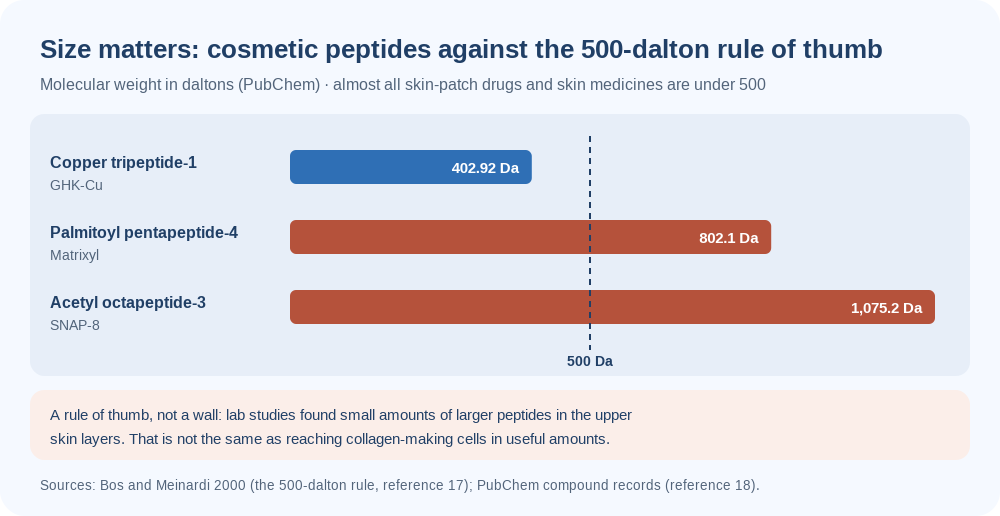
Most of the peptide never gets in. In 2000, dermatologists Jan Bos and Marcus Meinardi argued that a compound generally needs a molecular weight under 500 daltons to be absorbed through skin, because almost all common contact allergens, topical skin medicines and drugs used in skin patches are below that size.17 It is a rule of thumb, not a wall (our explainer on topical peptides and the skin barrier covers its limits), but by PubChem's figures palmitoyl pentapeptide-4 weighs about 802 daltons and acetyl octapeptide-3 about 1,075. The copper complex of GHK is smaller, at about 403.18
Direct measurements bear this out. When FDA scientists applied an Argireline cream to human skin in the laboratory, most of it washed off: 0.22% of the applied amount was found in the outer layer, about 0.01% in the epidermis and none in the dermis.19 In mouse skin, unmodified Matrixyl peptide was not found in any skin layer; the fatty-acid-linked version used in cosmetics reached all layers in small amounts, and both broke down quickly.20 In three volunteers, the two Matrixyl 3000 peptides were found throughout the outer layer, apparently around the cells rather than inside them; two of that study's authors worked for a skin-care company.21 Reaching the upper layers is not the same as reaching the cells that make collagen in amounts large enough to change how skin looks.
"Boosts collagen" usually means cells in a dish. Matrixyl's story starts with a 1993 laboratory study in which a five-amino-acid fragment of collagen's precursor stimulated collagen and fibronectin production in cultured cells.22 The GHK-Cu split-face paper also reported more collagen and elastin, but from human skin cells grown in dishes.12 These in vitro results show a peptide can signal to cells it touches directly, not that a serum reaches them through intact skin; our guide to human versus preclinical research explains why such results often fail to carry over. The human trials mostly measured the surface: photographs, silicone replicas, 3D wrinkle scans. The only trial that took biopsies over months tested a product that also contained a retinoid ester, and it measured fibrillin-1, not collagen.15
The trials looked at fine lines, not folds. They measured fine lines, crow's feet, eye-area roughness or a single wrinkle's depth and volume.3912 We found no peptide trial designed to test deep, set-in folds. The American Academy of Dermatology (AAD) puts it plainly: anti-ageing products "deliver modest results. You cannot get the results of a facelift from a cream."5
Headline numbers can flatter. A review of double-blind, placebo-controlled trials of topical treatments for photoaged skin found reporting "spin" in all 20 trials it examined, most often several primary outcomes and comparisons within a group instead of against the control.23 When a product claims a percentage improvement, the question is whether the peptide side beat the control side. In the GHK-Cu split-face trial, wrinkles also fell on the side using the plain serum.12 Our guide to statistical vs clinical significance explains the difference.
Does paying more get you a better peptide?
We found no study comparing price with effect, and the AAD says "effective anti-aging products come in all price ranges".5 Nor is the serum you bought necessarily the formulation that was tested: the positive GHK-Cu split-face trial, for instance, used a specially formulated nano-carrier serum, in a trial funded by a skincare company.12
Label language tells you little either. In the United States, FDA "does not pre-approve cosmetic products or ingredients, with the important exception of some color additives".24 A product intended to affect "the structure or any function of the body" is a drug in law,25 which is why serum labels talk about the appearance of fine lines rather than rebuilding collagen. The AAD notes that "clinically proven" on a label means the product "was given to consumers to try", not that it went through FDA approval.5 Since the 2022 Modernization of Cosmetics Regulation Act, companies do face requirements for adverse event reporting, facility registration, product listing and safety substantiation.24
How long to wait before giving up
The AAD says most anti-ageing products take at least six weeks to work, sometimes up to three months.28 That matches the trials, which mostly ran 4 to 12 weeks; only one lasted six months.3915 If nothing has changed by then, it may be the product, not your skin.
Can a peptide serum harm your skin?
In the trials, peptide products were generally well tolerated. In the GHK-Cu split-face trial, one of 40 participants had minor reactions on both sides of the face and stopped.3412 The Cosmetic Ingredient Review expert panel concluded in 2025 that Argireline is safe as currently used at low concentrations, with insufficient data for higher concentrations.26 Small, short trials cannot rule out rare reactions, and no trial we found followed users for more than a year.15
We found no trial, case report or review linking a topical peptide serum to sagging skin. The worry usually comes from "Botox-like" marketing, but laboratory data show almost none of Argireline reaches the dermis, let alone the muscle beneath.19 If sagging followed rapid weight loss, see our explainer on GLP-1 drugs and "Ozempic face".
Stop a product that stings or burns, and see a doctor or dermatologist for a rash, swelling or blistering. Seek urgent care for swelling of the lips, tongue or face, or trouble breathing. In the US, you can report a reaction to a cosmetic through FDA's MedWatch programme; elsewhere, report it to your national regulator.
What has better evidence
Sunscreen comes first. In a publicly funded randomised trial of 903 Australian adults over 4.5 years, the daily-sunscreen group "showed no detectable increase in skin aging", and ageing was 24% less than with occasional use.7 The AAD says "sunscreen and moisturizer are the two most-effective anti-aging products you can buy".5
Prescription retinoids come next. A 2024 systematic review called topical tretinoin "the gold standard" for photoageing, though poor tolerability often limits its use.6 The AAD says retinoids suit mild fine lines and wrinkles and "should not be used during pregnancy".29
Combining a peptide with retinol or vitamin C is popular, but untested as a combination. The best-known comparison, a randomised trial in 196 women led by Procter & Gamble scientists, found a cosmetic regimen of niacinamide, peptides and a retinoid ester improved wrinkle appearance more than prescription tretinoin at 8 weeks, with similar results at 24 weeks.27 Because that regimen contained a retinoid, the result cannot be credited to the peptides. We found no trial testing whether adding a peptide to retinol or vitamin C works better than either alone. Our peptides vs retinol guide compares the two ingredients.
If you are pregnant or already use a prescription skin treatment, ask a dermatologist before adding new products.
How we reviewed this article
Sources
InsidePeptides relies on primary sources: peer-reviewed studies, trial registries and regulators’ own documents. Read our editorial policy.
- Michalek IM et al. 2019. Peptides stimulating synthesis of extracellular matrix used in anti-ageing cosmetics: Are they clinically tested? A systematic review of the literature. Australasian Journal of Dermatology 60(4):e267–e271. PMID: 30941744. DOI: 10.1111/ajd.13036.
- Nukaly HY et al. 2026. Oral and topical peptides for skin aging: systematic review and meta-analysis of randomized controlled trials. Frontiers in Medicine 13:1618306. PMID: 41924746. DOI: 10.3389/fmed.2026.1618306.
- Robinson LR et al. 2005. Topical palmitoyl pentapeptide provides improvement in photoaged human facial skin. International Journal of Cosmetic Science 27(3):155–160. PMID: 18492182. DOI: 10.1111/j.1467-2494.2005.00261.x. Authors from The Procter & Gamble Company.
- Henseler H. 2023. Investigating the effects of Argireline in a skin serum containing hyaluronic acids on skin surface wrinkles using the Visia(®) Complexion Analysis camera system for objective skin analysis. GMS Interdisciplinary Plastic and Reconstructive Surgery DGPW 12:Doc09. PMID: 38024099.
- American Academy of Dermatology. 2026. How to select anti-aging skin care products. Accessed 22 October 2026.
- Siddiqui Z et al. 2024. Comparing Tretinoin to Other Topical Therapies in the Treatment of Skin Photoaging: A Systematic Review. American Journal of Clinical Dermatology 25(6):873–890. PMID: 39348007. DOI: 10.1007/s40257-024-00893-w.
- Hughes MC et al. 2013. Sunscreen and prevention of skin aging: a randomized trial. Annals of Internal Medicine 158(11):781–790. PMID: 23732711. DOI: 10.7326/0003-4819-158-11-201306040-00002.
- Aruan RR et al. 2023. Double-blind, Randomized Trial on the Effectiveness of Acetylhexapeptide-3 Cream and Palmitoyl Pentapeptide-4 Cream for Crow's Feet. Journal of Clinical and Aesthetic Dermatology 16(2):37–43. PMID: 36909866.
- Wang Y et al. 2013. The anti-wrinkle efficacy of argireline, a synthetic hexapeptide, in Chinese subjects: a randomized, placebo-controlled study. American Journal of Clinical Dermatology 14(2):147–153. PMID: 23417317. DOI: 10.1007/s40257-013-0009-9.
- Raikou V et al. 2017. The efficacy study of the combination of tripeptide-10-citrulline and acetyl hexapeptide-3. A prospective, randomized controlled study. Journal of Cosmetic Dermatology 16(2):271–278. PMID: 28150423. DOI: 10.1111/jocd.12314.
- Miller TR et al. 2006. Effects of topical copper tripeptide complex on CO2 laser-resurfaced skin. Archives of Facial Plastic Surgery 8(4):252–259. PMID: 16847171.
- Badenhorst T et al. 2016. Effects of GHK-Cu on MMP and TIMP Expression, Collagen and Elastin Production, and Facial Wrinkle Parameters. Journal of Aging Science 4(3):1000166. DOI: 10.4172/2329-8847.1000166. Not indexed in PubMed; funded by Snowberry New Zealand Ltd with Callaghan Innovation.
- Mokhtar J et al. 2026. The Regenerative Potential of GHK-Cu in Aesthetic Medicine. Aesthetic Surgery Journal, published online 20 August 2026. PMID: 42619529.
- Shin JY et al. 2024. Clinical Safety and Efficacy Evaluation of a Dissolving Microneedle Patch Having Dual Anti-Wrinkle Effects With Safe and Long-Term Activities. Annals of Dermatology 36(4):215–224. PMID: 39082657. DOI: 10.5021/ad.23.136.
- Watson RE et al. 2009. Effects of a cosmetic 'anti-ageing' product improves photoaged skin. British Journal of Dermatology 161(2):419–426. PMID: 19438432. Corrected title: "Effects of a cosmetic 'anti-ageing' product on photoaged skin"; funded by Alliance Boots Ltd.
- Lintner K et al. 2020. A serum containing vitamins C & E and a matrix-repair tripeptide reduces facial signs of aging as evidenced by Primos® analysis and frequently repeated auto-perception. Journal of Cosmetic Dermatology 19(12):3262–3269. PMID: 33103342.
- Bos JD, Meinardi MM. 2000. The 500 Dalton rule for the skin penetration of chemical compounds and drugs. Experimental Dermatology 9(3):165–169. PMID: 10839713. DOI: 10.1034/j.1600-0625.2000.009003165.x.
- National Library of Medicine. 2026. PubChem compound record: Palmitoyl Pentapeptide-4. Molecular weight 802.1; also PubChem CID 76283482 (Acetyl octapeptide-3, 1075.2) and CID 71587328 (Prezatide copper, 402.92). Accessed 22 October 2026.
- Kraeling ME et al. 2015. In vitro skin penetration of acetyl hexapeptide-8 from a cosmetic formulation. Cutaneous and Ocular Toxicology 34(1):46–52. PMID: 24754410.
- Choi YL et al. 2014. Dermal Stability and In Vitro Skin Permeation of Collagen Pentapeptides (KTTKS and palmitoyl-KTTKS). Biomolecules & Therapeutics 22(4):321–327. PMID: 25143811. DOI: 10.4062/biomolther.2014.053.
- Trzaska AH et al. 2026. Permeation behaviour of cosmetic actives into the human stratum corneum. International Journal of Pharmaceutics 705:127447. PMID: 42790608. DOI: 10.1016/j.ijpharm.2026.127447.
- Katayama K et al. 1993. A pentapeptide from type I procollagen promotes extracellular matrix production. Journal of Biological Chemistry 268(14):9941–9944. PMID: 8486721.
- Motosko CC et al. 2019. Analysis of spin in the reporting of studies of topical treatments of photoaged skin. Journal of the American Academy of Dermatology 80(2):516–522.e12. PMID: 29689326. DOI: 10.1016/j.jaad.2018.04.034.
- U.S. Food and Drug Administration. 2026. Cosmetics & U.S. Law. Content current as of 17 August 2026; accessed 22 October 2026.
- U.S. Food and Drug Administration. 2024. Is It a Cosmetic, a Drug, or Both? (Or Is It Soap?). Content current as of 11 September 2024; accessed 22 October 2026.
- Johnson W Jr et al. 2025. Safety Assessment of Acetyl Hexapeptide-8 Amide as Used in Cosmetics. International Journal of Toxicology 44(2 suppl):54S–63S. PMID: 40673537. DOI: 10.1177/10915818251340391.
- Fu JJ et al. 2010. A randomized, controlled comparative study of the wrinkle reduction benefits of a cosmetic niacinamide/peptide/retinyl propionate product regimen vs. a prescription 0.02% tretinoin product regimen. British Journal of Dermatology 162(3):647–654. PMID: 20374604. DOI: 10.1111/j.1365-2133.2009.09436.x.
- American Academy of Dermatology. 2026. How to maximize results from anti-aging skin care products. Accessed 22 October 2026.
- American Academy of Dermatology. 2021. Retinoid or retinol?. Last updated 25 May 2021; accessed 22 October 2026.
History
Each entry records a dated change to this article’s content. Link and formatting changes are not listed.
Current version
Written by InsidePeptides Editorial Team
Scientific review pending
Last updated
Published


