
Can Argireline Replace Botox? What a Cream Can and Cannot Do
Argireline vs Botox: why a cream cannot reach the muscle, what the small studies found, how long a cream would take and which is actually safer.

Key takeaways
- Botox is an injected prescription medicine that cuts the nerve protein SNAP-25; its frown-line approval rests on randomised trials in 537 adults.
- Argireline is a cosmetic peptide copied from part of SNAP-25; little of it gets into skin in lab tests and its human studies are small, short and mixed.
- Neither Argireline, GHK-Cu nor SNAP-8 has been shown to replace toxin injections, and counterfeit toxin from unlicensed sources is a documented hazard.
In this article
No. Nothing sold as "Botox in a jar" has been shown to do what a toxin injection does, and the reasons come down to depth and evidence. Botox (onabotulinumtoxinA) is a prescription medicine injected into the muscles that pull the brows together. It cuts a nerve protein called SNAP-25 so the muscle cannot fully contract, and large randomised trials back its approval for frown lines.1 Argireline (acetyl hexapeptide-8) is a cosmetic ingredient copied from a small piece of that same protein. In lab tests it disrupted nerve signalling far more weakly than the toxin, and when FDA scientists applied it to skin, none reached the deeper layers.23 Its human studies are few, small and short, and the one independent controlled study found no measurable effect.4
This page is for people who have toxin injections, or are thinking about them, and wonder whether a peptide serum could stand in. It gives no dosing information, recommends no products or clinics, and is not medical advice.
Botox and Argireline side by side
Botox Cosmetic is the example toxin here because its US label is public. Details were checked against the label, FDA records and published studies on 22 October 2026.
| Botox Cosmetic (onabotulinumtoxinA) | Argireline (acetyl hexapeptide-8) | |
|---|---|---|
| What it is | A protein toxin made by Clostridium botulinum bacteria, purified as a medicine5 | A lab-made six-amino-acid peptide copied from the start of SNAP-2526 |
| US status | Prescription medicine. Approved for frown (glabellar) lines on 12 April 2002, later for crow's feet (2013), forehead lines (2017) and neck bands (2024)78 | Cosmetic ingredient; cosmetics do not need FDA approval before sale9 |
| How it reaches its target | Injected into specific facial muscles by a clinician1 | Applied to the skin surface; none reached the dermis in lab skin tests3 |
| What it does | Cuts SNAP-25, so nerve endings cannot release the signal that makes the muscle contract15 | Interfered with the same machinery in lab tests, with "much lower efficacy" than the toxin; does not cut SNAP-252 |
| Largest controlled trial | Two randomised, placebo-controlled trials, 537 adults, one treatment: at day 30, 80% had none or mild frown lines vs 3% on placebo1 | One randomised, placebo-controlled study, 60 adults, 4 weeks, wrinkles around the eyes6 |
| How long it lasts | Responders fell to 48% at day 90 and 25% at day 120, vs 2% on placebo1 | Unknown; no study followed people after they stopped6410 |
| Main safety concerns | Boxed warning on toxin effects spreading beyond the injection site; drooping eyelid in 3% vs 0% on placebo in the frown-line trials1 | Few reported from creams; one serious infection after it was injected1112 |
The status row explains the careful wording on serum packaging. Under US law, a product meant to "affect the structure or any function of the body" is a drug, so a cosmetic can talk about how lines look but not claim to relax muscles.9 Our page on what FDA approval means covers the difference.
Why a cream cannot reach what the injection reaches
A frown line deepens each time the muscle beneath it contracts. The muscle contracts when the nerve ending next to it releases a chemical messenger, acetylcholine, which is stored in tiny bubbles (vesicles). Three proteins zip each bubble to the nerve cell's outer wall so it can empty: synaptobrevin on the bubble, and syntaxin and SNAP-25 on the wall. Together they form the SNARE complex.13
Botulinum toxin is an enzyme that cuts SNAP-25, as researchers showed in 1993.5 With SNAP-25 cut, the zip fails, and the Botox Cosmetic label describes the result as "partial chemical denervation of the muscle". The label adds that nerve endings may later reconnect to the muscle, slowly reversing the effect.1
Argireline was designed as a decoy: the first six amino acids of SNAP-25, chemically capped at both ends.6 The 2002 paper that introduced it reported that it interfered with "the formation and/or stability" of the SNARE complex and reduced signal release from cells, but with "much lower efficacy than the neurotoxin".2 It does not cut anything.
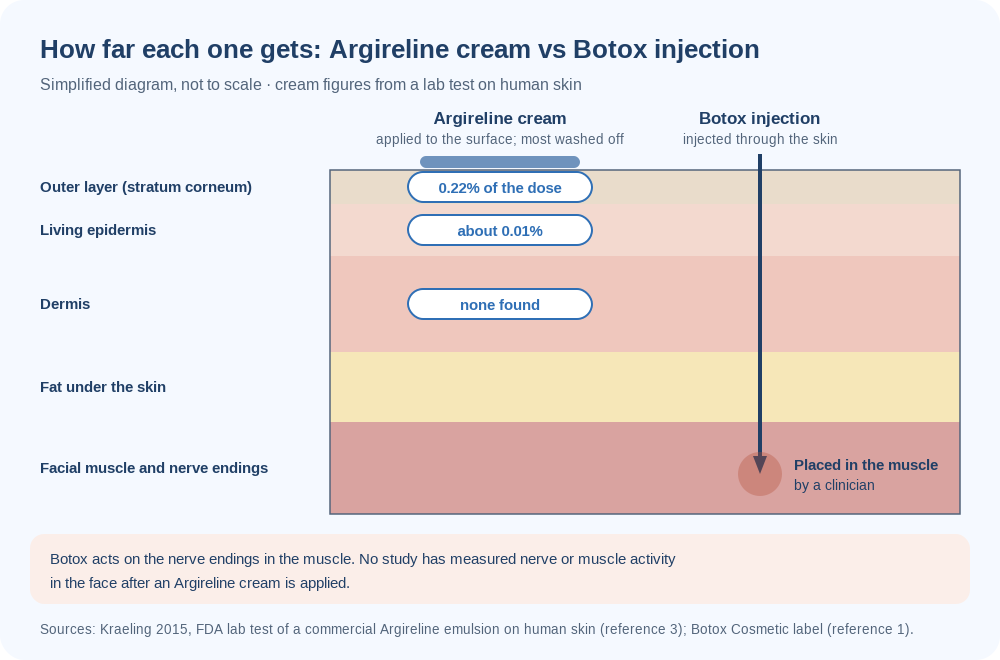
Even that weaker effect depends on reaching nerve endings that sit in muscle, under the full thickness of the skin. FDA scientists tested a commercial Argireline emulsion on human and guinea pig skin in a lab chamber (in vitro). Most of it washed off. Of the amount applied, 0.22% was found in the outer layer of human skin and about 0.01% in the living epidermis, and none in the dermis or in the fluid beneath the skin.3 Living skin may behave differently, but no study has measured nerve or muscle activity in the face after the cream is applied. A 2025 review concluded that "the ability of AH-8 to reach neuromuscular junctions remains uncertain".14 Our guide to how peptides get through the skin explains the barrier, and human vs preclinical research explains why results in cells are a reason to test something in people, not proof that it works.
What the Argireline studies found
Every human study measured how wrinkles looked, not whether muscles moved less. They are small, short and mostly about wrinkles around the eyes:
- The original 2002 study came from the team that designed the peptide. It reported that wrinkle depth fell by up to 30% after 30 days in "healthy women volunteers"; a later paper describes the group as 10 women.24 Argireline is a brand name of the Spanish company Lipotec, according to the NIH trial report below.11
- A 2013 randomised, placebo-controlled study in 60 Chinese adults found that 48.9% of the Argireline group improved on a global rating of wrinkle appearance after 4 weeks, against none on placebo. Three people got Argireline for every one on placebo, and the same group published overlapping reports of this work.6
- A 2023 double-blind split-face study gave 19 women a serum with Argireline on one side of the face and the same serum without it on the other. After 4 weeks, camera-based wrinkle scores showed no significant difference between the sides. The author, who declared no competing interests, concluded Argireline was "not deemed to be an alternative treatment to botulinum toxin".4
- A 2023 three-arm trial in 21 Indonesian women found an Argireline cream appeared less effective than a palmitoyl pentapeptide-4 (Matrixyl-type) cream over 8 weeks.10
- A 2026 study by L'Oréal scientists tested a serum combining Argireline with another "nerve" peptide and other ingredients in two single-arm studies (50 and 42 women). Dynamic wrinkles improved by 10% to 13% on clinical scoring. There was no control group, which the authors acknowledged, so the result cannot be credited to Argireline.15
Only one trial looked for a muscle effect. In 24 people with blepharospasm (involuntary eyelid closure) who were already having toxin injections, adding Argireline cream produced a non-significant trend toward longer symptom control: 3.7 months against 3.0 on placebo.11 A follow-up trial was terminated after enrolling 8 people.16 Our Argireline profile lists each study and trial registration.
How long would a cream take on forehead lines?
Nobody knows, because no published trial has tested Argireline on its own for forehead lines. The eye-area studies ran for 4 to 8 weeks with mixed results, and none checked whether any change lasted after people stopped.6410 Since the independent split-face study found no difference between serum with and without Argireline, it is possible, though untested, that some of the modest changes reported elsewhere come from the serum base rather than the peptide.4
For comparison, in Botox Cosmetic's forehead-line trials, 46% to 61% of treated people had improved by at least two grades on both clinician and self-ratings at day 30, against 0% to 1% on placebo.1
Is a cream safer?
It depends on what you compare.
Botox Cosmetic's label carries a boxed warning, FDA's strongest: "The effects of BOTOX Cosmetic and all botulinum toxin products may spread from the area of injection to produce symptoms consistent with botulinum toxin effects... Swallowing and breathing difficulties can be life threatening and there have been reports of death." The label says the risk is probably greatest in children treated for spasticity, and that no definitive serious reports of distant spread have been linked to its approved cosmetic uses at the labelled doses. In the frown-line trials, side effects more common than with placebo were drooping eyelid (3% vs 0%), facial pain, facial weakness and muscle weakness (1% each).1
Argireline creams have caused few reported problems in small, short studies, partly because they appear to do little. In the NIH trial, four people had mild eyelid irritation, two on Argireline and two on placebo.11 The industry-funded Cosmetic Ingredient Review panel concluded in 2025 that it is safe at the low concentrations currently used in cosmetics, and that data were insufficient for higher concentrations.1718 Several published efficacy studies, including the 2002 original, used formulations far stronger than the highest level the panel judged.217
Injecting Argireline is a different matter. A woman developed a Mycobacterium abscessus skin infection after Argireline was injected into her forehead and temples.12 It is not made or approved for injection, and in a 2026 rat study, injected Argireline produced "no detectable tissue-level effect".19 Our explainer on whether online injectables are safe covers the wider risks.
Fake toxin is the bigger documented hazard. In March 2024, seven women in Tennessee and New York City became ill after toxin injections given in homes or a spa by unlicensed people; four were hospitalised and two needed intensive care. FDA confirmed the product given to four of them was counterfeit.20 FDA warned that counterfeit Botox had been found in multiple states, and says genuine Botox Cosmetic cartons name the ingredient as "onabotulinumtoxinA".21 CDC's report concluded that injections "should be administered only by licensed and trained providers using recommended doses of FDA-approved products".20
Can you use a serum alongside Botox?
There is no known reason a cream would interfere with toxin treatment, and little evidence that adding one helps. The NIH blepharospasm trial is the only controlled test of Argireline alongside toxin, and its main result was not statistically significant.11 A 2024 journal supplement on clinicians' experience with an Argireline-containing serum used with toxin injections presented individual cases with no control group.22 Ask the clinician who does your injections before putting anything on treated skin in the first days afterwards.
What about copper peptides and SNAP-8?
GHK-Cu, the copper peptide in many serums marketed as Botox alternatives, does not act on nerves or the SNARE complex at all. Lab studies suggest it increases collagen and other skin-matrix proteins. A 2026 systematic review found only two randomised trials of GHK-Cu on its own in aesthetic use and called for larger, controlled trials.23 In one of them, objective wrinkle scores did not differ from control.24 Our GHK-Cu explainer covers the skin studies and the separate concerns about injected GHK-Cu, and GHK-Cu vs Argireline compares the two peptides.
SNAP-8 is Argireline with two extra amino acids. As of 22 October 2026 we found no peer-reviewed trial of SNAP-8 on its own and no SNAP-8 record on ClinicalTrials.gov; see Argireline vs SNAP-8.16
If you are deciding
If your aim is to stop lines forming when you frown or raise your brows, the treatment with strong evidence is a prescription toxin given by a licensed clinician. No peptide cream has been shown to do this. If you go ahead, check that the clinician is licensed and the product is FDA-approved.
If your aim is smoother texture and finer lines, cosmetic peptides have small, mixed studies. Our guide to whether peptide serums work compares the main ingredients, and peptides vs retinol explains why retinoids have stronger evidence.
Seek urgent care for trouble swallowing, speaking or breathing, double vision or new weakness after any toxin injection.121 See a doctor about a rash, swelling or lumps that persist after a cream or an injected product. Problems, including suspected counterfeit Botox, can be reported to FDA's MedWatch programme or your national regulator.21
How we reviewed this article
Sources
InsidePeptides relies on primary sources: peer-reviewed studies, trial registries and regulators’ own documents. Read our editorial policy.
- U.S. National Library of Medicine, DailyMed. 2026. BOTOX COSMETIC (onabotulinumtoxinA) injection, powder, lyophilized, for solution: prescribing information. Label version published 8 January 2026; accessed 22 October 2026.
- Blanes-Mira C et al. 2002. A synthetic hexapeptide (Argireline) with antiwrinkle activity. International Journal of Cosmetic Science 24(5):303–310. PMID: 18498523. DOI: 10.1046/j.1467-2494.2002.00153.x.
- Kraeling ME et al. 2015. In vitro skin penetration of acetyl hexapeptide-8 from a cosmetic formulation. Cutaneous and Ocular Toxicology 34(1):46–52. PMID: 24754410. Authors from FDA.
- Henseler H. 2023. Investigating the effects of Argireline in a skin serum containing hyaluronic acids on skin surface wrinkles using the Visia® Complexion Analysis camera system for objective skin analysis. GMS Interdisciplinary Plastic and Reconstructive Surgery DGPW 12:Doc09. PMID: 38024099.
- Blasi J et al. 1993. Botulinum neurotoxin A selectively cleaves the synaptic protein SNAP-25. Nature 365(6442):160–163. PMID: 8103915. DOI: 10.1038/365160a0.
- Wang Y et al. 2013. The anti-wrinkle efficacy of argireline, a synthetic hexapeptide, in Chinese subjects: a randomized, placebo-controlled study. American Journal of Clinical Dermatology 14(2):147–153. PMID: 23417317. DOI: 10.1007/s40257-013-0009-9.
- U.S. Food and Drug Administration. 2002. Approval letter, STN BL 103000/5000: Botulinum Toxin Type A (BOTOX COSMETIC) for glabellar lines. Dated 12 April 2002; accessed 22 October 2026.
- U.S. Food and Drug Administration. 2026. Drugs@FDA: BLA 103000 (BOTOX, BOTOX COSMETIC) approval history. Supplement approvals dated 11 September 2013 (S-5260, lateral canthal lines), 2 October 2017 (S-5303, forehead lines) and 18 October 2024 (S-5331); accessed 22 October 2026.
- U.S. Food and Drug Administration. 2024. Is It a Cosmetic, a Drug, or Both? (Or Is It Soap?). Content current as of 11 September 2024; accessed 22 October 2026.
- Aruan RR et al. 2023. Double-blind, Randomized Trial on the Effectiveness of Acetylhexapeptide-3 Cream and Palmitoyl Pentapeptide-4 Cream for Crow's Feet. Journal of Clinical and Aesthetic Dermatology 16(2):37–43. PMID: 36909866.
- Lungu C et al. 2013. Pilot study of topical acetyl hexapeptide-8 in the treatment for blepharospasm in patients receiving botulinum toxin therapy. European Journal of Neurology 20(3):515–518. PMID: 23146065. DOI: 10.1111/ene.12009. Two authors from BCN Peptides, part of the Lipotec Group.
- Chen CF et al. 2021. Mycobacterium abscessus infection after facial injection of argireline: A case report. World Journal of Clinical Cases 9(8):1996–2000. PMID: 33748252. DOI: 10.12998/wjcc.v9.i8.1996.
- Sutton RB et al. 1998. Crystal structure of a SNARE complex involved in synaptic exocytosis at 2.4 A resolution. Nature 395(6700):347–353. PMID: 9759724.
- Zdrada-Nowak J et al. 2025. Acetyl Hexapeptide-8 in Cosmeceuticals-A Review of Skin Permeability and Efficacy. International Journal of Molecular Sciences 26(12):5722. PMID: 40565185. DOI: 10.3390/ijms26125722.
- Zhu M et al. 2026. The effect of a serum containing acetyl hexapeptide-8, dipeptide diaminobutyroyl benzylamide diacetate and gluconolactone on skin biomarkers, wrinkles and skin texture: Ex vivo and clinical studies. International Journal of Cosmetic Science 48(5):913–925. PMID: 41668671. DOI: 10.1111/ics.70087. All authors from L'Oréal research centres.
- ClinicalTrials.gov. 2026. NCT01750346: Acetyl Hexapeptide-8 for Blepharospasm. Terminated with 8 participants; searches for argireline, acetyl hexapeptide, SNAP-8 and acetyl octapeptide checked 22 October 2026.
- Johnson W Jr et al. 2025. Safety Assessment of Acetyl Hexapeptide-8 Amide as Used in Cosmetics. International Journal of Toxicology 44(2 suppl):54S–63S. PMID: 40673537. DOI: 10.1177/10915818251340391.
- Cosmetic Ingredient Review. 2026. About the Cosmetic Ingredient Review. Accessed 22 October 2026: established by the industry trade association and "funded by the Council" (Personal Care Products Council).
- Acuner B et al. 2026. Effects of Botulinum Toxin Type A and Argireline on Dermal Collagen Remodeling and Skin Biology in a Flap Model. Aesthetic Plastic Surgery, published online 31 August 2026. PMID: 42675285. DOI: 10.1007/s00266-026-06225-z.
- Thomas CM et al. 2024. Notes from the Field: Illnesses After Administration of Presumed Counterfeit Botulinum Toxin in Nonmedical Settings - Tennessee and New York City, March 2024. MMWR Morbidity and Mortality Weekly Report 73(27):609–611. PMID: 38990782. DOI: 10.15585/mmwr.mm7327a3.
- U.S. Food and Drug Administration. 2024. Counterfeit Version of Botox Found in Multiple States. Content current as of 2 May 2024; accessed 22 October 2026.
- Lupin M et al. 2024. INDIVIDUAL ARTICLE: Real-World Clinical Experience With a Neuro-Peptide Serum in Combination With Botulinum Toxin Type-A Injections. Journal of Drugs in Dermatology 23(11 suppl 2):s3–s14. PMID: 39496132.
- Mokhtar J et al. 2026. The regenerative potential of GHK-Cu in aesthetic medicine. Aesthetic Surgery Journal, published online 20 August 2026. PMID: 42619529.
- Miller TR et al. 2006. Effects of topical copper tripeptide complex on CO2 laser-resurfaced skin. Archives of Facial Plastic Surgery 8(4):252–259. PMID: 16847171.
History
Each entry records a dated change to this article’s content. Link and formatting changes are not listed.
Current version
Written by InsidePeptides Editorial Team
Scientific review pending
Last updated
Published


