
How Regulatory Approval for Peptide Medicines Works
How a peptide drug gets approved: evidence, manufacturing quality, human trials and FDA or EU review, plus timelines and accelerated approval.

Key takeaways
- Discovery begins a sequence of evidence, product design, and manufacturing decisions.
- Permission to investigate a product in people is distinct from marketing approval.
- Regulatory review assesses a specific product and use, with safety monitoring continuing afterward.
In this article
Regulatory approval for a peptide medicine requires assessment of a specified product, intended use, evidence and manufacturing quality. Discovering an active peptide is the start of drug development. To become a medicine, a candidate needs a defined product, evidence about its behavior and risks, human studies appropriate to its proposed use, and regulatory assessment of its benefits, risks, and manufacturing quality.
There is no automatic progression from “discovered” to “approved.” A candidate may be redesigned, delayed, or discontinued when a necessary question cannot be answered satisfactorily. The pathway below focuses on a new therapeutic product; generic medicines and other application types can follow different routes.
The development stages
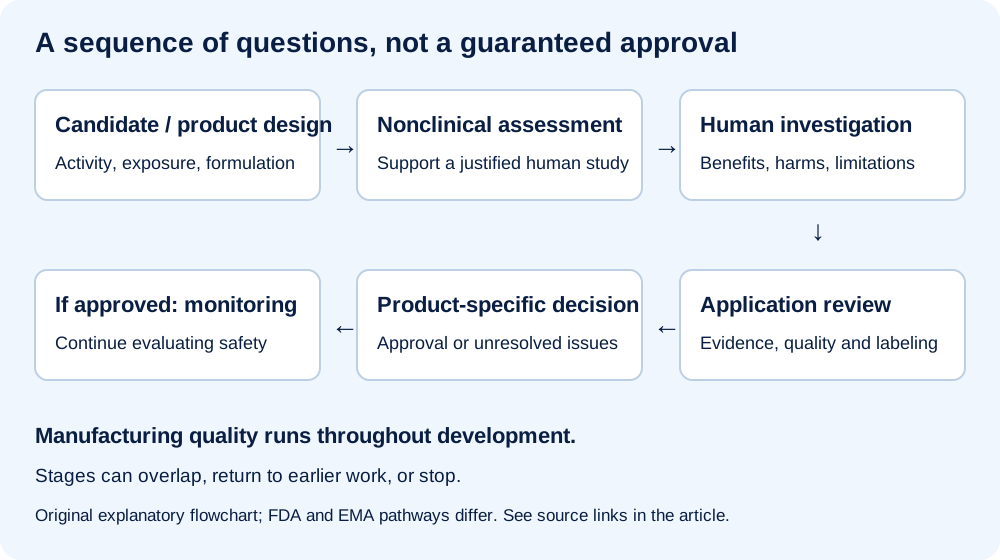
This sequence is a guide, not a rigid timetable. Manufacturing work continues through several stages, and research may overlap or return to earlier questions. The FDA’s development overview describes the broad stages.
1. Discover a useful biological starting point
Researchers identify a peptide or design one to interact with a target relevant to disease. A candidate might come from studying a natural hormone, screening molecules, or modifying an existing sequence.
The first challenge is to define what it does beyond binding to a target. Researchers need a plausible link between that activity and the proposed treatment goal.
A historical example comes from GLP-1 research and the discovery of exendin-4 in Gila monster venom. Exenatide was developed as a synthetic version of exendin-4. That history does not mean every GLP-1 medicine is derived from lizard venom: related therapies have different molecular designs. The NIDDK account of these discoveries explains the distinction.
2. Turn the molecule into a usable product
Optimize exposure and administration
An active peptide may need changes to its stability or delivery. Researchers ask whether it can reach the relevant site at a useful concentration, how long it remains active, and whether the proposed route is workable.
Chemical modifications can change these properties, but may also change other behavior. The resulting product must be characterized and tested. The review by Wang and colleagues, PDF covers peptide design, production, modification, and delivery approaches. Our peptide bioavailability guide explains the exposure question.
Establish manufacturing quality
Manufacturing is part of development rather than a final packaging step. A clinical finding needs to be connected to a product whose identity, biological activity, and quality can be reproduced.
In July 2026, the FDA published 17 revised draft product-specific guidances for certain generic peptide products, addressing areas including impurities, structure, biological activity, and immune-response testing. The agency also withdrew its older May 2021 synthetic-peptide guidance. These are updates for specified generic products, not an approval pathway for arbitrary research peptides. FDA announcement.
3. Build evidence before exposing people
Nonclinical research investigates activity, exposure, and potential harms using methods appropriate to the candidate and intended use. Laboratory and, where appropriate, animal studies help researchers decide whether a proposed human study is justified.
This evidence does not establish that the treatment is effective in people. Its immediate purpose includes informing the starting conditions, monitoring, and risks of human testing. See the FDA preclinical overview.
4. Obtain permission to begin clinical investigation
For a new drug under the US investigational new drug pathway, an IND application supplies information supporting the proposed clinical investigation. FDA describes a 30-day review period for the initial submission. Investigation may proceed when the agency notifies the applicant that it may proceed, or after the period if the application has not been placed on clinical hold. FDA IND overview.
Permission to investigate is not marketing approval. A clinical hold can delay or suspend investigation over issues such as inadequate safety information, product quality, or the proposed protocol. The FDA clinical-hold explanation provides examples.
5. Test the product in people
Clinical development asks progressively more demanding questions.
| Stage | Central question | What a reader should avoid assuming |
|---|---|---|
| Phase 1 | What are the initial tolerability, exposure, and dosing findings? | That initial tolerability establishes treatment benefit |
| Phase 2 | Is there a useful activity or benefit signal, and what regimen should be studied further? | That an encouraging small study settles efficacy or safety |
| Phase 3 | Does the product show an acceptable benefit–risk profile in the intended setting? | That a phase label guarantees a positive result |
| Post-approval research | What further evidence is needed about use and safety? | That approval ends investigation |
The FDA describes typical study sizes of 20–100 participants in Phase 1, up to several hundred in Phase 2, and 300–3,000 in Phase 3. These are illustrative ranges, not compulsory limits or a way to grade evidence by headcount. Actual programs differ by disease, design, and regulatory pathway. FDA clinical-research guide.
For a reader-friendly explanation of comparators and endpoints, see our clinical-trial guide.
6. Submit the evidence for regulatory review
For a new US drug, the marketing application brings together the evidence regulators need to assess the proposed product. Review includes the clinical findings, safety information, manufacturing, and proposed labeling. FDA approval is a decision about that application and use; it is not an endorsement of every substance with a similar name. FDA drug-review overview.
The EU process has a different division of responsibility
For centrally authorised medicines, EMA performs the scientific evaluation and recommends whether authorisation should be granted; the European Commission takes the legally binding decision. EMA’s standard assessment takes up to 210 active days, with clock-stops for applicants to answer questions. That is review time, not the time from discovery to approval. EMA journey overview and current pre-authorisation guidance, section 5.1.1.
A universal “peptides take X years” timeline would conceal major differences between candidates and development routes.
Accelerated approval does not remove the need to verify benefit
FDA can grant accelerated approval for qualifying serious conditions based on an appropriate surrogate endpoint reasonably predicting clinical benefit. A surrogate is an indirect measurement, rather than the clinical benefit itself. Confirmatory evidence remains required; the outcome of that work can affect the approval. See the FDA accelerated-approval program. This is a specific regulatory pathway, not a shortcut available to every research peptide.
7. Continue learning after approval
Approval does not reveal every possible risk. Wider use and longer follow-up can add information about uncommon adverse events and use in populations less represented in trials. Regulators may update labeling or take other actions as evidence changes. FDA post-market monitoring.
For interpreting reported harms, use the adverse-event guide. Our guide to what FDA approval means explains how to interpret approval alongside remaining uncertainty.
How to check a peptide’s development status
Use three separate checks:
- Research status: locate a specific trial and read its phase, status, intervention, and available results. A study listed as recruiting has not established its planned benefits.
- Product status: identify the exact medicine, formulation, route, and intended indication. Do not transfer evidence between products without justification.
- Regulatory status: locate the regulator’s product record and current labeling for the jurisdiction in question.
A ClinicalTrials.gov record is not a marketing authorisation; the FDA’s registry-transparency presentation, PDF explains the limits of listings. Our approved versus unapproved peptide guide offers related context.
The reader’s takeaway: the bridge from discovery to medicine is a sequence of evidence and quality decisions. The most informative update is the next question answered well, rather than an announcement that a peptide has entered another phase.
Reference details
- Wang L, Wang N, Zhang W, et al. Therapeutic peptides: current applications and future directions. Signal Transduction and Targeted Therapy. 2022;7:48. DOI: 10.1038/s41392-022-00904-4. PMID: 35165272.
- FDA. FDA Publishes Revised Draft Product-Specific Guidances for Certain Generic Peptide Products. July 28, 2026. The recommendations are draft and product-specific; the notice also documents withdrawal of the May 2021 guidance.
- EMA. Pre-authorisation guidance, section 5.1.1: How long does it take for my application to be evaluated? Current guidance checked 10 October 2026. The 210-day standard excludes clock-stops.
Official agency references are linked beside the relevant claims. Sources checked on 10 October 2026.


