
Peptide YY: the basics
What is it?
A gut hormone released after eating that helps signal fullness. PYY(3–36) is a form frequently used in appetite research.
Research paper 1 ↗Research paper 2 ↗Research paper 3 ↗What do people claim it helps with?
Less hunger and weight loss. A short-term reduction in eating does not establish a sustainable obesity treatment.
What has research actually shown?
Small human infusion studies found reduced food intake. A longer nasal-spray trial did not demonstrate meaningful weight loss and was limited by nausea and vomiting. Hormone changes after bariatric surgery do not prove that giving PYY alone reproduces its benefits.
Research paper 1 ↗Research paper 2 ↗Research paper 3 ↗Has this been demonstrated in people?
Human physiology and small human administration studies, alongside laboratory and animal research. These studies do not establish a routine treatment for the claims listed here.
Research paper 1 ↗Research paper 2 ↗Research paper 3 ↗What side effects, risks and unknowns should I understand?
Nausea and vomiting can limit experimental administration. Long-term effectiveness, safety and interactions remain uncertain.
Research paper 1 ↗Research paper 2 ↗Research paper 3 ↗Is it an approved medicine?
The native hormone described here is not an FDA-approved standalone medicine. Medicines that act on similar pathways are different products with their own approvals.
Research paper 1 ↗Research paper 2 ↗Research paper 3 ↗Approval here means U.S. FDA approval and applies to a particular product, formulation and use. This is a starting overview, not a complete side-effect list. Sources checked 10 October 2026; independent scientific review pending.
How is it used or studied?
Experimental preparations and infusions, rather than an approved standalone PYY medicine.
Different routes and formulations can have different effects. A study of one product does not validate every product with the same peptide name.
A common misunderstanding
Different PYY forms and modified drug candidates should not be treated as the same intervention.
What should I ask a clinician?
- What diagnosis or goal are we trying to address, and what established options are available?
- Was the expected benefit shown in people like me, using this exact product?
- How could my medicines, health conditions or pregnancy plans affect the risks?
- What monitoring is needed, and what would tell us the treatment is helping or should be stopped?
What do the research words mean?
- Peptide
- A short chain of amino acids, the building blocks of proteins.
- Preclinical
- Research in cells, tissues or animals before dependable treatment evidence in people.
- Controlled trial
- A study comparing a treatment with another treatment or a placebo to help separate its effects from other explanations.
- Biomarker
- A measurement, such as a hormone level. A change does not necessarily mean someone feels better or lives longer.
Peptide YY Evidence & Clinical Profile
Human Study Limits
Peptide YY has been investigated in clinical contexts. Patient outcomes must be evaluated against study size, design, and control cohorts.
Laboratory & In Vivo Assays
Cellular and animal disease models examine receptor binding affinities and signaling cascades, which require human confirmation.
What is Peptide YY?
Peptide YY (PYY 3-36) is An endogenous 36-amino-acid gastrointestinal peptide hormone co-secreted with GLP-1 by distal ileal and colonic enteroendocrine L-cells. Cleaved by DPP-4 into PYY(3-36), which acts as an 'ileal brake' via central neuropeptide Y Y2 receptors to suppress appetite and delay gastric motility. Aliases include: PYY, PYY(3-36), Ileal brake peptide hormone.
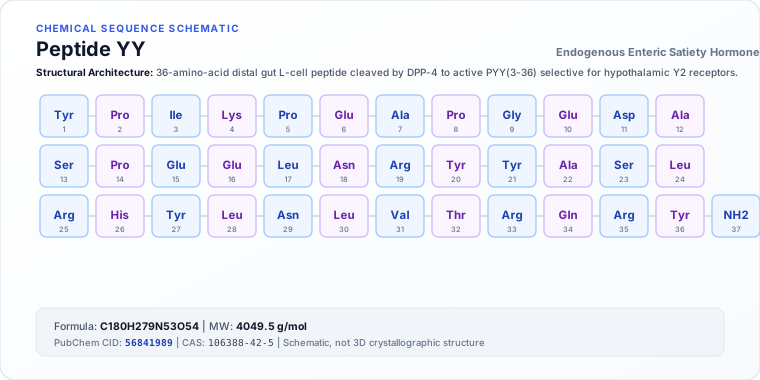
- Sequence (one-letter)
- IKPEAPGEDASPEELNRYYASLRHYLNLVTRQRY-NH2
- Molecular formula
- C180H279N53O54
- Molecular weight
- 4049.5 g/mol
- CAS Number
- 123583-37-9
- UNII Code
- 7PQZ90ULIR
- PubChem CID
- 59404585
Identifiers are for PYY(3-36), the main circulating form. Full-length PYY(1-36) carries UNII T2670C12I5 and CAS 118997-30-1.
Identifiers checked against PubChem and FDA's Global Substance Registration System on 13 October 2026. FDA substance record ↗ · PubChem record ↗ See all names and codes in the peptide name index.
Clinical Trials & Human Cohorts
Human research can examine tolerability, symptoms or patient outcomes. The design and comparator determine what each result can establish.
Inhibition of Food Intake in Obese and Lean Subjects by Peptide YY3-36 [1]
What was reported
PYY(3-36) infusion reduced buffet-lunch caloric intake by 30% in obese and 31% in lean subjects and lowered cumulative 24-hour caloric intake in both groups.
What limits the conclusion
Single-infusion crossover study in 24 volunteers; it does not show sustained weight loss with repeated dosing.
How the compound may work
Mechanisms describe how Peptide YY may affect biological processes. Laboratory findings and patient outcomes answer different questions.
Y2 Receptor-Mediated Appetite Suppression
Pharmacological and genetic studies indicate the Y2 receptor mediates the anorectic effects of PYY(3-36), with the hypothalamus, vagus and brainstem identified as potential sites of action. [3]
Brain Appetite and Reward Circuits
PYY(3-36) has been reported to modulate neuronal activity in hypothalamic, brainstem and reward-processing brain regions. [3]
Areas Being Studied
These research topics reflect active areas of scientific exploration, distinct from unverified commercial marketing claims.
Obesity Pharmacotherapy & Satiety
Obese subjects were not resistant to the anorectic effect of PYY(3-36), supporting interest in the PYY system as an obesity target. [1]
Bariatric Metabolic Mechanisms
Roux-en-Y gastric bypass patients showed increased postprandial PYY and GLP-1 compared with lean and obese controls, which may contribute to reduced appetite after surgery. [2]
Compare the study designs.
| Study | Design / sample | Outcome type | Key limitation |
|---|---|---|---|
| Batterham Obesity Trial · 2003 [1] | Double-blind randomized crossover trial n = 24 |
Clinical endpoint evaluation | Single-infusion crossover study in 24 volunteers; it does not show sustained weight loss with repeated dosing. |
Regulatory Status & Clinical Safety
Regulatory Classification
Endogenous physiological peptide. Investigated in combination pharmacotherapies for obesity.
Safety Realities & Impurities
Safety depends on the molecule, formulation, route and evidence. A laboratory purity measurement alone cannot establish safety for human use.
Clinical Trials Registry Records
Official registry records from ClinicalTrials.gov. Study registration does not imply government endorsement or guaranteed efficacy.
WADA & Anti-Doping Regulations
WADA Anti-Doping Status
Peptide YY is not prohibited under current World Anti-Doping Agency (WADA) regulations. However, athletes must ensure unregulated preparations or unverified vendor products do not violate Section S0 (Non-approved substances). Last verified: October 2026.
Research Timeline
What Researchers Still Don't Know
Long-term safety profiles
Multi-year observational data in broader heterogeneous cohorts remains uncharacterized.
Optimal dose-response thresholds
Comparative trials optimizing minimal effective exposure versus adverse event rates.
Formulation bioavailability
Differences between oral, subcutaneous, and modified peptide delivery vehicles.
References
Primary sources verified against PubMed / NLM and regulatory databases.
-
Landmark Clinical RCT
Inhibition of food intake in obese and lean subjects by peptide YY3-36 ↗ (external website)
- Clinical Cohort
-
Physiology Review
The role of peptide YY in appetite regulation and obesity ↗ (external website)
-
Landmark Clinical Study
Gut hormone PYY(3-36) physiologically inhibits food intake ↗ (external website)
- Discovery