
Lixisenatide: the basics
What is it?
A lab-made 44-amino-acid peptide that copies the action of GLP-1, a gut hormone that helps the body handle sugar after meals.
Research paper 1 ↗Research paper 2 ↗Research paper 3 ↗What do people claim it helps with?
Better blood-sugar control in adults with type 2 diabetes. It has also been tested for Parkinson's disease, but that is still experimental.
What has research actually shown?
Trials showed lower blood sugar than placebo, especially after meals. A large heart study (ELIXA) found it did not raise or lower the risk of heart attacks and strokes.
Research paper 1 ↗Research paper 2 ↗Research paper 3 ↗Has this been demonstrated in people?
Demonstrated in people, including large controlled trials in type 2 diabetes. The Parkinson's finding comes from one mid-sized Phase 2 trial.
Research paper 1 ↗Research paper 2 ↗Research paper 3 ↗What side effects, risks and unknowns should I understand?
Nausea, vomiting and diarrhea are common. Serious allergic reactions, pancreatitis and kidney problems from dehydration can occur. In Soliqua it is mixed with insulin, so low blood sugar is a key risk and mix-ups with other insulins must be avoided.
Prescribing information ↗Is it an approved medicine?
FDA approved lixisenatide alone (Adlyxin) and in Soliqua 100/33 with insulin glargine. Adlyxin is no longer listed for sale in the U.S.; Soliqua 100/33 is still available for adults with type 2 diabetes.
FDA safety information 1 ↗FDA safety information 2 ↗Prescribing information 3 ↗Approval here means U.S. FDA approval and applies to a particular product, formulation and use. This is a starting overview, not a complete side-effect list. Sources checked 10 October 2026; independent scientific review pending.
How is it used or studied?
Prescription once-daily injection. In the U.S. today it comes as Soliqua 100/33, a pen that also contains long-acting insulin.
Different routes and formulations can have different effects. A study of one product does not validate every product with the same peptide name.
A common misunderstanding
Soliqua is not the same as lixisenatide alone, because it also contains insulin. Lixisenatide is also a different medicine from exenatide, even though most of their amino-acid chains are the same.
What should I ask a clinician?
- What diagnosis or goal are we trying to address, and what established options are available?
- Was the expected benefit shown in people like me, using this exact product?
- How could my medicines, health conditions or pregnancy plans affect the risks?
- What monitoring is needed, and what would tell us the treatment is helping or should be stopped?
What do the research words mean?
- Peptide
- A short chain of amino acids, the building blocks of proteins.
- Preclinical
- Research in cells, tissues or animals before dependable treatment evidence in people.
- Controlled trial
- A study comparing a treatment with another treatment or a placebo to help separate its effects from other explanations.
- Biomarker
- A measurement, such as a hormone level. A change does not necessarily mean someone feels better or lives longer.
Lixisenatide Evidence & Clinical Profile
Established Clinical Trials
Lixisenatide has been investigated in clinical contexts. Patient outcomes must be evaluated against study size, design, and control cohorts.
Laboratory & In Vivo Assays
Cellular and animal disease models examine receptor binding affinities and signaling cascades, which require human confirmation.
What is Lixisenatide?
Lixisenatide (Adlyxin; in Soliqua 100/33) is Lixisenatide is a once-daily GLP-1 receptor agonist: a 44-amino-acid synthetic peptide whose first 37 amino acids match those of exenatide (PubChem sequences). FDA approved it alone as Adlyxin in 2016 and with insulin glargine as Soliqua 100/33. The standalone Adlyxin pen is no longer listed for sale in the U.S., so in practice lixisenatide reaches U.S. patients through Soliqua. Its ELIXA heart outcome trial was neutral: no rise and no fall in major cardiovascular events. Aliases include: Adlyxin, Lyxumia, AVE0010, ZP10, Soliqua 100/33 (with insulin glargine).
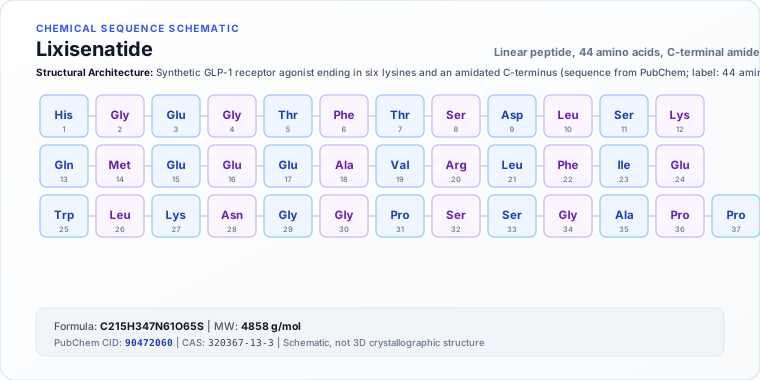
- Sequence (one-letter)
- HGEGTFTSDLSKQMEEEAVRLFIEWLKNGGPSSGAPPSKKKKKK-NH2
- Molecular formula
- C215H347N61O65S
- Molecular weight
- 4858 g/mol
- CAS Number
- 320367-13-3
- UNII Code
- 74O62BB01U
- PubChem CID
- 90472060
Identifiers checked against PubChem and FDA's Global Substance Registration System on 13 October 2026. FDA substance record ↗ · PubChem record ↗ See all names and codes in the peptide name index.
Clinical Trials & Human Cohorts
Human research can examine tolerability, symptoms or patient outcomes. The design and comparator determine what each result can establish.
Efficacy and safety of the once-daily GLP-1 receptor agonist lixisenatide in monotherapy (GetGoal-Mono) [1]
What was reported
HbA1c fell by 0.54 to 0.66 percentage points more than placebo, with a marked reduction in after-meal glucose.
What limits the conclusion
Only 12 weeks long. Nausea was common (23% vs 4.1% with placebo). Body weight fell by about the same amount in all groups, including placebo.
Lixisenatide in Patients with Type 2 Diabetes and Acute Coronary Syndrome (ELIXA) [2]
What was reported
Primary cardiovascular composite: 406 (13.4%) with lixisenatide vs 399 (13.2%) with placebo; HR 1.02 (95% CI 0.89 to 1.17). Non-inferior (no increase in risk) but not superior.
What limits the conclusion
Shows cardiovascular safety, not benefit. No differences in heart-failure hospitalization or death. Funded by Sanofi.
LixiLan (insulin glargine plus lixisenatide fixed-ratio combination) versus its components: the LixiLan-O trial [3]
What was reported
HbA1c fell 1.6 points with the combination vs 1.3 with insulin glargine alone and 0.9 with lixisenatide alone; 74% vs 59% vs 33% reached HbA1c below 7%.
What limits the conclusion
Open-label and industry-sponsored. Hypoglycemia rates were similar to insulin glargine alone. This tested the combination product, not lixisenatide as a standalone drug.
Trial of Lixisenatide in Early Parkinson's Disease [4]
What was reported
Motor-disability score (MDS-UPDRS part III) changed by -0.04 points with lixisenatide vs +3.04 with placebo at 12 months (difference 3.08 points, 95% CI 0.86 to 5.30).
What limits the conclusion
A small Phase 2 trial with a modest difference on one scale; other secondary endpoints did not differ much. Nausea occurred in 46% and vomiting in 13%. Parkinson's disease is not an approved use; larger, longer trials are needed.
How the compound may work
Mechanisms describe how Lixisenatide may affect biological processes. Laboratory findings and patient outcomes answer different questions.
GLP-1 receptor agonist
Lixisenatide activates the GLP-1 receptor, increasing glucose-dependent insulin release, lowering glucagon secretion and slowing gastric emptying. [5]
Strong after-meal effect
Its glucose-lowering effect is most marked after meals. The Soliqua label notes the effect on post-meal glucose was greatest with the first meal of the day and smaller with later meals. [5]
Areas Being Studied
These research topics reflect active areas of scientific exploration, distinct from unverified commercial marketing claims.
Type 2 diabetes
Glucose-lowering trials alone and in a fixed-ratio combination with insulin glargine. [3]
Cardiovascular safety
A neutral result: lixisenatide neither increased nor reduced major cardiovascular events after a recent acute coronary syndrome. [2]
Parkinson's disease
An investigational use prompted by animal neuroprotection data; one Phase 2 trial suggested slower motor-score progression. [4]
Compare the study designs.
| Study | Design / sample | Outcome type | Key limitation |
|---|---|---|---|
| GetGoal-Mono: monotherapy · 2012 [1] | Randomized, double-blind, placebo-controlled trial; 12 weeks n = 361 |
Clinical endpoint evaluation | Only 12 weeks long. Nausea was common (23% vs 4.1% with placebo). Body weight fell by about the same amount in all groups, including placebo. |
| ELIXA: cardiovascular outcomes · 2015 [2] | Randomized, double-blind, placebo-controlled outcomes trial; median follow-up 25 months n = 6068 |
Clinical endpoint evaluation | Shows cardiovascular safety, not benefit. No differences in heart-failure hospitalization or death. Funded by Sanofi. |
| LixiLan-O: combination with insulin glargine · 2016 [3] | Open-label randomized Phase 3 trial; 30 weeks n = 1170 |
Clinical endpoint evaluation | Open-label and industry-sponsored. Hypoglycemia rates were similar to insulin glargine alone. This tested the combination product, not lixisenatide as a standalone drug. |
| Early Parkinson's disease (Phase 2) · 2024 [4] | Phase 2, double-blind, randomized, placebo-controlled trial; 12 months plus 2-month washout n = 156 |
Clinical endpoint evaluation | A small Phase 2 trial with a modest difference on one scale; other secondary endpoints did not differ much. Nausea occurred in 46% and vomiting in 13%. Parkinson's disease is not an approved use; larger, longer trials are needed. |
Regulatory Status & Clinical Safety
Regulatory Classification
United States, checked 11 October 2026. Drugs@FDA still lists Adlyxin (lixisenatide injection, BLA 208471, Sanofi; approved 27 July 2016, deemed a BLA on 23 March 2020) with a "Prescription" marketing status, and FDA approved a class-wide GI safety labeling supplement for it in March 2026. However, the FDA National Drug Code Directory lists no Adlyxin product (the only lixisenatide listing is Soliqua 100/33), and DailyMed carries no current Adlyxin label, so the standalone product is not being marketed. Sanofi stopped U.S. sales of Adlyxin for commercial reasons; FDA has not announced any safety-related withdrawal. Soliqua 100/33 (insulin glargine plus lixisenatide, BLA 208673) remains approved and listed for adults with type 2 diabetes. GLP-1 receptor agonists are not named on the WADA Prohibited List.
Safety Realities & Impurities
Safety depends on the molecule, formulation, route and evidence. A laboratory purity measurement alone cannot establish safety for human use.
Clinical Trials Registry Records
Official registry records from ClinicalTrials.gov. Study registration does not imply government endorsement or guaranteed efficacy.
GLP-1 Receptor Agonist Lixisenatide in Patients With Type 2 Diabetes for Glycemic Control and Safety Evaluation in Monotherapy [10]
- Planned enrollment
- 361 (actual enrollment)
- Posted results
- Available
- Sponsor
- Sanofi
- Last updated
- 2016-12-12
Evaluation of Cardiovascular Outcomes in Patients With Type 2 Diabetes After Acute Coronary Syndrome During Treatment With AVE0010 (Lixisenatide) [11]
- Planned enrollment
- 6068 (actual enrollment)
- Posted results
- Available
- Sponsor
- Sanofi
- Last updated
- 2016-12-20
Efficacy and Safety of Insulin Glargine/ Lixisenatide Fixed Ratio Combination Compared to Insulin Glargine Alone and Lixisenatide Alone on Top of Metformin in Patients With T2DM [12]
- Planned enrollment
- 1170 (actual enrollment)
- Posted results
- Available
- Sponsor
- Sanofi
- Last updated
- 2017-05-09
Study to Evaluate the Effect of Lixisenatide in Patient With Parkinson's Disease [13]
- Planned enrollment
- 156 (actual enrollment)
- Posted results
- Pending in registry
- Sponsor
- University Hospital, Toulouse
- Last updated
- 2025-11-28
WADA & Anti-Doping Regulations
WADA Anti-Doping Status
Lixisenatide is not prohibited under current World Anti-Doping Agency (WADA) regulations. However, athletes must ensure unregulated preparations or unverified vendor products do not violate Section S0 (Non-approved substances). Last verified: October 2026.
Research Timeline
-
2015
ELIXA published
The cardiovascular outcomes trial finds no increase and no reduction in major cardiovascular events. [2]
-
2016
FDA approvals
FDA approves Adlyxin (July) and the Soliqua 100/33 combination with insulin glargine (November). [6]
-
2020
Deemed a biologic
Under the biologics transition, the Adlyxin application is deemed a BLA (BLA 208471) on 23 March 2020. [6]
-
2024
Parkinson's Phase 2 published
A 156-person trial reports less motor-score progression than placebo at 12 months. [4]
-
2026
Current U.S. supply
Adlyxin is absent from FDA's National Drug Code Directory; Soliqua 100/33 remains listed and labelled. [9]
What Researchers Still Don't Know
Long-term safety profiles
Multi-year observational data in broader heterogeneous cohorts remains uncharacterized.
Optimal dose-response thresholds
Comparative trials optimizing minimal effective exposure versus adverse event rates.
Formulation bioavailability
Differences between oral, subcutaneous, and modified peptide delivery vehicles.
References
Primary sources verified against PubMed / NLM and regulatory databases.
- Phase 3 RCT DOI: 10.2337/dc11-1935 ↗ (external website)
-
Cardiovascular outcomes RCT
Lixisenatide in Patients with Type 2 Diabetes and Acute Coronary Syndrome ↗ (external website)
DOI: 10.1056/NEJMoa1509225 ↗ (external website) - Phase 3 RCT DOI: 10.2337/dc16-0917 ↗ (external website)
-
Phase 2 RCT
Trial of Lixisenatide in Early Parkinson's Disease ↗ (external website)
DOI: 10.1056/NEJMoa2312323 ↗ (external website) -
Official prescribing information
Sanofi SPL published March 2026; checked 11 October 2026.
-
FDA approval record
Drugs@FDA: Adlyxin, BLA 208471 ↗ (external website)
Lists original approval 27 July 2016, deemed-BLA date 23 March 2020 and a March 2026 labeling supplement.
-
FDA approval record
Drugs@FDA: Soliqua 100/33, BLA 208673 ↗ (external website)
Original approval 21 November 2016.
- FDA supplement approval letter
-
FDA database
FDA National Drug Code Directory (searched for lixisenatide) ↗ (external website)
Searched 11 October 2026 via the openFDA NDC endpoint: the only lixisenatide product listed is Soliqua 100/33 (NDC 0024-5761); no Adlyxin listing.
-
Official registry
API record checked 11 October 2026.
-
Official registry
API record checked 11 October 2026.
-
Official registry
API record checked 11 October 2026.
-
Official registry
API record checked 11 October 2026.