
Larazotide: the basics
What is it?
A lab-made chain of eight amino acids, taken by mouth, designed to tighten the seals between cells lining the gut.
Research paper 1 ↗Research paper 2 ↗Research paper 3 ↗What do people claim it helps with?
Treating celiac disease symptoms, fixing a 'leaky gut', and helping with post-COVID illness or other inflammatory conditions.
What has research actually shown?
In celiac trials, only the lowest dose helped symptoms in the biggest study, and higher doses did not. The phase 3 trial meant to confirm it was stopped early by its sponsor.
Research paper 1 ↗Research paper 2 ↗Research paper 3 ↗Has this been demonstrated in people?
Human trials in adults with celiac disease, a small trial in children with a post-COVID inflammatory illness, and laboratory and animal studies.
Research paper 1 ↗Research paper 2 ↗Research paper 3 ↗What side effects, risks and unknowns should I understand?
Side effects in trials were similar to placebo, but the trials were short. Long-term safety is unknown, and it is not a substitute for a gluten-free diet.
Research paper 1 ↗Research paper 2 ↗Is it an approved medicine?
No FDA-approved medicine contains this peptide. It remains an investigational drug, and its phase 3 celiac trial was terminated.
Research paper ↗Approval here means U.S. FDA approval and applies to a particular product, formulation and use. This is a starting overview, not a complete side-effect list. Sources checked 10 October 2026; independent scientific review pending.
How is it used or studied?
Studied as an oral medicine in clinical trials. There is no approved product, and a product sold online is not necessarily the trial formulation.
Different routes and formulations can have different effects. A study of one product does not validate every product with the same peptide name.
A common misunderstanding
The code AT1001 was also used for migalastat, an unrelated Fabry disease drug, so check which medicine a study or listing means.
What should I ask a clinician?
- What diagnosis or goal are we trying to address, and what established options are available?
- Was the expected benefit shown in people like me, using this exact product?
- How could my medicines, health conditions or pregnancy plans affect the risks?
- What monitoring is needed, and what would tell us the treatment is helping or should be stopped?
What do the research words mean?
- Peptide
- A short chain of amino acids, the building blocks of proteins.
- Preclinical
- Research in cells, tissues or animals before dependable treatment evidence in people.
- Controlled trial
- A study comparing a treatment with another treatment or a placebo to help separate its effects from other explanations.
- Biomarker
- A measurement, such as a hormone level. A change does not necessarily mean someone feels better or lives longer.
Larazotide Evidence & Clinical Profile
Human Study Limits
Larazotide has been investigated in clinical contexts. Patient outcomes must be evaluated against study size, design, and control cohorts.
Laboratory & In Vivo Assays
Cellular and animal disease models examine receptor binding affinities and signaling cascades, which require human confirmation.
What is Larazotide?
Larazotide Acetate (AT-1001) is An eight-amino-acid oral peptide designed to tighten the junctions between gut-lining cells, studied mainly as an add-on to a gluten-free diet in celiac disease. Phase 2 trials gave mixed results, and the phase 3 celiac trial was terminated by its sponsor in 2022 without published results. It is not approved anywhere. Aliases include: Larazotide acetate, AT-1001, AT1001.
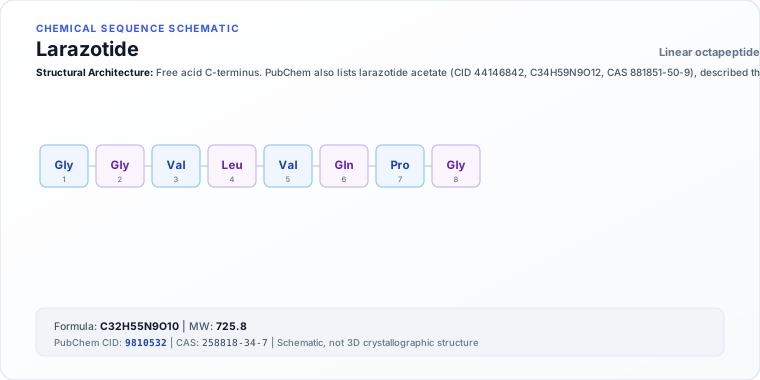
- Sequence (one-letter)
- GGVLVQPG
- Molecular formula
- C32H55N9O10
- Molecular weight
- 725.8 g/mol (free base)
- CAS Number
- 258818-34-7
- UNII Code
- ZN3R5560ZV
- PubChem CID
- 9810532
Identifiers are for the free base; trials used larazotide acetate (UNII FO8S2IW40N).
Identifiers checked against PubChem and FDA's Global Substance Registration System on 13 October 2026. FDA substance record ↗ · PubChem record ↗ See all names and codes in the peptide name index.
Clinical Trials & Human Cohorts
Human research can examine tolerability, symptoms or patient outcomes. The design and comparator determine what each result can establish.
Larazotide acetate for persistent symptoms of celiac disease despite a gluten-free diet: a randomized controlled trial [1]
What was reported
The lowest dose reduced gastrointestinal symptom scores versus placebo; the two higher doses were no different from placebo. Safety was comparable with placebo.
What limits the conclusion
No dose-response, so the positive result may not be robust; the phase 3 trial meant to confirm it was terminated.
Larazotide acetate in patients with coeliac disease undergoing a gluten challenge: a randomised placebo-controlled study [2]
What was reported
No difference in the gut-permeability test (lactulose-to-mannitol ratio). The lowest dose limited gluten-induced symptoms, and antibody rises were smaller than with placebo.
What limits the conclusion
Exploratory; the main barrier biomarker did not change, which undercuts the proposed mechanism.
Larazotide acetate for treatment of celiac disease: A systematic review and meta-analysis of randomized controlled trials [3]
What was reported
No effect on the gut-permeability ratio. Symptoms improved during gluten challenge but not in patients already on a gluten-free diet.
What limits the conclusion
Few, mostly sponsor-run trials with varied doses and designs.
Viral spike antigen clearance and augmented recovery in children with post-COVID multisystem inflammatory syndrome treated with larazotide [4]
What was reported
Children given larazotide had faster resolution of gut symptoms and spike-antigen clearance; no larazotide-related adverse events were reported.
What limits the conclusion
Very small; the registered trial was terminated early because MIS-C cases declined.
How the compound may work
Mechanisms describe how Larazotide may affect biological processes. Laboratory findings and patient outcomes answer different questions.
Tight-junction regulation
Larazotide is proposed to block zonulin-driven opening of tight junctions and to rearrange tight-junction proteins and actin; it has also been linked to inhibition of myosin light chain kinase. Supporting work is largely in cells, rodents and pigs. [5]
Disputed zonulin link
Celiac immunologists have questioned the relationship between AT1001 and zonulin, so the mechanism remains debated. [6]
Areas Being Studied
These research topics reflect active areas of scientific exploration, distinct from unverified commercial marketing claims.
Celiac disease
Studied as an add-on to a gluten-free diet for persistent symptoms and gluten exposure. [1]
MIS-C and long COVID
Investigated under the code AT1001 for post-COVID inflammatory syndromes; the long COVID trial has no posted results. [4]
Gut injury models
Studied in pig intestinal ischemia and mouse arthritis models, which do not establish human benefit. [5]
Compare the study designs.
| Study | Design / sample | Outcome type | Key limitation |
|---|---|---|---|
| Persistent celiac symptoms · 2015 [1] | Phase 2b multicentre double-blind placebo-controlled RCT n = 342 |
Clinical endpoint evaluation | No dose-response, so the positive result may not be robust; the phase 3 trial meant to confirm it was terminated. |
| Gluten challenge study · 2013 [2] | Exploratory double-blind placebo-controlled RCT n = 184 |
Clinical endpoint evaluation | Exploratory; the main barrier biomarker did not change, which undercuts the proposed mechanism. |
| Meta-analysis · 2022 [3] | Systematic review and meta-analysis n = 626 |
Clinical endpoint evaluation | Few, mostly sponsor-run trials with varied doses and designs. |
| MIS-C in children · 2025 [4] | Phase 2a double-blind placebo-controlled RCT n = 12 |
Clinical endpoint evaluation | Very small; the registered trial was terminated early because MIS-C cases declined. |
Regulatory Status & Clinical Safety
Regulatory Classification
Not approved by FDA or, as far as we found, any other regulator; Drugs@FDA lists no larazotide product. Phase 3 trial NCT03569007 was terminated by the sponsor in 2022. WADA 2026: falls under S0 (non-approved substances), prohibited at all times.
Safety Realities & Impurities
Safety depends on the molecule, formulation, route and evidence. A laboratory purity measurement alone cannot establish safety for human use.
Clinical Trials Registry Records
Official registry records from ClinicalTrials.gov. Study registration does not imply government endorsement or guaranteed efficacy.
Study to Evaluate the Efficacy and Safety of Larazotide Acetate for the Relief of CeD Symptoms [8]
- Planned enrollment
- 307 (patients)
- Posted results
- Pending in registry
- Sponsor
- 9 Meters Biopharma, Inc.
- Last updated
- 2022
A Double-blind Placebo-controlled Study to Evaluate Larazotide Acetate for the Treatment of Celiac Disease [9]
- Planned enrollment
- 342 (patients)
- Posted results
- Pending in registry
- Sponsor
- 9 Meters Biopharma, Inc.
- Last updated
- 2017
AT1001 for the Treatment of Long COVID [10]
- Planned enrollment
- 107 (patients)
- Posted results
- Pending in registry
- Sponsor
- Massachusetts General Hospital
- Last updated
- 2026
AT1001 for the Treatment of COVID-19 Related MIS-C [11]
- Planned enrollment
- 12 (patients)
- Posted results
- Pending in registry
- Sponsor
- Massachusetts General Hospital
- Last updated
- 2024
WADA & Anti-Doping Regulations
WADA Section S0: Prohibited Substance
The World Anti-Doping Agency (WADA) classifies Larazotide under Section S0 of the Prohibited List. Prohibited at all times (in- and out-of-competition). Last verified: October 2026.
Research Timeline
-
2007
First celiac study
A proof-of-concept study gives single doses of AT-1001 to people with celiac disease. [7]
-
2013
Gluten challenge RCT
Exploratory trial finds no change in gut permeability but some symptom effects. [2]
-
2015
Phase 2b result
Only the lowest dose beats placebo for persistent symptoms. [1]
-
2022
Phase 3 terminated
The phase 3 celiac trial (307 enrolled) is terminated by its sponsor. [8]
-
2025
MIS-C pilot published
A 12-child randomized pilot reports faster recovery from post-COVID inflammatory syndrome. [4]
What Researchers Still Don't Know
Long-term safety profiles
Multi-year observational data in broader heterogeneous cohorts remains uncharacterized.
Optimal dose-response thresholds
Comparative trials optimizing minimal effective exposure versus adverse event rates.
Formulation bioavailability
Differences between oral, subcutaneous, and modified peptide delivery vehicles.
References
Primary sources verified against PubMed / NLM and regulatory databases.
- Phase 2b RCT
- Randomized controlled trial
- Meta-analysis
- Phase 2a RCT
- Review
- Letter
- Early clinical study
- Registry Record
- Registry Record
-
Registry Record
NCT05747534 AT1001 for the Treatment of Long COVID ↗ (external website)
-
Registry Record
NCT05022303 AT1001 for the Treatment of COVID-19 Related MIS-C ↗ (external website)