
Afamelanotide: the basics
What is it?
A lab-made copy of a natural skin-darkening hormone (alpha-MSH). It tells pigment cells to make more melanin, the brown pigment in skin.
Research paper 1 ↗Research paper 2 ↗What do people claim it helps with?
Less pain from light for people with erythropoietic protoporphyria (EPP), a rare inherited disease. Some people also hope to use it for tanning or vitiligo, which are not approved uses.
What has research actually shown?
Two controlled trials found adults with EPP could spend more time in sunlight without pain and had better quality of life, though the gains were modest.
Research paper 1 ↗Research paper 2 ↗Has this been demonstrated in people?
Demonstrated in people with EPP in two randomized trials and a long-term observational study; vitiligo results come from a small trial.
Research paper 1 ↗Research paper 2 ↗What side effects, risks and unknowns should I understand?
Implant-site reactions, nausea, sore throat, cough, tiredness, dizziness and skin darkening are common. Moles and freckles can darken, so a full skin check twice a year is advised. Serious allergic reactions have been reported.
Prescribing information ↗Is it an approved medicine?
Yes. Scenesse is FDA-approved to increase pain-free light exposure in adults with a history of light reactions from EPP. It is not approved for tanning, vitiligo or children.
FDA safety information 1 ↗Prescribing information 2 ↗Approval here means U.S. FDA approval and applies to a particular product, formulation and use. This is a starting overview, not a complete side-effect list. Sources checked 10 October 2026; independent scientific review pending.
How is it used or studied?
A tiny dissolving rod implanted under the skin by a trained health professional; it is not a self-injected product.
Different routes and formulations can have different effects. A study of one product does not validate every product with the same peptide name.
A common misunderstanding
Afamelanotide is not melanotan II. Melanotan II is a different, unapproved peptide sold online for tanning, with its own safety reports.
What should I ask a clinician?
- What diagnosis or goal are we trying to address, and what established options are available?
- Was the expected benefit shown in people like me, using this exact product?
- How could my medicines, health conditions or pregnancy plans affect the risks?
- What monitoring is needed, and what would tell us the treatment is helping or should be stopped?
What do the research words mean?
- Peptide
- A short chain of amino acids, the building blocks of proteins.
- Preclinical
- Research in cells, tissues or animals before dependable treatment evidence in people.
- Controlled trial
- A study comparing a treatment with another treatment or a placebo to help separate its effects from other explanations.
- Biomarker
- A measurement, such as a hormone level. A change does not necessarily mean someone feels better or lives longer.
Afamelanotide Evidence & Clinical Profile
Established Clinical Trials
Afamelanotide has been investigated in clinical contexts. Patient outcomes must be evaluated against study size, design, and control cohorts.
Laboratory & In Vivo Assays
Cellular and animal disease models examine receptor binding affinities and signaling cascades, which require human confirmation.
What is Afamelanotide?
Afamelanotide (Scenesse implant) is Afamelanotide is a 13-amino-acid synthetic analogue of alpha-melanocyte-stimulating hormone (alpha-MSH) that mainly activates the MC1 receptor and darkens skin by increasing eumelanin, without sun exposure. As the Scenesse implant (Clinuvel), it is FDA-approved to increase pain-free light exposure in adults with erythropoietic protoporphyria (EPP), a rare inherited condition that causes severe pain after light exposure. Aliases include: Scenesse, CUV1647, [Nle4, D-Phe7]-alpha-MSH, NDP-MSH.
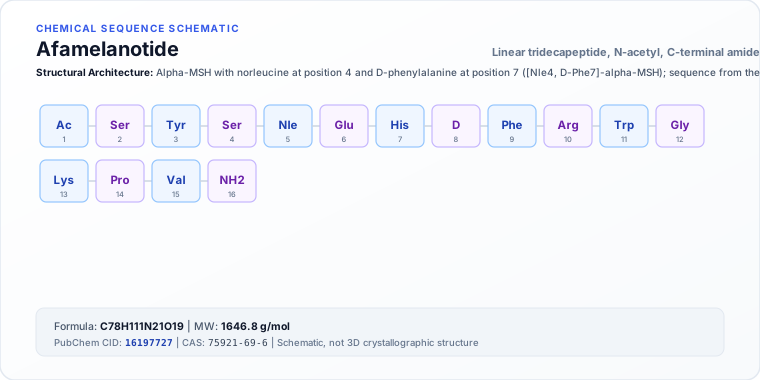
- Sequence (one-letter)
- Ac-SYS-Nle-EH-dF-RWGKPV-NH2
- Molecular formula
- C78H111N21O19
- Molecular weight
- 1646.8 g/mol
- CAS Number
- 75921-69-6
- UNII Code
- QW68W3J66U
- PubChem CID
- 16197727
Identifiers are for the free base. The approved implant contains afamelanotide acetate (UNII 1XCC161YKC).
Identifiers checked against PubChem and FDA's Global Substance Registration System on 13 October 2026. FDA substance record ↗ · PubChem record ↗ See all names and codes in the peptide name index.
Clinical Trials & Human Cohorts
Human research can examine tolerability, symptoms or patient outcomes. The design and comparator determine what each result can establish.
Afamelanotide for Erythropoietic Protoporphyria [1]
What was reported
Median pain-free direct-sunlight time was longer with afamelanotide (U.S.: 69.4 vs 40.8 hours over 6 months; EU: 6.0 vs 0.8 hours over 9 months). Phototoxic reactions were fewer in the EU trial (77 vs 146) and quality of life improved.
What limits the conclusion
Endpoints relied on patient diaries of sun exposure and pain. Absolute gains were modest and the studies were funded by the manufacturer. Adverse events were mostly mild.
Long-term observational study of afamelanotide in 115 patients with erythropoietic protoporphyria [2]
What was reported
EPP-specific quality-of-life scores rose from 31% of maximum before treatment to about 74% and stayed there; only minor treatment-related adverse events, mostly nausea, were recorded.
What limits the conclusion
No control group and run by specialist centres, so improvement cannot be fully separated from expectation or patient selection. 23% stopped, mostly for reasons such as pregnancy or cost.
Afamelanotide and narrowband UV-B phototherapy for the treatment of vitiligo: a randomized multicenter trial [3]
What was reported
Repigmentation at day 168 was 48.6% with the combination vs 33.3% with phototherapy alone, with faster response on the face and upper limbs; benefit was clearest in skin types IV to VI.
What limits the conclusion
Small trial; no benefit seen in skin type III. Vitiligo is not an approved use, and a Phase 3 trial was still active (not recruiting) at last registry update.
How the compound may work
Mechanisms describe how Afamelanotide may affect biological processes. Laboratory findings and patient outcomes answer different questions.
MC1 receptor agonist
Afamelanotide is a structural analogue of alpha-MSH that binds mainly to the MC1 receptor on melanocytes and increases eumelanin production in the skin, independent of sunlight or UV exposure. [4]
Slow-release implant
The peptide is mixed into a small bioresorbable polymer rod. Plasma levels were highly variable between people; the apparent half-life from the implant is about 15 hours. [4]
Areas Being Studied
These research topics reflect active areas of scientific exploration, distinct from unverified commercial marketing claims.
Erythropoietic protoporphyria
The approved use: reducing light-triggered pain episodes and increasing tolerated light exposure. [1]
Vitiligo
Combined with narrowband UV-B phototherapy to speed repigmentation, mainly in darker skin types. [3]
Compare the study designs.
| Study | Design / sample | Outcome type | Key limitation |
|---|---|---|---|
| EPP Phase 3 trials (EU and U.S.) · 2015 [1] | Two multicenter, randomized, double-blind, placebo-controlled trials (EU 180 days, U.S. 270 days) n = 168 |
Clinical endpoint evaluation | Endpoints relied on patient diaries of sun exposure and pain. Absolute gains were modest and the studies were funded by the manufacturer. Adverse events were mostly mild. |
| Long-term use in 115 patients · 2015 [2] | Observational study at two porphyria centres (Rome and Zurich); up to 8 years n = 115 |
Clinical endpoint evaluation | No control group and run by specialist centres, so improvement cannot be fully separated from expectation or patient selection. 23% stopped, mostly for reasons such as pregnancy or cost. |
| Vitiligo with NB-UVB (Phase 2) · 2015 [3] | Randomized multicenter trial: afamelanotide plus narrowband UV-B vs narrowband UV-B alone n = 55 |
Clinical endpoint evaluation | Small trial; no benefit seen in skin type III. Vitiligo is not an approved use, and a Phase 3 trial was still active (not recruiting) at last registry update. |
Regulatory Status & Clinical Safety
Regulatory Classification
United States, checked 11 October 2026: Scenesse (NDA 210797, Clinuvel) is approved to increase pain-free light exposure in adult patients with a history of phototoxic reactions from erythropoietic protoporphyria. It is a bioresorbable implant inserted under the skin by a trained health care professional. Safety and effectiveness in children have not been established. Patients still need sun and light protection. Vitiligo and other uses are investigational. Not named on the WADA Prohibited List to our knowledge.
Safety Realities & Impurities
Safety depends on the molecule, formulation, route and evidence. A laboratory purity measurement alone cannot establish safety for human use.
Clinical Trials Registry Records
Official registry records from ClinicalTrials.gov. Study registration does not imply government endorsement or guaranteed efficacy.
Phase III Confirmatory Study in Erythropoietic Protoporphyria (EPP) [6]
- Planned enrollment
- 74 (actual enrollment)
- Posted results
- Available
- Sponsor
- Clinuvel Pharmaceuticals Limited
- Last updated
- 2021-10-12
Phase III Confirmatory Study in Erythropoietic Protoporphyria [7]
- Planned enrollment
- 93 (actual enrollment)
- Posted results
- Available
- Sponsor
- Clinuvel Pharmaceuticals Limited
- Last updated
- 2019-09-19
A Study to Compare the Efficacy and Safety of SCENESSE and Narrow-Band Ultraviolet (NB-UVB) Light Versus NB-UVB Light Alone in Patients With Vitiligo [8]
- Planned enrollment
- 200 (estimated enrollment)
- Posted results
- Pending in registry
- Sponsor
- Clinuvel, Inc.
- Last updated
- 2025-07-08
WADA & Anti-Doping Regulations
WADA Anti-Doping Status
Afamelanotide is not prohibited under current World Anti-Doping Agency (WADA) regulations. However, athletes must ensure unregulated preparations or unverified vendor products do not violate Section S0 (Non-approved substances). Last verified: October 2026.
Research Timeline
-
2015
Phase 3 results published
NEJM reports the EU and U.S. randomized EPP trials. [1]
-
2015
Long-term cohort
Two European porphyria centres report up to 8 years of routine use in 115 patients. [2]
-
2019
FDA approval
FDA approves Scenesse (NDA 210797) for adults with EPP. [5]
-
2026
Current status
Approved for adult EPP only; vitiligo remains under investigation. [4]
What Researchers Still Don't Know
Long-term safety profiles
Multi-year observational data in broader heterogeneous cohorts remains uncharacterized.
Optimal dose-response thresholds
Comparative trials optimizing minimal effective exposure versus adverse event rates.
Formulation bioavailability
Differences between oral, subcutaneous, and modified peptide delivery vehicles.
References
Primary sources verified against PubMed / NLM and regulatory databases.
-
Phase 3 RCTs
Afamelanotide for Erythropoietic Protoporphyria ↗ (external website)
DOI: 10.1056/NEJMoa1411481 ↗ (external website) - Observational study DOI: 10.1111/bjd.13598 ↗ (external website)
- Randomized trial DOI: 10.1001/jamadermatol.2014.1875 ↗ (external website)
-
Official prescribing information
Scenesse (afamelanotide) implant, current U.S. label ↗ (external website)
Clinuvel SPL published May 2026; checked 11 October 2026.
-
FDA approval record
Drugs@FDA: Scenesse, NDA 210797 ↗ (external website)
Original approval 8 October 2019.
-
Official registry
Phase III Confirmatory Study in Erythropoietic Protoporphyria (EPP) ↗ (external website)
API record checked 11 October 2026.
-
Official registry
Phase III Confirmatory Study in Erythropoietic Protoporphyria ↗ (external website)
API record checked 11 October 2026.
-
Official registry
API record checked 11 October 2026.