
LL-37: the basics
What is it?
A peptide made by the immune system that helps defend against microbes and also affects inflammation.
Research paper 1 ↗Research paper 2 ↗What do people claim it helps with?
Fighting infections, helping wounds heal and strengthening immunity. A lab antimicrobial effect does not prove an infection treatment works in people.
What has research actually shown?
Human trials have tested topical LL-37 on chronic wounds. The larger venous-ulcer trial did not show a significant overall healing benefit; exploratory subgroup findings need confirmation.
Research paper 1 ↗Research paper 2 ↗Has this been demonstrated in people?
Laboratory and animal evidence plus human trials of particular topical wound preparations. These do not establish the benefits of systemic injections.
Research paper 1 ↗Research paper 2 ↗What side effects, risks and unknowns should I understand?
Effects depend on the tissue and exposure. FDA highlights incomplete human safety data and concerning nonclinical findings.
FDA safety information ↗Is it an approved medicine?
No FDA-approved medicine contains this peptide. Availability online or through a clinic does not mean it has been approved.
FDA safety information ↗Approval here means U.S. FDA approval and applies to a particular product, formulation and use. This is a starting overview, not a complete side-effect list. Sources checked 10 October 2026; independent scientific review pending.
How is it used or studied?
Studied using specific research preparations. There is no FDA-approved treatment formulation; an online vial, capsule or spray is not necessarily the product used in a study.
Different routes and formulations can have different effects. A study of one product does not validate every product with the same peptide name.
A common misunderstanding
“Part of the immune system” does not mean that adding more is beneficial or safe.
What should I ask a clinician?
- What diagnosis or goal are we trying to address, and what established options are available?
- Was the expected benefit shown in people like me, using this exact product?
- How could my medicines, health conditions or pregnancy plans affect the risks?
- What monitoring is needed, and what would tell us the treatment is helping or should be stopped?
What do the research words mean?
- Peptide
- A short chain of amino acids, the building blocks of proteins.
- Preclinical
- Research in cells, tissues or animals before dependable treatment evidence in people.
- Controlled trial
- A study comparing a treatment with another treatment or a placebo to help separate its effects from other explanations.
- Biomarker
- A measurement, such as a hormone level. A change does not necessarily mean someone feels better or lives longer.
LL-37 Evidence & Clinical Profile
Human Study Limits
LL-37 has been investigated in clinical contexts. Patient outcomes must be evaluated against study size, design, and control cohorts.
Laboratory & In Vivo Assays
Cellular and animal disease models examine receptor binding affinities and signaling cascades, which require human confirmation.
What is LL-37?
Human Cathelicidin Antimicrobial Peptide is An endogenous 37-amino-acid amphipathic alpha-helical peptide cleaved from human cathelicidin (hCAP-18). Exhibits direct antimicrobial membrane disruption and immunomodulatory signaling, investigated in Phase 2 topical wound healing trials. Aliases include: hCAP-18 fragment, CAMP 134-170, Cathelicidin LL-37.
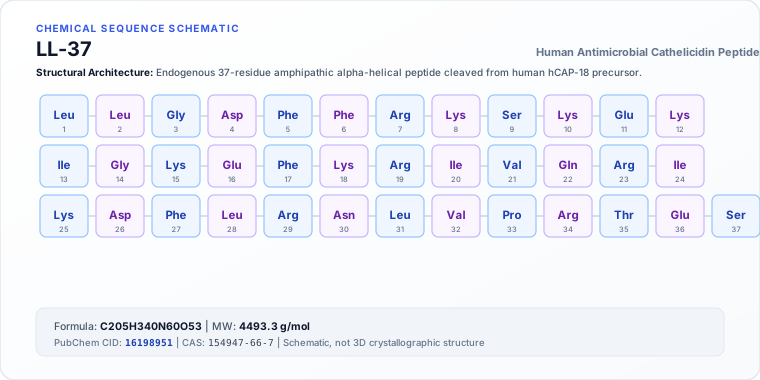
- Sequence (one-letter)
- LLGDFFRKSKEKIGKEFKRIVQRIKDFLRNLVPRTES
- Molecular formula
- C205H340N60O53
- Molecular weight
- 4493.3 g/mol
- CAS Number
- 154947-66-7
- UNII Code
- 3DD771JO2H
- PubChem CID
- 16198951
Identifiers checked against PubChem and FDA's Global Substance Registration System on 13 October 2026. FDA substance record ↗ · PubChem record ↗ See all names and codes in the peptide name index.
Clinical Trials & Human Cohorts
Human research can examine tolerability, symptoms or patient outcomes. The design and comparator determine what each result can establish.
Treatment with LL-37 is safe and effective in enhancing healing of hard-to-heal venous leg ulcers: a randomized, placebo-controlled clinical trial [1]
What was reported
Healing rate constants at the two lower concentrations were about six- and threefold higher than placebo (statistically significant only for the lowest); the highest concentration did not differ from placebo. No local or systemic safety concerns.
What limits the conclusion
Small first-in-man trial with short treatment; dose-response was not linear.
Evaluation of LL-37 in healing of hard-to-heal venous leg ulcers: A multicentric prospective randomized placebo-controlled clinical trial [5]
What was reported
No significant improvement in healing versus placebo in the full study population; a post hoc analysis suggested benefit in patients with large wounds. Well tolerated.
What limits the conclusion
Primary analysis negative; the large-ulcer finding is post hoc and needs an adequately powered study.
How the compound may work
Mechanisms describe how LL-37 may affect biological processes. Laboratory findings and patient outcomes answer different questions.
Antibacterial Activity
LL-37 is processed from the cathelin-containing precursor encoded by the FALL39 gene, stored in granulocytes, and is a potent antibacterial peptide. [2]
FPRL1 (FPR2) Chemotactic Agonism
Chemotactic for monocytes, neutrophils and T cells and induces calcium mobilization through formyl peptide receptor-like 1 (FPRL1). [3]
Areas Being Studied
These research topics reflect active areas of scientific exploration, distinct from unverified commercial marketing claims.
Chronic Venous Leg Ulcers
Topical LL-37 did not significantly improve healing overall versus placebo; a post hoc analysis suggested benefit in large ulcers. [5]
Psoriasis & Autoimmunity
LL37 binds self-DNA into aggregated structures that trigger interferon production by plasmacytoid dendritic cells via TLR9, a pathway proposed to drive psoriasis. [4]
Compare the study designs.
| Study | Design / sample | Outcome type | Key limitation |
|---|---|---|---|
| First-in-Man Venous Ulcer Trial · 2014 [1] | Randomized double-blind placebo-controlled dose-response trial n = 34 |
Clinical endpoint evaluation | Small first-in-man trial with short treatment; dose-response was not linear. |
| HEAL LL-37 Phase 2b · 2021 [5] | Phase 2b double-blind randomized placebo-controlled trial n = 148 |
Clinical endpoint evaluation | Primary analysis negative; the large-ulcer finding is post hoc and needs an adequately powered study. |
Regulatory Status & Clinical Safety
Regulatory Classification
Unapproved as a prescription medicine; investigated under IND.
Safety Realities & Impurities
Safety depends on the molecule, formulation, route and evidence. A laboratory purity measurement alone cannot establish safety for human use.
Clinical Trials Registry Records
Official registry records from ClinicalTrials.gov. Study registration does not imply government endorsement or guaranteed efficacy.
WADA & Anti-Doping Regulations
WADA Anti-Doping Status
LL-37 is not prohibited under current World Anti-Doping Agency (WADA) regulations. However, athletes must ensure unregulated preparations or unverified vendor products do not violate Section S0 (Non-approved substances). Last verified: October 2026.
Research Timeline
-
1996
Gene Characterized
FALL39 gene sequenced and mature LL-37 isolated from granulocytes. [2]
-
2014
First-in-Man Trial
Topical trial in hard-to-heal venous leg ulcers reports improved healing at lower concentrations. [1]
-
2021
Phase 2b Trial
HEAL LL-37 trial finds no significant overall healing benefit versus placebo. [5]
-
2026
Regulatory Status
Not an approved prescription medicine. [6]
What Researchers Still Don't Know
Long-term safety profiles
Multi-year observational data in broader heterogeneous cohorts remains uncharacterized.
Optimal dose-response thresholds
Comparative trials optimizing minimal effective exposure versus adverse event rates.
Formulation bioavailability
Differences between oral, subcutaneous, and modified peptide delivery vehicles.
References
Primary sources verified against PubMed / NLM and regulatory databases.
- Clinical RCT
- Discovery Paper
- Mechanistic Study
-
Pathology Study
Plasmacytoid dendritic cells sense self-DNA coupled with antimicrobial peptide ↗ (external website)
- Phase 2b RCT
- Regulatory