
Evidence-Based Summary
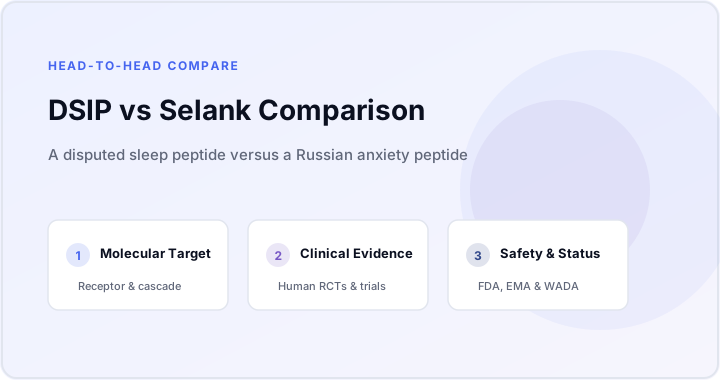
DSIP and Selank are often marketed together for sleep and stress, but they are unrelated molecules with separate, limited evidence. DSIP (emideltide) was isolated from rabbits in 1977. Small human insomnia trials gave conflicting results: an early author reported benefit, while later double-blind studies found weak or clinically insignificant effects, and a 2006 review noted that no DSIP gene or receptor had been identified. Selank is a synthetic analogue of the immune peptide tuftsin. Russian trials by groups that include its developers report anxiety reduction similar to benzodiazepine comparators, but these were small, published mainly in Russian, and not replicated independently. No study has compared DSIP with Selank. Neither is FDA-approved, and FDA lists both among compounding substances that may present significant safety risks.
Quick Comparison: DSIP vs Selank
A high-level comparison of molecule class, molecular receptor targets, FDA regulatory approvals, and verified clinical programs.
| Feature | DSIP | Selank |
|---|---|---|
| Class | Nonapeptide (Trp-Ala-Gly-Gly-Asp-Ala-Ser-Gly-Glu) | Synthetic heptapeptide: tuftsin (Thr-Lys-Pro-Arg) plus Pro-Gly-Pro |
| Target receptor | None identified; no DSIP gene or receptor found | No single receptor established; GABA-related gene changes in rats and enkephalinase inhibition in blood samples proposed |
| How it has been given in studies | Intravenous administration in small insomnia and anaesthesia studies | Intranasal in rat studies; route not stated in the English abstracts of the human trials |
| Main research use | Insomnia (1980s-1990s); anaesthesia adjunct | Generalized anxiety and related disorders (Russia) |
| U.S. regulatory status | Not FDA-approved; on FDA's compounding safety list (as emideltide) | Not FDA-approved; on FDA's compounding safety list (selank acetate) |
| Strongest human evidence | Small double-blind trials with conflicting, mostly weak results | Small Russian comparative trials against benzodiazepines, developer-affiliated |
| Main safety concerns | FDA: immunogenicity, impurities, no safety data for proposed route | FDA: immunogenicity, impurities, lack of human safety information |
| WADA status (2026) | Not named; WADA's S0 class covers substances with no government approval for human use | Not named on the 2026 Prohibited List |
An Unresolved Sleep Peptide vs a Proposed Anxiety Modulator
Neither peptide has a confirmed receptor. Mechanism claims for both come largely from animal studies or lab measurements, so they should be read as hypotheses.
DSIP (emideltide)
Primary Target: No receptor identified
Affinity Profile: Unknown
The original 1977 work found delta and spindle EEG changes when the peptide was infused into rabbit brain ventricles. A 2006 review called its link to sleep 'extremely poorly documented' because no gene, precursor protein or receptor had been isolated. In an anaesthesia study it had the opposite of the expected EEG effect.
Selank
Primary Targets: No single receptor established
Affinity Profile: Proposed allosteric modulation of GABA signaling; inhibits enkephalin-degrading enzymes in blood samples
In rats, Selank changed the expression of many genes involved in GABA neurotransmission, which the authors linked to benzodiazepine-like effects. In human blood samples it slowed enkephalin breakdown. These are lab and animal findings, not proof of how it acts in patients.
FDA, International and Anti-Doping Status
United States status checked 11 October 2026. FDA's significant-safety-risk compounding list (content current as of 22 April 2026) names both emideltide (DSIP) and selank acetate.
DSIP Status & Formulations
No FDA-approved medicine contains DSIP. FDA lists emideltide among bulk drug substances that may present significant safety risks, citing possible immunogenicity, impurity and characterization concerns, and no safety information for the proposed route. No ClinicalTrials.gov record was found. Not named on WADA's 2026 list; the S0 class covers pharmacological substances with no current government approval for human therapeutic use.
Selank Status & Formulations
Not FDA-approved or EMA-approved. FDA lists selank acetate among bulk drug substances that may present significant safety risks, citing immunogenicity and impurity concerns and a lack of human safety information. It is studied and used clinically in Russia; this page did not independently verify its current Russian registration. No ClinicalTrials.gov record was found. Not named on WADA's 2026 Prohibited List.
Critical Regulatory Distinction
Use in another country is not U.S. approval, and nasal sprays or vials sold online as 'research peptides' are not regulated medicines. A 2020 Belgian analysis of seized products found Selank and Semax in unlabelled preparations sold online.
Small, Older or Regional Trials on Both Sides
Both peptides have human data, but the trials are small, short and mostly decades old or published in a single country by groups linked to the compound.
DSIP: Clinical Evidence Overview
A 1981 letter and a 1987 study of 14 people with chronic insomnia by the same researcher reported better sleep and daytime alertness. Later double-blind work did not confirm a meaningful effect: a 1987 crossover study judged improvements of little clinical significance, and a 1992 study of 16 patients found weak objective changes, partly due to the placebo group, and no change in subjective sleep. A 2009 anaesthesia study in 24 women found DSIP lightened rather than deepened anaesthetic EEG measures.
Selank: Clinical Evidence Overview
A 2008 trial in 62 patients with generalized anxiety disorder or neurasthenia found Selank's anti-anxiety effect similar to medazepam (a benzodiazepine), with additional anti-fatigue effects. A 2014 study of 60 patients compared it with phenazepam, and a 2015 study of 70 patients reported fewer phenazepam side effects when Selank was added. Authors in these studies include Selank's developers, the reports are in Russian, and no independent Western replication exists. A 52-person fMRI study in healthy people looked at brain connectivity only.
Curated Clinical Evidence Table
A curated selection of the primary studies behind each compound’s evidence profile. Results from different studies are not directly comparable.
| Study & Citation | Population | Comparison & Dosing | Duration | Main Endpoint | Key Finding | Methodological Limitations |
|---|---|---|---|---|---|---|
| Schneider-Helmert, 1987 (DSIP) | 14 middle-aged adults with chronic insomnia | DSIP vs placebo | 7 nights | Sleep recordings and daytime performance | Reported improved night sleep and daytime alertness. | Tiny single-investigator study; not confirmed independently. |
| Bes et al., 1992 (DSIP) | 16 adults with chronic insomnia | DSIP vs placebo (matched pairs) | 5 lab nights | Objective and subjective sleep | Weak objective differences, partly from the placebo group; no subjective change. | Small and short; authors judged major benefit unlikely. |
| Pomfrett et al., 2009 (DSIP) | 24 women undergoing anaesthesia | DSIP vs saline | During surgery | EEG depth measures, heart rate | Lightened anaesthetic depth and raised heart rate, contrary to the hypothesis. | Specialist setting; not a sleep trial. |
| Zozulia et al., 2008 (Selank) | 62 patients with generalized anxiety disorder or neurasthenia | Selank vs medazepam | Not stated in abstract | Hamilton, Zung and CGI scales | Similar anti-anxiety effect; Selank also had anti-fatigue effects. | Small; no placebo arm; developer-affiliated; Russian-language. |
| Medvedev et al., 2014 (Selank) | 60 patients with anxiety and somatoform disorders | Selank vs phenazepam | Not stated in abstract | Anxiety and tolerability | Reported pronounced anti-anxiety effect. | Abstract gives no comparative statistics; developer co-authors. |
What Is Known About Safety
Neither peptide has modern safety studies of the size expected for an approved medicine. FDA says it lacks adequate human safety information for both.
Both are on FDA's compounding safety list
FDA names emideltide (DSIP) and selank acetate among bulk substances that may present significant safety risks in compounding, mainly because of possible immune reactions, impurities and missing human safety data.
| Safety Consideration | DSIP | Selank |
|---|---|---|
| Human safety data | Small 1980s-1990s trials and one anaesthesia study | Small Russian trials; tolerability reported as good by developer-linked groups |
| Unexpected effects | Raised heart rate and lightened anaesthesia in one study | None highlighted in available abstracts; data are limited |
| Product quality | FDA: immunogenicity and impurity concerns | FDA: immunogenicity and impurity concerns |
| Interactions | Not studied | Studied mainly alongside benzodiazepines in Russian trials |
What DSIP and Selank Have in Common
Where the two compounds overlap in biology, evidence or regulatory context.
Small, dated or regional evidence
Each has only small human trials, none of them modern, independent and large.
Same U.S. status
Neither is FDA-approved, and FDA lists both as compounding substances that may present significant safety risks.
No confirmed receptor
Mechanisms for both remain proposals based on animal or lab work.
Key Scientific & Clinical Differences
Meaningful distinctions in mechanism, strength of evidence, safety and regulatory status.
Different targets
DSIP was studied for insomnia; Selank for anxiety disorders.
Different origins
DSIP was isolated from rabbit blood; Selank is a designed analogue of the immune peptide tuftsin.
Direction of evidence
Later DSIP trials weakened the early positive reports. Selank's trials are positive but unreplicated outside its developers' network.
Scientific Comparison vs Clinical Recommendations
Inside Peptides compares scientific evidence, receptor pharmacology, and official regulatory documents to advance public and professional understanding. We do not determine which compound is appropriate for an individual patient, rank medications with arbitrary scores, or recommend initiating or switching treatments.
Decisions about any medicine require a licensed healthcare professional who can weigh personal medical history, contraindications, interactions and monitoring needs. Unapproved peptides have no established safe use, and products sold as “research chemicals” are not the preparations studied in clinical research.
Approved Uses vs Online Claims
A critical scientific distinction between verified, FDA-approved clinical uses and unverified claims circulating on social media and vendor platforms.
DSIP gives deep, restorative sleep
Not supportedNot FDA-approved; on FDA's compounding safety list.
Early positive reports were followed by double-blind trials with weak or clinically insignificant results, and no receptor has been identified.
Selank works like a benzodiazepine without the side effects
UnprovenNot FDA-approved; FDA says it lacks human safety information.
Small Russian trials report similar anti-anxiety effects to benzodiazepines, but they lack placebo control or independent replication.
Stacking DSIP with Selank improves sleep and stress
Not supportedNeither is an approved medicine.
No study has tested the two together or against each other.
Evidence Strength Across Clinical Domains
Inside Peptides evaluates scientific certainty at the claim level. Because clinical evidence varies significantly depending on the therapeutic endpoint evaluated, each domain is assessed independently.
Sleep
DSIP's insomnia trials conflict; Selank has not been tested for insomnia.
Anxiety
Selank has small developer-linked comparative trials; DSIP has none for anxiety.
Mechanism in people
Selank's proposed mechanisms come from rats and blood samples; DSIP's receptor is unknown.
What Research Still Doesn’t Tell Us
Identifying open scientific questions, pending active-comparator trials, and areas where long-term clinical data remain incomplete.
No modern placebo-controlled trials
Neither peptide has a large, independent, placebo-controlled trial.
No direct comparison
DSIP and Selank have never been compared, and their combination has never been studied.
Safety of products sold online
Identity, purity and sterility of online products are unknown, and FDA has flagged both substances.
Related Compound Profiles
Individual profiles provide full molecular datasheets, CAS numbers, preclinical histories, and compound monographs.
Related Educational Resources
Scientific & Regulatory References
Every pharmacological mechanism, clinical trial result, and regulatory approval cited on this page is traceable to official FDA prescribing documentation, ClinicalTrials.gov registries, or peer-reviewed medical publications.
-
Original animal research (rabbits)
Characterization of a delta-electroencephalogram (-sleep)-inducing peptide.
-
Early clinical letter
Synthetic delta-sleep-inducing peptide improves sleep in insomniacs.
-
Small controlled trial
Effects of delta-sleep-inducing peptide on 24-hour sleep-wake behaviour in severe chronic insomnia.
-
Small controlled crossover trial
Study of delta sleep-inducing peptide efficacy in improving sleep on short-term administration to chronic insomniacs.
-
Small double-blind randomized trial
Effects of delta sleep-inducing peptide on sleep of chronic insomniac patients. A double-blind study.
-
Small randomized study
Delta sleep-inducing peptide alters bispectral index, the electroencephalogram and heart rate variability when used as an adjunct to isoflurane anaesthesia.
-
Review
Delta sleep-inducing peptide (DSIP): a still unresolved riddle.
-
Randomized active-comparator trial (Russian-language)
[Efficacy and possible mechanisms of action of a new peptide anxiolytic selank in the therapy of generalized anxiety disorders and neurasthenia].62 patients; selank versus medazepam. Authors include the peptide's developers.
-
Comparative clinical study (Russian-language)
[A comparison of the anxiolytic effect and tolerability of selank and phenazepam in the treatment of anxiety disorders].
-
Randomized add-on study (Russian-language)
[Optimization of the treatment of anxiety disorders with selank].
-
Human blood and enzyme study
The inhibitory effect of Selank on enkephalin-degrading enzymes as a possible mechanism of its anxiolytic activity.
-
Animal study (rats)
Selank Administration Affects the Expression of Some Genes Involved in GABAergic Neurotransmission.
-
Human imaging study (healthy volunteers)
Functional Connectomic Approach to Studying Selank and Semax Effects.
-
Analytical study of seized products
The occurrence of putative cognitive enhancing research peptides in seized pharmaceutical preparations: An incentive for controlling agencies to prepare for future encounters of the kind.
-
FDA compounding safety list
Certain Bulk Drug Substances for Use in Compounding that May Present Significant Safety RisksPage content current as of 22 April 2026; checked 11 October 2026.
-
Anti-doping rule
World Anti-Doping Code International Standard: Prohibited List 2026